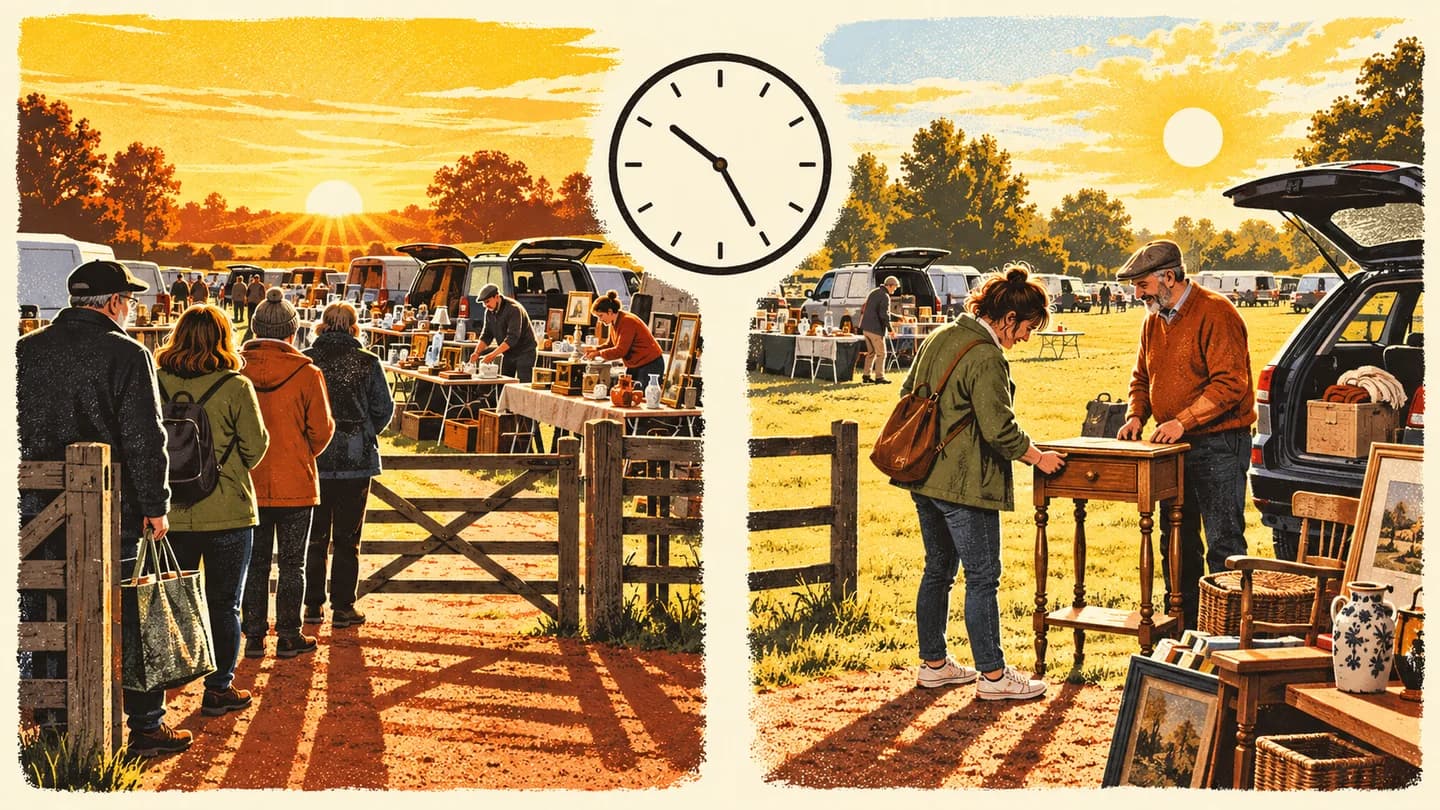
Choose your arrival time around selection, negotiation and the kind of stock you want to buy.
Choose a time for the stock you want
Arriving early and arriving late solve different buying problems. Early access can give you a wider selection of one-off objects. Later shopping may suit a flexible buyer who can make a useful offer on what remains. Neither is a reliable shortcut to profit, and neither replaces identifying and inspecting the purchase.
Start with your objective. Are you looking for a particular camera model, several ordinary books to bundle, or a small piece of furniture you can collect immediately? The best arrival time depends on the sort of opportunity you can recognise and fulfil, as well as the actual event’s opening arrangements.
Read buyer admission separately from seller setup
Check the organiser’s current information before setting an alarm. Some events have distinct seller and public entry times; others offer a paid early-buyer period. Do not infer permission to enter from seeing vehicles or sellers on the field. Opening times can also change with the season, ground conditions or venue.
Plan enough time for the journey and parking without treating a queue as permission to bypass access rules. Allow sellers to unload and establish their stall. Reaching into a vehicle or opening packed boxes without an invitation is not a legitimate early-shopping strategy. Good timing should give you a better look at goods, not prevent the owner from setting up safely.
Compare what each part of the morning offers
These are practical trade-offs to test at your local sale, not claims that every event follows the same pattern.
| Timing | Potential advantage | Cost or limitation |
|---|---|---|
| At public opening | Earlier view of one-off stock | Queues, competition and possible extra admission |
| After the initial rush | More settled stalls and time to inspect | Some desirable stock may already have sold |
| Later in the sale | Flexible offers on remaining goods may suit both parties | Reduced selection and sellers who may already be packing |
| A return circuit | Revisit a researched item or see newly displayed stock | Extra time and no guarantee the item remains |
Early visits work best with a prepared eye
A specialist buyer can benefit from seeing an exact model before other buyers do. Preparation lets you distinguish a promising item from a merely familiar shape quickly enough to spend your inspection time well. Learn the identifiers, common expensive faults and buying limit before arriving.
Early competition can also encourage rushed decisions. A camera that another person is looking at is not necessarily a good purchase for you. If you skip the battery compartment, missing charger or model check to secure it first, the earlier arrival has bought speed at the expense of evidence. Keep your inspection standard even when the opportunity may disappear.
An early start may suit you when
Choose it for a reason you can review afterwards, rather than because successful buyers are supposedly always first.
- You seek distinctive one-off stock and know its important variants.
- The organiser permits the access you intend to use.
- Your budget covers any extra entry and travel costs.
- You can inspect promptly without abandoning essential checks.
- You have a short target list and will not buy random substitutes if it disappoints.
- You can still prepare and list the purchases after an early morning.
Later shopping rewards flexibility
A later visit can suit someone who has several acceptable categories and no need to find one exact object. A seller may be willing to agree a combined price for related items or a bulky piece they would prefer not to transport home. That is a possible alignment of needs, not an obligation to discount.
Ask what is included, inspect it and make a clear offer. Be ready to carry the purchase away under an agreed arrangement. A promise to collect a large item another day may be less useful to the seller than a smaller offer with an immediate, practical handover. Do not offer immediate removal unless your vehicle, help and storage can support it.
Do not assume the remaining stock is either worthless or a bargain
Something may remain because it is specialised, poorly displayed, awkward to carry, overpriced or damaged. Those explanations require different decisions. An overlooked specialist item can still deserve research. A faulty object does not become usable because closing time is near.
Recheck the condition if goods have spent hours exposed to weather or repeated handling. Verify that accessories have not been sold separately and that the person agreeing the price is responsible for the item. A stall being packed away creates time pressure; it does not make a rushed contents check more reliable.
Compare the extra access cost with actual results
Imagine two visits with the same ordinary travel cost. These invented figures illustrate a review; they are not expected earnings. Contribution here means proceeds after purchase, selling, fulfilment and preparation costs, before the visit’s access and travel costs.
| Visit | Completed-stock contribution | Entry cost | After entry |
|---|---|---|---|
| Early visit | £32 | £6 | £26 |
| Later visit | £24 | £1 | £23 |
Look beyond the winning purchase
In the example, the early visit leaves £3 more after entry, before the common travel cost and the value of your time. If it also took much longer, that difference may not justify your preferred routine. If either batch still includes unsold stock, keep its cost and status visible instead of reporting only the items that sold well.
One visit cannot settle the question. Weather, seller turnout and chance vary. Use several observations and record the failures as well as successful finds. You are trying to learn which pattern works for your categories and constraints, not prove that your favourite time is always best.
A middle visit can be a sensible experiment
The choice is not limited to the opening minute or the final hour. Visiting after the initial rush may give you more room to ask questions and inspect. It can also fit travel, family or access needs better. The important measure is the quality of buying decisions you can complete within the available time.
A newcomer may find a less crowded period useful for learning how the sale is organised. Accept the trade-off that some stock will have gone. You can use the visit to practise identifiers, check ordinary prices and discover which categories appear there, even when there is no purchase worth making.
Use a second circuit deliberately
On the first pass, note a few genuinely promising items and their locations if you need time to research. On a return pass, confirm they are still available and inspect again before buying. A seller has not agreed to reserve something simply because you asked its price earlier.
Set a finish time for the circuit. Repeatedly returning to the same overpriced object can make familiarity feel like evidence. If your ceiling is unchanged and the seller’s price is unchanged, the decision is unchanged too. A second pass is useful for new information, not for wearing down your own limit.
Test an arrival strategy over several visits
Keep the record brief enough to maintain. Review the completed batches when enough sales have actually happened.
- Record the event, date, weather and public admission arrangements.
- Note arrival, departure and all trip costs.
- Record target categories and relevant items you could properly inspect.
- Log purchases, declined opportunities and the reasons for each.
- Track preparation time, actual sales and stock still held.
- Compare the results per visit and the time involved.
- Change one part of the plan for the next trial rather than every variable at once.
Let conditions override the plan
Check for cancellation before travelling and reassess if the site is unsafe, inaccessible or closing earlier than expected. Do not chase an advertised bargain through poor visibility, exhausted decision-making or an impractical journey. The trip remains optional even after you set the alarm.
When the stock does not fit your plan, leave with your budget intact. A later start is not a failure if the visit produces useful research; an early start is not a success if it creates an unlisted pile. Choose the arrival time that helps you make repeatable, well-supported purchases and complete their sales.