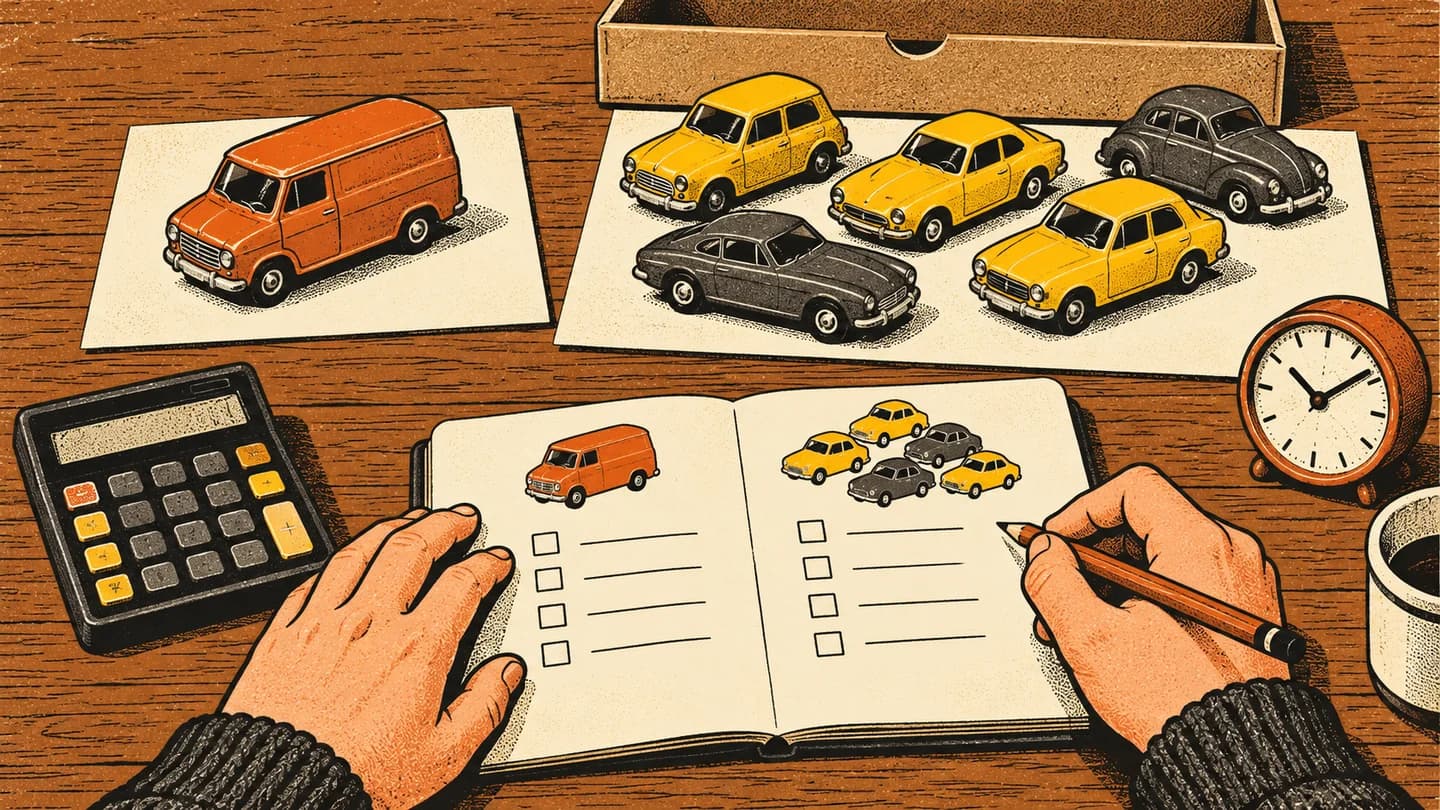
Compare net proceeds per hour, not just the sum of possible individual selling prices.
The highest total selling price may not be the best result
A box of six items might appear to be worth much more when each piece has its own listing. That calculation often leaves out the six descriptions, separate packing jobs, extra messages and pieces that never sell. A job lot can produce less revenue while making better use of your time and space.
The useful comparison is between complete selling plans. Estimate realistic proceeds, expenses, work and leftovers for each option. Then consider a third route: sell the strongest pieces separately and group the rest into a bundle that makes sense to its buyer.
Inventory the contents before choosing a format
Do this before researching an exciting headline value for the whole box.
- Identify every meaningful item, including its exact model, edition, size or version.
- Record condition, testing and completeness. Separate unknowns from confirmed faults.
- Look for items that belong together, such as an original set, compatible accessories or a complete sequence.
- Identify pieces with credible standalone demand and enough value to survive their own selling costs.
- Research genuine sold comparisons for both individual items and similar lots.
- Write down the work and costs for each selling route before deciding.
Research a lot as a lot, not as a pile of optimistic prices
The sum of several asking prices is not evidence that a buyer will pay that total for a mixed box. A lot buyer may not want every item and may need to spend time checking or reselling the extras. Look for completed sales with similar contents, quantity, condition and delivery arrangements.
eBay Product research can help narrow sales by product, condition and other filters, and can show actual accepted-offer prices. The usefulness still depends on your comparison. A complete branded set in good condition is not equivalent to six loosely related pieces with unknown functionality. Record those differences rather than averaging everything together.
A worked comparison: six small collectables
Suppose six items cost £18 together. Research suggests each could sell for £12, with £5 of selling and fulfilment costs per separate sale. Alternatively, a coherent lot could sell for £45 with £9 of those costs. All figures are invented and assume the proposed sales complete.
| Plan | All sold individually | Sold as one lot |
|---|---|---|
| Revenue | 6 × £12 = £72 | £45 |
| Selling and fulfilment costs | 6 × £5 = £30 | £9 |
| Purchase cost | £18 | £18 |
| Amount remaining | £24 | £18 |
| Assumed hands-on time | 3 hours | 1 hour |
| Amount per hands-on hour | £8 | £18 |
Stress-test the assumption that everything sells
In the same example, suppose only five individual items sell during your chosen review period. Revenue is £60 and their selling costs are £25. After recovering the original £18 purchase outlay, £17 of cash remains and one item is still unsold. This is a cash-recovery view, not a declaration that the remaining stock has no accounting value.
You could eventually sell the last piece, but doing so requires another buyer and more work. Ask whether the expected extra return justifies waiting. Do not treat the leftover’s original asking price as cash already earned, or let it disappear from the stock record because the better pieces covered the purchase.
Three routes worth comparing
Your best option can depend on the mix of contents rather than the number of objects alone.
List individually
Useful when each item has a recognisable buyer, adequate standalone value and an efficient preparation process. It gives buyers a precise choice, but creates more transactions and more opportunities for small costs to accumulate.
Build one coherent lot
Useful when the buyer benefits from the grouping: compatible components, a matching set or low-value pieces that make economic sense together. The contents still need clear identification and condition information.
Use a hybrid
Separate a scarce or clearly valuable item, then group the common remainder sensibly. Recheck that removing the strongest piece does not destroy the appeal or completeness of the remaining lot.
Preserve completeness when it has value
Before splitting a set, investigate whether buyers seek it complete. An original case with its matching instrument, a full sequence of books or a working system with the correct control unit may be more useful together. A small accessory can contribute more to the complete package than its separate price suggests.
Also check whether separating something makes the remainder difficult to use or identify. Removing a power supply to sell independently could turn a straightforward product into an incomplete listing. You need evidence that the extra proceeds outweigh the reduced appeal and additional work, not simply a high asking price for the accessory.
Make the bundle useful to someone specific
A good bundle has a reason to exist. Several books on the same specialist topic may serve one reader. Matching pieces of tableware may help someone replace missing pieces or build a set. Compatible hobby materials may save a buyer several separate purchases.
A box described as “random bits” can still find a buyer, but uncertainty normally changes what that buyer is willing to pay. Do not bulk together unrelated objects merely to avoid describing them. If the attraction is resale potential, give an honest contents list and condition summary rather than promising the next buyer a profit.
Check the delivery economics of the combined parcel
Combining items saves some work, but can introduce new costs and risks.
- Measure and weigh the packed lot, not just the objects on the table.
- Check whether the combined size or weight moves it into a more expensive service band.
- Protect each item from the others, especially when mixing heavy and fragile pieces.
- Confirm that the selected service accepts every type of content in the parcel.
- Consider whether a local collection sale is more practical, without assuming it removes the need for accurate descriptions or suitable handling.
Describe every material part of the lot
Show the entire included group in a clear overview, then add identifying and condition photographs. State the number of pieces and explain any meaningful variation in condition. If three items were tested and two were not, say which were which. “Mixed condition” alone can hide information a buyer needs.
List empty boxes, duplicate items and missing components explicitly. Keep props and excluded accessories out of the group photograph where possible. If you use a numbered inventory, check that the images and text agree and that every listed piece is actually packed. A bulk sale is still a sale of specified goods.
Allow for preparation time before committing to a split
Try processing one representative item from the box. Time the identification, inspection, photographs, description and packing estimate. That gives you a more realistic basis than assuming each of the remaining pieces will take five minutes. Some categories need substantial research even when the object itself is small.
Batching can improve efficiency: photograph similar pieces with one setup and use a consistent description structure. Keep their stock references and faults distinct. If only the scarce piece justifies the research time, the hybrid route may let you focus your attention where it has the strongest return.
Do not allocate the purchase cost twice
Choose a review date for the leftovers
A split-sale plan should say what happens if the slower pieces remain. You might combine them later, reduce the price based on new evidence or choose another suitable route. Make that a decision at a known review date rather than allowing miscellaneous leftovers to accumulate indefinitely.
Record the eventual result for the whole purchase as well as each sale. This reveals whether separating similar lots actually earns enough extra money for the work involved. The best format is the one that fits both the market and your capacity to complete the sales.