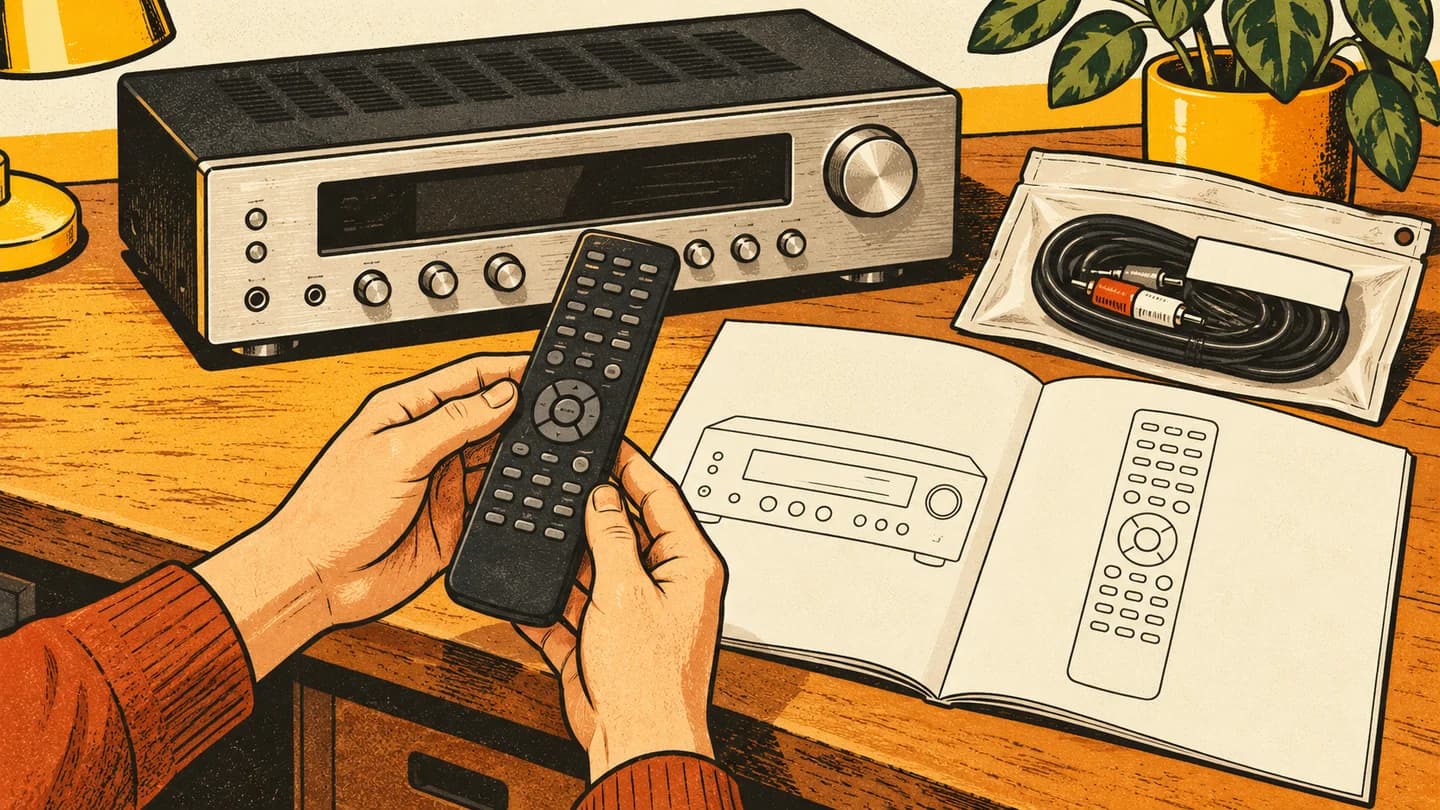
Price the exact compatible replacement and compare the complete-item premium before ordering.
Complete the buyer’s job, not just the photograph
A missing remote, lid, charger or game piece can make an otherwise attractive find difficult to use. Replacing it may improve the selling price, widen the audience or let you test the item properly. But the cost of completion can also consume the entire return.
Before ordering anything, identify exactly what is missing and what difference it makes. A decorative box is not the same as a safety guard. A generic remote that turns a television on may not provide all the functions of the original. The decision needs compatibility, condition and a comparison of net proceeds—not simply the cheapest search result.
Classify the missing part
This helps you decide which questions must be answered before spending money. Some items fall into more than one group.
Essential for operation or assessment
A suitable power supply, connecting lead or control may be needed to use or test the main item. Its absence can hide other faults.
Safety-critical
Guards, restraints, structural fittings and other protective components require the correct specification and appropriate assessment. Do not improvise a substitute to make the set look complete.
Useful convenience
A remote, carry case or stand may improve the package without being essential to every buyer. Research whether the benefit supports the cost.
Collectable completeness
Original packaging, inserts and matched accessories may matter to collectors. A modern reproduction does not necessarily provide the same value.
Identify the exact replacement before shopping
Use the main item’s own identifying details and reliable documentation. Search listings can help locate a part, but a seller’s keyword-filled title is not proof of compatibility.
- Record the full model number, version, region and relevant serial-range information where the manufacturer uses it.
- Find the correct manual, parts diagram or manufacturer support information for that version.
- Write down the required part number and any confirmed alternative or superseded part.
- Check physical fit, connections and required functions, not just the brand name or colour.
- For electrical or safety-related parts, verify the manufacturer’s approved specification and use a suitable supplier.
- If compatibility remains unclear, ask the manufacturer or a competent specialist before ordering.
A matching connector is not enough
A power supply can appear to fit while being unsuitable for the device. Battery platforms can differ within one brand, and a shared voltage label does not establish interchangeability. Follow the exact product’s compatibility information rather than experimenting with whatever is already in your drawer.
The same principle applies beyond electronics. A lid may sit on a pot without being the correct matched lid. A board-game component may have different artwork or rules in another edition. A replacement handle may have the wrong mounting arrangement. Confirm the details that matter to use and value before treating the item as complete.
Test the main item as far as you reasonably can
A missing accessory can be a genuine inconvenience, but it can also prevent you discovering a more expensive fault. Do not value an untested unit as a working one solely because the absent charger looks inexpensive. Include the uncertainty in the buying ceiling and the completion decision.
If you can safely use a known suitable test accessory, establish the main item’s condition before buying a replacement to include in the sale. Record that the test accessory is not included unless you intend to supply it. Where testing requires specialist knowledge or equipment, allow for that assessment instead of substituting an optimistic assumption.
Compare complete and incomplete sales like for like
Look for the same version in a similar condition. The difference in sale price is not automatically the value of the missing part if the examples differ in other important ways.
| Check | Why it matters |
|---|---|
| Same model and revision? | A newer version may command more independently of accessories |
| Same working condition? | A tested complete item is not directly comparable to an untested incomplete one |
| Original or replacement accessory? | Collectors and users can value these differently |
| Same delivery terms? | A larger case or extra part may change shipping costs |
| Comparable seller and service? | A warranty or professional refurbishment can affect the price |
| Several relevant results? | One exceptional sale may not represent the market |
Calculate the added return after added costs
Start with expected net proceeds from selling in the current state, where that is an appropriate route. Then estimate net proceeds with the correct accessory, after the changed selling charges and fulfilment costs. Subtract the delivered part cost and any fitting or assessment expense. The difference is what remains to reward your extra work and risk.
Keep the original purchase cost outside this incremental comparison because it is common to both routes. You still deduct it when calculating the whole item’s profit. Otherwise you may count it twice or reject a useful improvement for the wrong reason.
A remote-control example
These amounts are illustrative. Assume the main unit is already appropriately tested and suitable for sale, and the difference concerns the package offered to the buyer.
| Line | Without remote | With suitable remote |
|---|---|---|
| Expected customer receipts | £55 | £80 |
| Selling and fulfilment costs | −£12 | −£15 |
| Net before accessory purchase and original stock cost | £43 | £65 |
| Replacement remote, delivered | £0 | −£18 |
| Amount left before original stock cost and your time | £43 | £47 |
A £25 higher sale leaves only £4 extra in this example
The complete package brings £25 more in receipts, but the extra selling costs and £18 remote reduce the improvement to £4. Decide whether that supports the time spent researching, ordering, checking and photographing it. If the remote costs £25 instead, the route would leave £40 and be £3 worse than selling without it.
Completion might still improve saleability or reduce questions, but describe that as a reasoned judgement rather than guaranteed extra profit. Use your own completed results to learn whether that benefit occurs. Do not justify every weak calculation with an assumed faster sale that you have never measured.
Original, third-party and reproduction are different claims
An original accessory from another example may be a suitable match, but check its condition and exact version. A third-party accessory may be appropriate for some products if compatibility and quality are established. A reproduction can be useful for display while adding little of the collector value of an original.
State what you are supplying. Do not photograph a replacement beside original packaging in a way that implies it was part of the original set. If a case, instruction booklet or display stand is a later addition, say so where it matters to the buyer’s assessment. Honest completeness is more useful than a broad “all original” claim you cannot support.
Include the cost of finding and receiving the part
Small purchases become expensive when several minor costs are ignored.
- The part price, delivery and any applicable import or other charges.
- Condition checks on a used replacement, including wear that could make it unsuitable.
- Fitting, configuration or pairing where the product requires it.
- Time waiting for the part and storage of the unfinished item.
- The possibility of a wrong, damaged or incomplete delivery and the practical return route.
- Any larger parcel, extra protection or changed shipping service needed for the completed package.
Donor items need their own calculation
Buying a second incomplete item for one part can make sense, but do not assume the leftovers will pay for it. Verify that the needed part is present, compatible and in usable condition. Add the donor’s collection or delivery cost and the work required to separate it.
Record the donor purchase and allocate costs consistently if several saleable items result. If you remove a functioning accessory from stock already listed as complete, update that listing immediately or withdraw it. Solving one incomplete item by silently making another incomplete creates a fulfilment problem rather than a saving.
When the replacement arrives
Finish the job before moving the item into available stock.
- Match the delivered part to the order and the confirmed compatibility information.
- Inspect its condition and arrange any required fitting or assessment by a competent person.
- Check the relevant functions, including features that a partial substitute might not support.
- Update the stock record with the actual delivered cost and the work performed.
- Photograph the exact complete package and list all included and excluded items.
- Store the accessory with the main item, or use a clearly cross-referenced location if separate storage is necessary.
Stop when completion no longer supports the sale
A scarce accessory can turn into an open-ended search. Set a spending limit and review date based on the item’s likely return, your available cash and storage. If the right part remains unavailable, compare a properly described incomplete sale, an appropriate specialist route or another lawful exit.
Keep the lesson in your buying notes. A category with consistently expensive missing parts may only work when you buy complete examples. Knowing that before the next purchase is often more valuable than rescuing one weak buy through several further expenses.