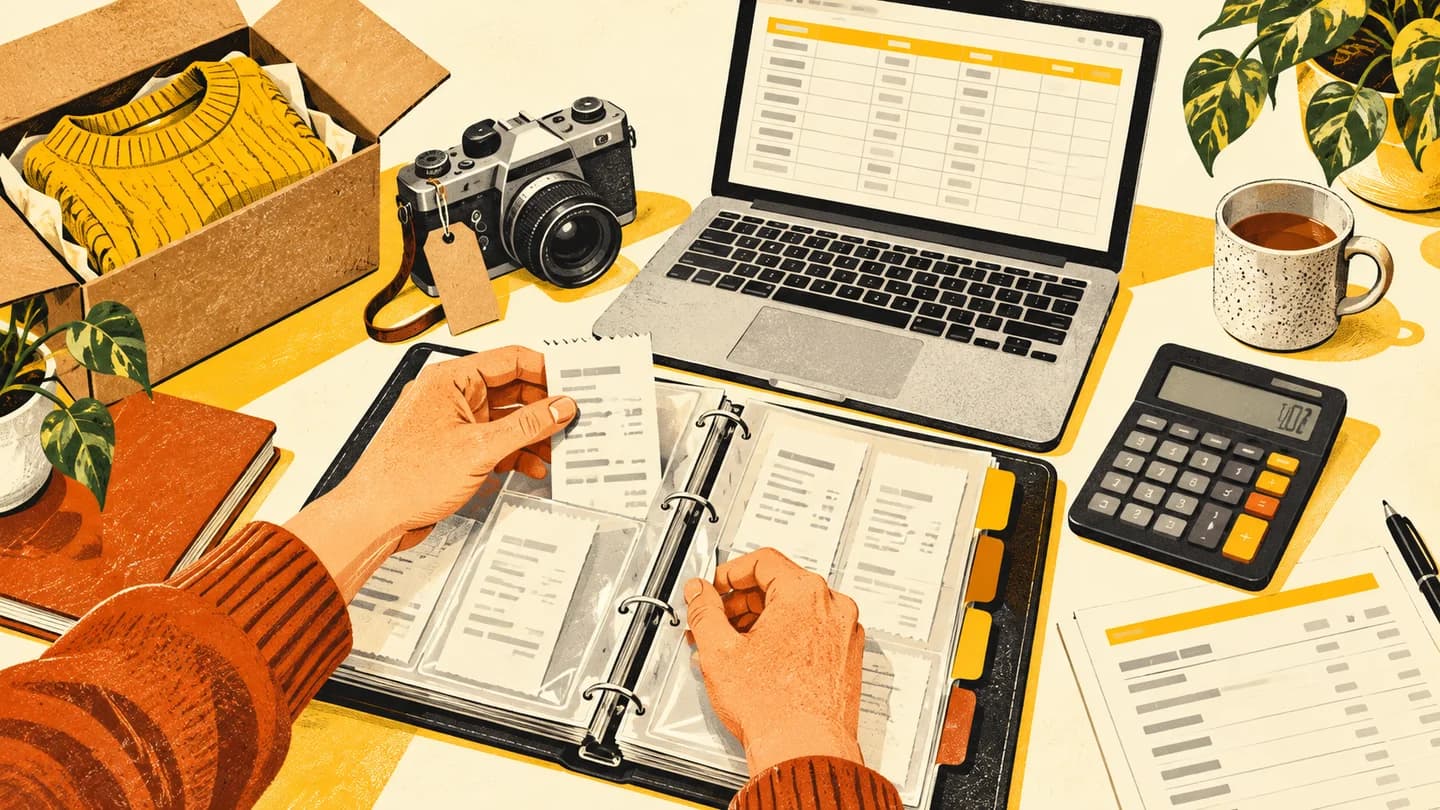
Keep clear transaction records from the first purchase and check HMRC’s rules for your own trading circumstances.
Keep a trail from the purchase to the final payment
Good reselling records let you explain what happened to an item and its money without reconstructing months of messages. The practical aim is to connect a purchase, a sale, the associated costs and any later refund. A total in a spreadsheet is much more useful when you can open the evidence behind it.
This guide focuses on a UK individual reselling as a sole trader. Limited companies, partnerships, VAT and employing staff introduce additional requirements. Use the current HMRC guidance for your circumstances, and ask a qualified tax adviser about uncertain treatment rather than assuming a stock-profit spreadsheet is automatically a finished tax calculation.
Build an evidence folder alongside the stock sheet
Use a permanent stock code and an order reference to connect these records. Keep original downloads and receipts as well as your summary.
| Stage | Useful evidence and detail |
|---|---|
| Purchase | Date, source, item or batch, amount paid and available receipt or payment evidence |
| Preparation | Parts, repairs and other costs, with receipts and the item concerned |
| Sale | Order reference, date, item price, delivery income and platform |
| Deductions | Fees, postage and other charges shown separately |
| Payment | Platform settlement statement and the corresponding bank receipt |
| After the sale | Returns, refunds, adjustments and the final outcome |
Record cash purchases while the facts are fresh
At a car boot sale, note the date, venue, item description and amount paid when you buy. Ask for a receipt where practical and keep any evidence the seller provides. Photograph the purchased batch and allocate its stock code before it disappears into several storage boxes. A cash withdrawal shows that cash was obtained; it does not by itself prove which business items you bought.
If no receipt is available, keep an honest contemporaneous purchase note and the supporting material you do have. Do not invent a supplier invoice or present your own note as a receipt issued by someone else. Consistent detail makes the record easier to explain, but it does not guarantee that HMRC will accept every unsupported expense.
Keep batch costs traceable
Suppose you pay £60 for six items in one lot. Record the £60 purchase once and preserve the batch reference. For your internal item-profit review, allocate the cost using a reasonable, recorded method. Six equal £10 allocations may suit similar items; a mixed lot with one valuable piece may need a different approach. The allocations should still total £60.
Do not enter both the full batch and every allocated item cost as separate expenditure in the tax totals. Keep a note of items retained, discarded or still unsold. Cost allocation helps you understand performance, but the timing and treatment of tax deductions depend on the accounting basis and applicable rules.
Separate gross receipts from the bank payout
A platform may subtract fees or refunds before transferring money. Record enough detail to reconstruct the sales and deductions instead of calling the net bank receipt your entire turnover. Include delivery income where it forms part of the money received for the order, and keep the actual postage cost separately.
For an illustrative order, a buyer pays £45 for the item and £5 delivery. The platform deducts £6 and transfers £44. Your record should explain the £50 received for the order, the £6 deduction and the £44 settlement. If you separately pay £4.50 postage, record that payment too. Do not deduct the £6 again from the £44 when calculating the same result.
Keep expenses specific and separate from personal spending
A payment appearing on a bank statement does not automatically make it an allowable business expense. Keep the reason for the cost and check the relevant rules.
- Identify stock bought for resale rather than goods bought for your own use.
- Keep platform charges, packaging and dispatch evidence connected to the activity.
- Record the business purpose of travel instead of treating every outing as a sourcing trip.
- Separate the business element of mixed-use costs using an appropriate supported method.
- Distinguish money you introduce or withdraw from sales income and operating expenses.
- Ask about equipment and other uncertain costs rather than assuming everything has the same tax treatment.
Understand the £1,000 trading allowance
The allowance concerns gross trading income before expenses, combined across relevant activities. It is not £1,000 of profit or a separate allowance for each marketplace. Eligibility and exceptions matter, and records are still needed when full relief applies. Income from an employer or certain connected parties, for example, can prevent use of the allowance.
Check all your relevant trading receipts before deciding what to report. Someone with £900 from resale activity and £300 from a separate relevant trading activity has £1,200 combined gross income, even though neither source alone exceeds £1,000. Keep employment and other income records as required too, but do not treat wages as another resale marketplace.
Compare the allowance with actual allowable costs
Where eligible, the trading allowance is an alternative to deducting actual expenses and other allowances for that income. It is not an extra deduction on top. This simplified example assumes all £1,800 of costs are allowable and ignores other adjustments.
| Method | Calculation | Result |
|---|---|---|
| Actual allowable expenses | £3,000 income − £1,800 costs | £1,200 |
| Trading allowance | £3,000 income − £1,000 allowance | £2,000 |
Do not confuse calculated profit with tax payable
The example shows why preserving expense evidence can matter. It does not tell you the final tax due: that depends on your wider position, applicable allowances and other rules. Losses and special circumstances may also affect the choice. Check the appropriate treatment before making an election or submitting the return.
Keep the underlying records whichever option you expect to use. Choosing a convenient allowance early in the year is not a reason to discard receipts, especially if the volume of trading or its costs later increases.
Know which accounting basis your records support
Cash basis is the standard method for eligible sole traders and partnerships without corporate partners. Broadly, it records income when received and expenses when paid. Traditional accounting instead works with income earned and expenses incurred, including amounts not yet settled. Check your eligibility and method rather than mixing the two according to whichever produces a preferred result.
A stock sheet may calculate the margin when an item sells, while a tax computation under cash basis can recognise a qualifying purchase at a different time. Keep transaction dates and payment dates clear. Traditional accounting also requires relevant year-end information such as stock values and amounts owed. Ask an adviser about platform balances or transactions spanning tax years if receipt timing is unclear.
Reconcile reports to the UK tax year
A digital platform’s seller information report may cover the calendar year and show amounts after specified deductions. The UK tax year runs from 6 April to 5 April. Save the report, compare it with your detailed records and investigate differences in dates, fees, refunds or included transactions. Do not paste its annual total straight into a tax return without checking what it represents.
Platform reporting does not automatically mean tax is owed, and the report does not replace your records. Conversely, the absence of a report does not decide your tax obligations. Keep evidence that distinguishes personal possessions from purchased resale stock if both appear in the same account.
Check whether digital reporting changes your setup
Making Tax Digital for Income Tax is being introduced according to qualifying income and other eligibility conditions. From 6 April 2026, the first income threshold is over £50,000 of qualifying income for 2024–25; lower thresholds bring more people into scope in later years. Qualifying income can include self-employment and property income, so do not check only your resale sales.
Use HMRC’s current eligibility check, including exemptions and your start date. If the rules apply, choose a compatible recordkeeping and reporting setup. A standalone spreadsheet should not be assumed sufficient by itself. Digital records and required submissions need planning before deadlines, rather than a last-minute export from your stock tracker.
Retain evidence long enough and make it recoverable
For self-employed tax records, the general minimum is five years after the 31 January submission deadline for the relevant tax year. For example, records for a 2025–26 return due on 31 January 2027 should ordinarily be kept until at least the end of January 2032. Different circumstances, including very late returns or an ongoing enquiry, can require further care.
Keep readable backups in a separate location and test that a sample receipt or statement opens. Use clear filenames, restrict access and avoid unnecessary customer data. If records are lost, try to obtain replacements from banks, platforms and suppliers; distinguish estimates or provisional figures honestly when completing a return.
Make the monthly tidy-up small enough to do
A regular reconciliation is easier than rebuilding an entire year in January.
- Save new purchase evidence and assign missing stock references.
- Download sales, fees, refunds and payout records from each platform.
- Match settlements to bank entries and record cash transactions.
- Resolve duplicate entries, unexplained differences and missing documents.
- Review combined trading income and any registration or reporting deadlines.
- Back up the records and keep a list of questions that need HMRC or professional clarification.