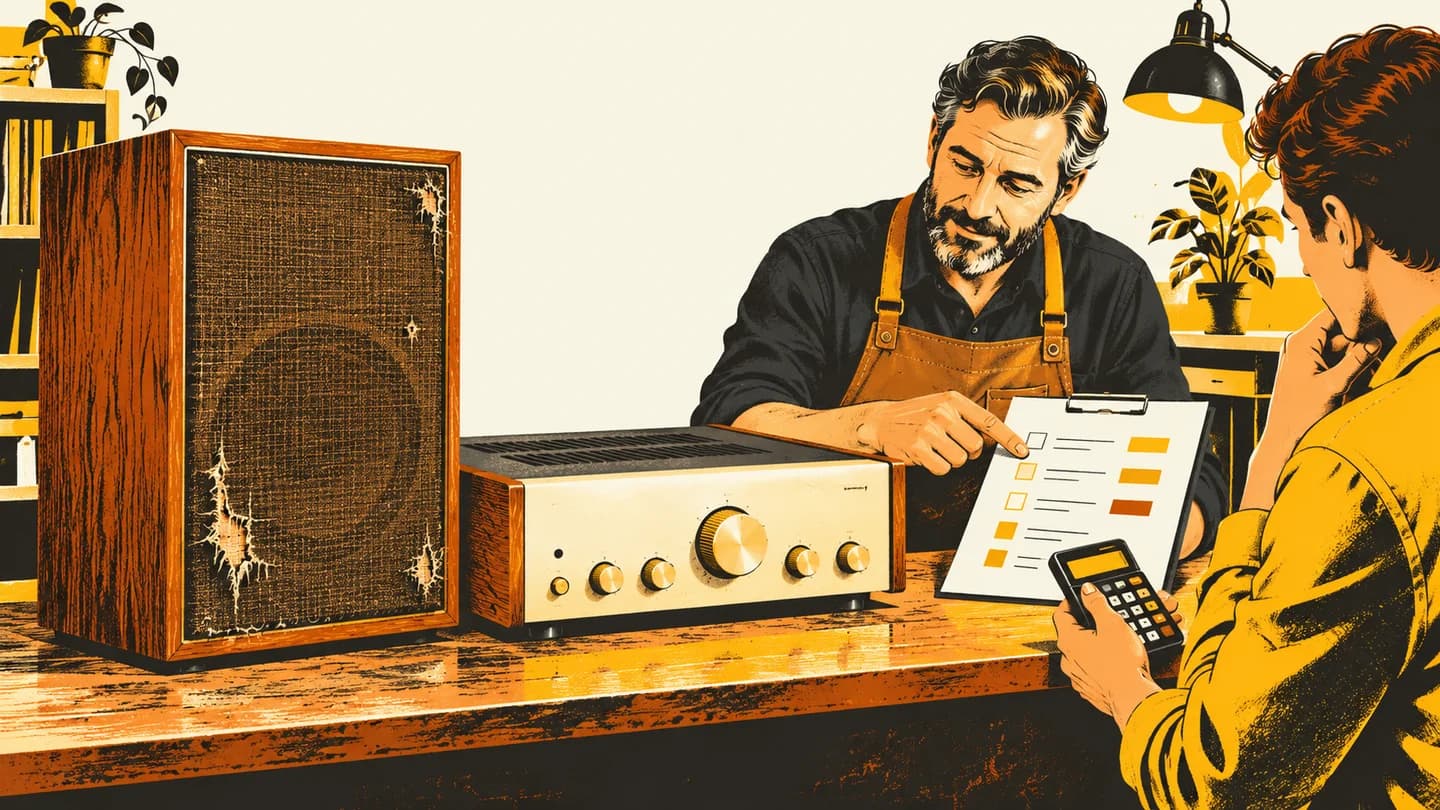
Identify the exact component and assess testing, service and shipping costs before buying.
The model and condition do more work than the badge
A recognised hi-fi brand can appear on equipment with very different demand, capabilities and repair prospects. Before treating an amplifier, CD player or pair of speakers as a bargain, identify the exact model and decide how you will assess it. Nostalgia is not a substitute for a workable resale calculation.
Begin with equipment you understand and can test appropriately. A straightforward component with clear identification may be a better first purchase than a complicated system missing its remote and proprietary cables. This guide focuses on selecting useful stock, establishing its condition and pricing the whole transaction.
Make an equipment record
Photograph labels and connections so you can check details without relying on memory.
- Manufacturer, full model and any relevant version.
- Type of component and the role it performs in a system.
- Required power equipment and connection types.
- Included remote, cables, covers, grilles and other accessories.
- Known faults, repairs, modifications and service documentation.
- Dimensions, weight and a realistic collection or shipping plan.
Know which components you are buying
An integrated amplifier, power amplifier, receiver and source component are not interchangeable simply because they fit on the same shelf. Check the manual and connections. For speakers, establish whether they are passive or contain amplification and what supporting equipment they require.
Do not assume a stack of matching-looking units is complete or mutually compatible. Some systems depend on specific cables or control connections. Identify each component separately and verify the arrangement before valuing it as a ready-to-use system. A missing small cable can be a larger obstacle than its appearance suggests.
Research a sale that matches your condition
Look for the exact model in relevant completed sales, reading the condition and contents. Separate professionally serviced examples, dealer warranties, incomplete units and faulty stock. The highest price may reflect work or assurance you cannot offer.
Keep a cautious range rather than one flattering result. If there are few comparable transactions, allow more uncertainty and consider how long you can hold the item. An active £300 advert does not show that buyers are paying £300, and a rare-looking model is not automatically in demand.
Inspect before a demonstration
Use a suitable environment and stop if visible condition makes operation questionable.
- Check the case, vents, connectors and accessible controls.
- Look for impact damage, liquid marks, unusual odour or improvised wiring.
- Inspect speaker cabinets, terminals, grilles and visible drivers without pressing them.
- Confirm the correct power specification and suitable accessories.
- Ask about known faults, repairs and the scope of any claimed service.
- Record what cannot be assessed from the viewing.
Use a compatible test setup
Follow the equipment manual and use known-good sources, cables and suitable speakers or headphones. Make connections with power off as directed and begin at a sensible low volume. Do not connect unfamiliar outputs and inputs merely because a plug fits.
A silent channel can arise from the source, settings, cable, speaker or amplifier. Check ordinary setup causes methodically within your competence before deciding which component is faulty. Changing one variable at a time makes the observation more useful. It does not replace a technician’s assessment where electrical condition or a persistent fault is uncertain.
Test the functions you plan to advertise
Adapt the list to the component rather than claiming that one routine covers all hi-fi.
- Both stereo channels through a suitable known-good setup.
- Relevant source inputs and output options.
- Volume, balance and other ordinary controls.
- Remote functions where a remote is included.
- Disc loading and playback on a CD player, including more than its first moments.
- Ordinary operation long enough to notice obvious intermittent symptoms.
- Any display, network or special feature that materially supports the asking price.
Describe what the test establishes
“Both channels played from the auxiliary input during a 20-minute demonstration” is a defined observation if that is what happened. “Perfect in every way” is a much broader claim. Keep untested inputs and functions visible, especially where the model has many features.
For connected equipment, check whether the functions buyers care about are still supported and usable through a legitimate setup. Do not assume an older streaming feature works because it appears in the printed manual. Remove your own accounts and saved credentials through the supported process before resale.
A listening test is not an electrical safety assessment
Price preparation and delivery before buying
These figures are invented and are not current hi-fi values, service prices or platform charges.
| Line | Amount |
|---|---|
| Cautious expected sale proceeds | £180 |
| Selling, packing and delivery | −£35 |
| Confirmed assessment or preparation cost | −£30 |
| Desired contribution before tax and time | −£40 |
| Allowance for uncertainty | −£20 |
| Maximum purchase under these assumptions | £55 |
Do not substitute a parts price for a repair quote
A replacement part listed online does not tell you whether it is the correct part, whether it will solve the fault or what the work will cost. Diagnosis, labour and appropriate testing can dominate a repair bill. Ask about those stages before treating a faulty unit as a cheap working one.
Check availability of model-specific parts such as remotes, display assemblies, drivers or proprietary connections. A generic replacement may not preserve the functionality or originality buyers expect. If the return depends on an unavailable component, the purchase may only suit a specialist parts route at a very different price.
Make transport part of the product decision
Heavy hi-fi can require substantial packaging. Measure and weigh the protected parcel and check the carrier’s terms for the actual item and value. Original packaging may help if sound and complete, but a worn retail box alone is not a guarantee of safe transit.
For local collection, plan a suitable demonstration and safe movement. A large speaker pair may be more practical locally even if a national listing appears to offer a higher price. Compare the money and work after delivery costs, not just the audience size. Avoid promising cheap postage before you know what the parcel requires.
List from your equipment record
Give the buyer facts that make the system fit and condition clear.
- Use the full model name and verified specifications.
- Show front, rear connections, labels and included accessories.
- Describe cosmetic wear, faults and modifications.
- Summarise meaningful tests and any limitations.
- State service history only to the extent supported by documentation.
- Explain collection or delivery arrangements and exactly what is included.
Use the complete outcome to choose future stock
Record the sale, all expenses, preparation time and any post-sale adjustments. Keep failed or unsold purchases in the same category review. A good result on one familiar amplifier does not justify buying every unit carrying its brand. Develop a shortlist of equipment whose identity, testing and fulfilment you can manage reliably, then improve buying limits from actual completed results.