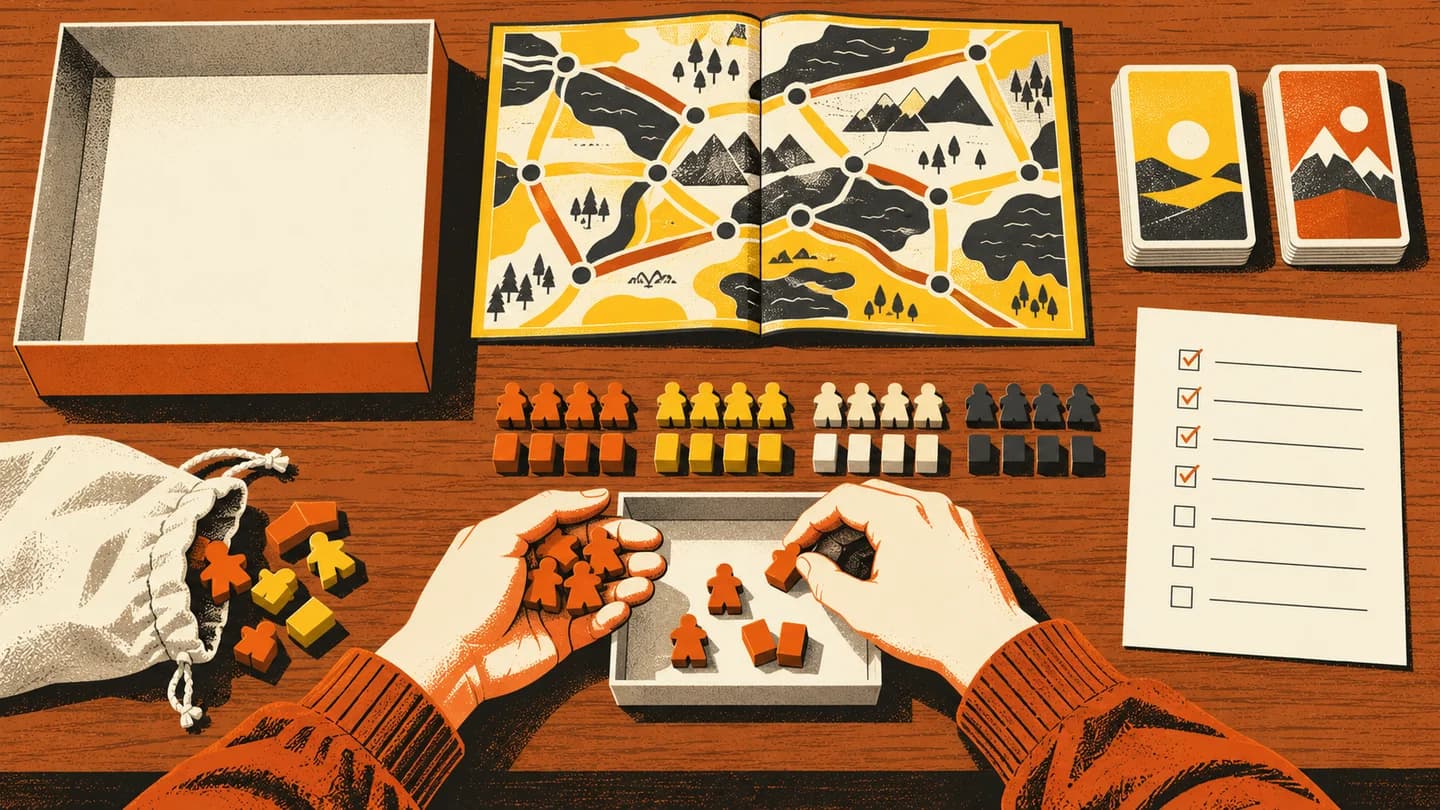
Confirm the correct edition and count the components before calling a game complete.
A full box is not proof of a complete game
A used board game can look promising when you lift the lid: cards, bags of pieces and a board all seem to be there. Yet one missing deck or a handful of specific tokens can change whether somebody can play it properly. Before treating it as resale stock, identify the game and check what that edition should contain.
The work is part of the buying decision. A simple family game may take minutes to inspect; a large strategy game can involve hundreds of components and several expansions. A low purchase price is only useful if the likely return supports that checking time and any unresolved problems.
Identify the exact game, edition and language
Read the publisher, product code and edition information on the box and rulebook. Check the language of the cards as well as the rules. A translated rulebook does not make a text-heavy foreign-language edition equivalent to an English copy.
Similar artwork can appear on revised editions, travel versions and standalone spin-offs. Compare the actual package with an appropriate publisher reference. Do not use the component list or price of a newer edition simply because the name is nearly the same.
Establish whether you have a base game or an expansion
Some expansions need another game to be playable. Others are standalone, and some boxes contain a mixture of base and expansion material. Read the publisher’s description and explain the actual requirements rather than assuming every boxed product is a complete experience on its own.
If a collection has been combined into one box, identify each included expansion separately. Extra pieces are not evidence that the original game is complete. You need a contents check for the base game and for whatever additional material you plan to advertise.
Prepare a component check that you can finish
Use the correct rulebook or official contents list as your starting point.
- Clear a clean table with enough space to keep groups separate.
- Write down each component type and its expected quantity.
- Sort pieces by the distinctions that matter, such as colour, shape or function.
- Count each group and record the actual quantity.
- Check cards by type or identifier where possible, not only total count.
- Inspect condition while handling each group.
- Bag or organise the checked groups so you do not have to start again.
Count the right things
This is a generic worksheet. The required groups and quantities must come from the specific game, not from these examples.
| Group | What to record |
|---|---|
| Boards and tiles | Correct versions, quantity and condition |
| Player pieces | Each required colour and type |
| Cards | Deck, category or identifier; duplicates and omissions |
| Tokens and markers | Function and denomination, not merely one mixed total |
| Dice or special components | Required markings and actual condition |
| Rules and reference sheets | Edition, language and missing pages |
| Campaign materials | Opened, altered, consumed or still sealed |
A correct total can still hide the wrong contents
Suppose a hypothetical deck should contain forty different cards. Forty cards in the box do not prove completeness if one is duplicated and another is missing. Where the cards are numbered or listed, check the identities as well as the quantity.
The same applies to tokens with different functions or values. Keep notes precise enough that a buyer can understand a limitation. “One scoring marker missing” is clearer than “a few pieces might be missing”, and it helps you investigate a replacement without guessing.
Inspect condition that affects play
Look for torn boards, damaged hinges, warped tiles, marked card backs, missing information and components that no longer function. Uneven wear on a hidden-information deck can matter if it lets players recognise cards from the back. Box damage and playing-component damage are separate issues.
Check for damp, odours and signs of poor storage. For games with an electronic element, inspect and test the required functions using suitable power and the manufacturer’s instructions. A clean box should not lead you to describe an untested timer or sound unit as working.
Check campaign and one-use games before buying
Investigate a reset rather than assuming one exists
Ask what has been played, altered or discarded and inspect the relevant material. If the publisher offers a recharge or reset product, check what it includes, what the original game must still contain and whether it is currently available. Include its price and delivery in the calculation.
Do not assume every legacy game becomes unusable after a campaign, either. Some support further play in a changed state. The listing should explain the supported experience the buyer is getting. Avoid showing spoilers unnecessarily while still disclosing alterations that affect the purchase.
Confirm replacement parts before pricing a repair
Publisher support can sometimes help, but policies, stock and edition compatibility vary. Asmodee UK has a spare-parts request process subject to availability; Stonemaier also provides a replacement-parts route. Neither is a reason to assume that every missing item in a bargain box will arrive free and immediately.
Identify the exact missing part and check the applicable process. Do not misrepresent how the game was obtained or what happened to it. If you use a substitute, describe it and make sure it is suitable for the game. A homemade replacement does not become an original component because it looks similar in a photograph.
Choose the sale description that the evidence supports
These routes describe different products and should have different comparisons.
Complete and checked
The contents have been compared with the correct list, with condition and any substitutions disclosed.
Incomplete but clearly described
The missing or altered parts are identified so a buyer can assess whether the game suits them.
Parts or project stock
The sale is for the actual components shown, with no claim that they form a complete playable game.
Research the matching version and package
Compare completed sales for the same edition, language and contents. Separate standard copies from deluxe editions, bundles and packages with expensive extras. Current retail discounts also matter: a used game needs to make sense beside an available new copy.
Do not assume an out-of-print game commands a premium without evidence of demand. Check when relevant copies actually sold and whether the examples were complete. A high asking price for a sealed collectable edition is not a buying guide for a heavily played incomplete one.
Include the missing part and the parcel
These invented amounts illustrate a purchase with a confirmed replacement cost. They are not current game values, publisher charges or postage rates.
| Line | Amount |
|---|---|
| Expected proceeds | £35 |
| Purchase price | −£8 |
| Confirmed replacement including delivery | −£6 |
| Selling charges, packaging and dispatch | −£9 |
| Contribution before tax, time and other expenses | £12 |
Decide whether the counting work is worthwhile
The example leaves £12 before your time. If the game takes an hour to identify and check, another session to photograph and a special trip to dispatch, that may be a poor fit for your process. A complete copy costing slightly more could be the better purchase.
For a mixed bundle, assess the strongest games individually and give the uncertain remainder a cautious value. Do not assume every full-looking box contributes the same profit. Set aside enough time and space to finish checking before the stock joins a growing pile of unlisted projects.
Make the listing and parcel match your checks
Photograph the actual game and keep the inventory notes with the stock record.
- State the edition, language and whether it needs a base game.
- List included expansions and distinguish them from unrelated extras.
- Show the components grouped clearly, plus significant defects.
- Disclose replacements, missing pieces and campaign alterations.
- Protect cards, keep small pieces contained and stop parts moving in transit.
- Use an outer parcel that protects the game box, then weigh and measure it.
Keep the checked contents together until dispatch
Once a game is counted, store it as a single labelled stock item. Avoid borrowing a component to complete another box without updating both records. Recheck that the listed contents are packed before sealing the parcel.
Good used-game selling depends on making the buyer’s first session straightforward. An honest, well-organised inventory and careful packaging are practical advantages: they reduce uncertainty for the buyer and help you distinguish a real bargain from a box of work you cannot profitably finish.