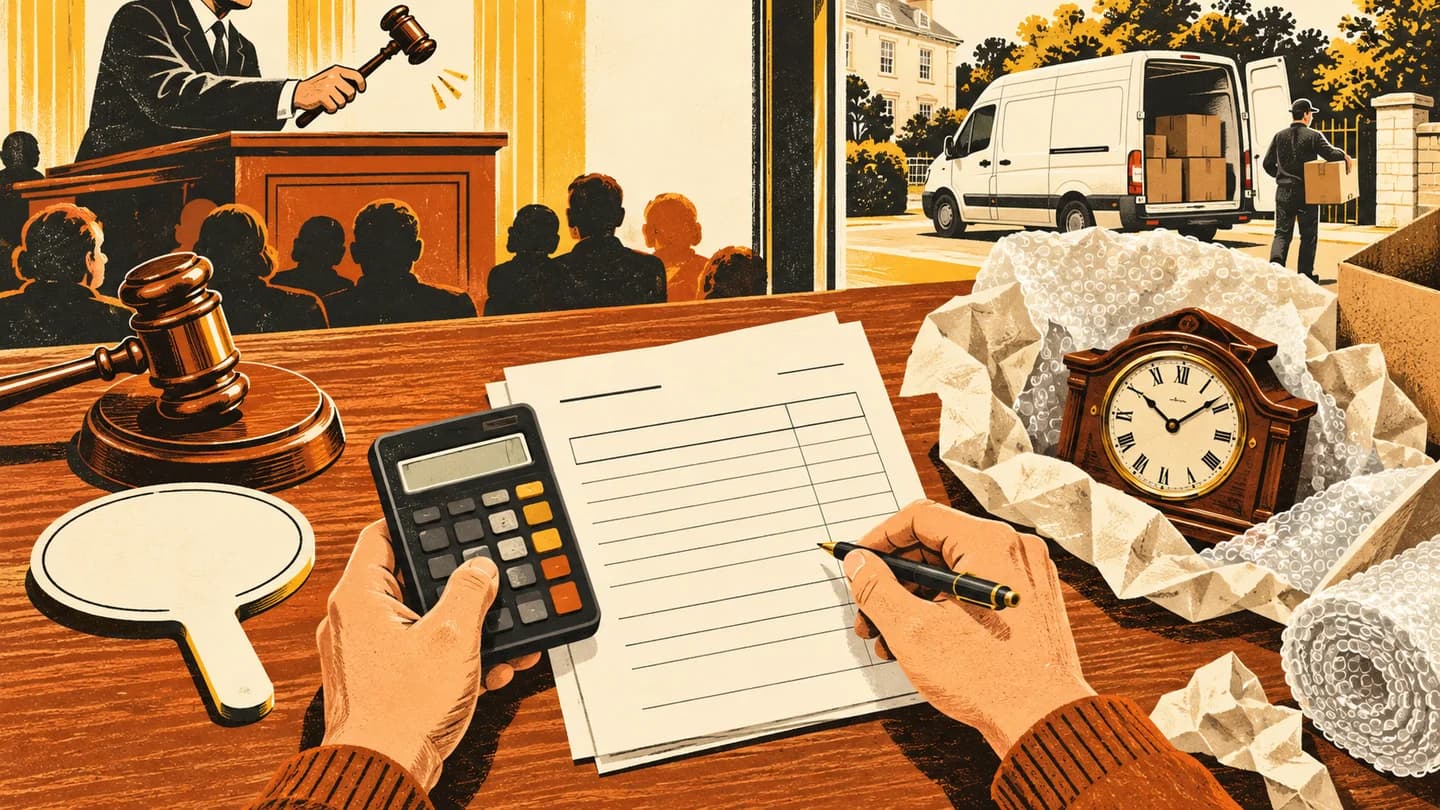
Calculate the full invoice and collection cost before deciding your maximum bid.
Set the total you can afford before setting a bid
The number called by the auctioneer or shown on a bidding screen is usually the hammer price. Your invoice can also include buyer’s premium, tax and charges for the route you used to bid. Getting the object home is another cost. A winning £100 bid therefore does not mean you have bought £100 stock.
For resale, begin with the whole transaction. Decide what the lot could realistically return after your selling costs, how much contribution you need for the work, and what remains available for purchase and collection. Only then work backwards to a maximum hammer bid.
Understand the numbers in the catalogue
Similar-looking figures do different jobs. Read the explanation supplied by the auction house for that sale.
Estimate
An indication of the auction house’s expected bidding range. It is not an invoice total, a guaranteed sale price or proof of what you can resell the item for.
Hammer price
The accepted winning bid, before any additional charges due under the sale terms.
Buyer’s premium
A charge added by the auction house. Check the rate, whether VAT is included and whether different bands or lot types have different treatment.
Landed cost
Your purchase invoice plus the cost of bringing the lot into your possession, including applicable packing, transport and collection expenses.
Check the exact sale and the exact bidding method
Read the current terms attached to the auction, not a remembered percentage from another house. Identify buyer’s premium, any online platform charge, tax treatment and other applicable lot charges. An auction house’s own online bidding route can have different costs from a third-party platform or bidding in the room.
Look for symbols beside the lot and read their definitions. Some lots have tax on the hammer price or other special treatment. Ask the auction house for an example invoice at your proposed bid if anything is unclear. Do not assume all tax is recoverable merely because you are buying stock; budget for the cash you will actually have to pay.
An illustrative invoice, line by line
This invented example uses a 25% buyer’s premium, 20% VAT on that premium, a 3% online charge and 20% VAT on that charge. It assumes no tax on the hammer and no other charges. These are example inputs, not a quote for any auction house.
| Line | Calculation | Amount |
|---|---|---|
| Hammer | Winning bid | £100.00 |
| Buyer’s premium | 25% of £100 | £25.00 |
| VAT on premium | 20% of £25 | £5.00 |
| Online charge | 3% of £100 | £3.00 |
| VAT on online charge | 20% of £3 | £0.60 |
| Invoice total | All five lines | £133.60 |
| Collection cost | Illustrative allowance | £25.00 |
| Landed cost | Invoice plus collection | £158.60 |
Calculate the ceiling in the right direction
Suppose you can allocate £160 to purchase and collection under those example terms. Subtract the £25 collection allowance first, leaving £135 for the invoice. Because the example invoice is 1.336 times the hammer price, £135 divided by 1.336 gives a hammer ceiling of approximately £101.05.
If the auction’s available increments jump from £100 to £110, stop at £100. The £110 bid would cost £171.96 including the same collection allowance, exceeding your limit. Do not round your ceiling upwards simply because the next increment feels small. With tiered fees or other lot charges, calculate the actual invoice rather than forcing it into this simple multiplier.
Read the description as carefully as the photographs
Confirm the lot number, measurements, model or attribution, number of items and any qualifications in the description. A group photograph may contain neighbouring lots or items shown for context. Ask exactly what is included if the wording and images leave room for doubt.
Check for amendments and saleroom notices before bidding. Keep a copy of the description and relevant replies so that you know which information informed your decision. Never interpret a short description or the absence of a damage statement as proof that the item is complete, original or fully working.
Request a condition report with specific questions
Ask early enough for the auction house to respond before the sale.
- Are there repairs, cracks, chips or replacements in the areas that matter to this object?
- Can you provide clear photographs of the base, back, marks or model label?
- Which accessories, lids, stands, keys or components are included?
- Has the item been functionally tested, and exactly what was checked?
- Are there signs of damp, corrosion or alteration that the main photograph does not show?
- What do any abbreviations or condition qualifications mean in this catalogue?
Know what the report does and does not establish
A condition report adds information to the catalogue. It is not necessarily a complete technical inspection, an authentication or a guarantee of future performance. A clock that runs briefly during cataloguing has not thereby had its timekeeping, wear and servicing needs fully assessed.
View in person when the purchase warrants it and the auction offers viewing. Inspect within the house’s rules and your own competence. If a key question remains unanswered, bid on the condition you can support, lower your ceiling to reflect the uncertainty, or leave the lot. “I could not get a reply” does not make the missing information favourable.
Arrange the logistics before auction day
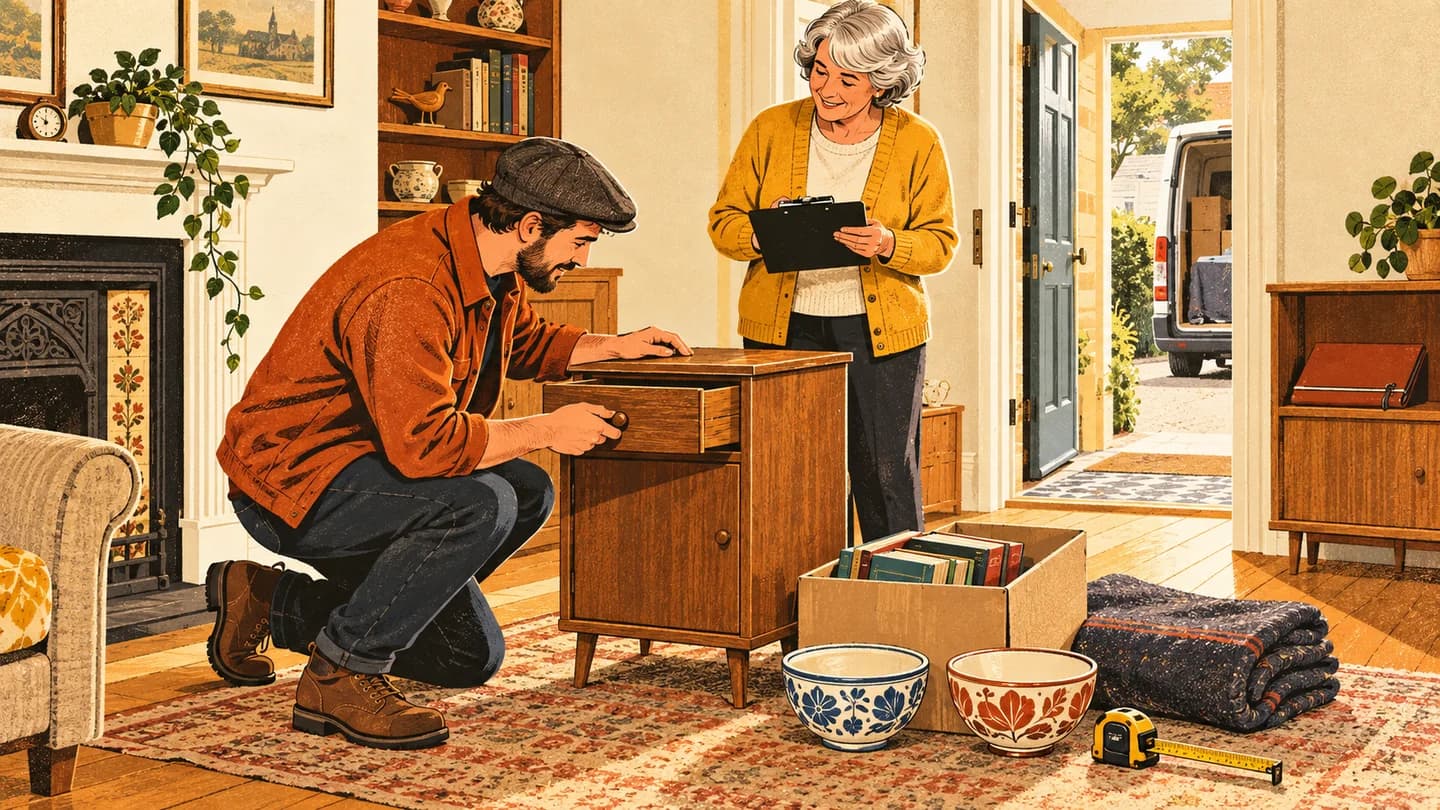
Collection can decide whether a lot is viable even when the hammer price is attractive.
- Confirm where the goods are stored; the collection address may differ from the auction office.
- Check the payment deadline, collection window and appointment requirements.
- Find out whether staff provide packing or loading assistance, and what it costs.
- Measure the object, vehicle space and access route for bulky purchases.
- Get a suitable carrier’s quote if you cannot collect yourself.
- Check storage charges and what happens if collection is delayed.
Include the difficult part of moving the object
A courier price based on an unwrapped parcel is irrelevant if the auction house will not pack the item. Ask who prepares it for transport, what dimensions and weight the carrier needs, and what protection or insurance is available for that category. Fragile and heavy goods need a specific plan.
When collecting several lots, allow for the full load. A small cabinet that fits alone may not fit beside the other purchases you are hoping to win. Also check the cost if you win only one lot: a shared trip budget should not make an otherwise uneconomic single purchase look affordable.
Choose a bidding method you understand
Register in good time and complete any identity checks or deposits required by the house. Read how commission bids, maximum online bids or telephone bidding work for that sale. A maximum bid is a commitment up to your chosen limit under the applicable rules, not a risk-free reservation.
For timed sales, check whether late bidding extends the closing time. For live sales, pay attention to the current lot and bid amount, and allow for connection delays. Use one clear plan rather than placing overlapping bids through several routes and hoping they will coordinate automatically.
A winning bid is a commitment
After winning, reconcile before collecting
Compare the invoice with your calculation and query unexpected charges promptly. Pay through the auction house’s verified process, using contact details you independently recognise if payment instructions seem unusual. Obtain the release information required for you or your carrier to collect.
At collection, match the goods to the lot and check that listed components accompany them. Raise a discrepancy with the auction house before leaving where possible and keep photographs and paperwork. Record hammer, charges, transport and preparation separately in your stock records so that the eventual profit calculation starts with the full cost.
Review the result without congratulating the bid alone
A bid below the estimate can still become an expensive purchase after fees, work and transport. Judge it when you know what was needed to list the lot and what buyers actually paid. Keep unresolved stock visible rather than treating an optimistic asking price as a completed return.
After a few purchases, compare your estimated invoices and collection costs with the actual figures. Correct the parts you underestimated before increasing your budget. The useful auction skill is not winning more often; it is recognising the lots you can buy, finish and sell on terms that make sense.