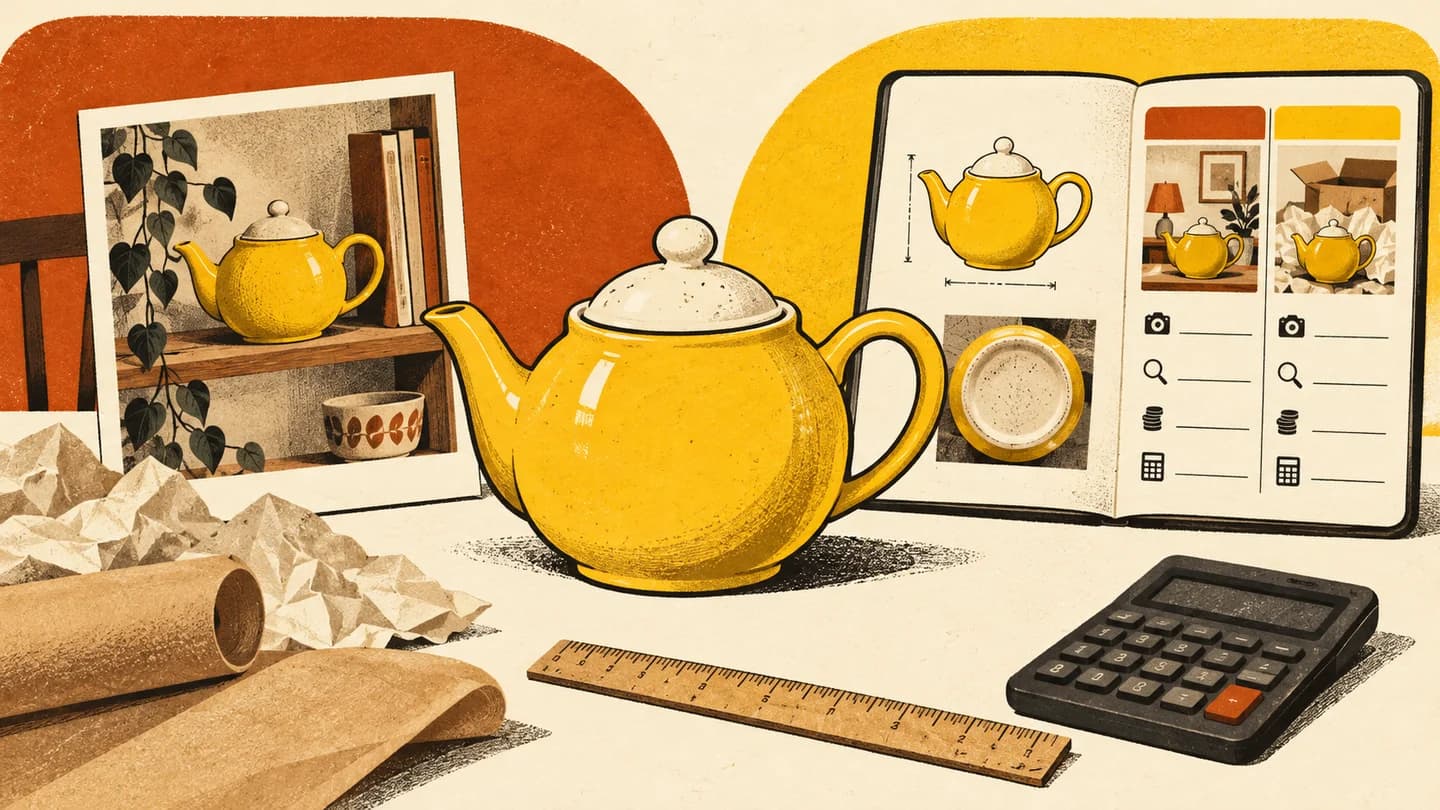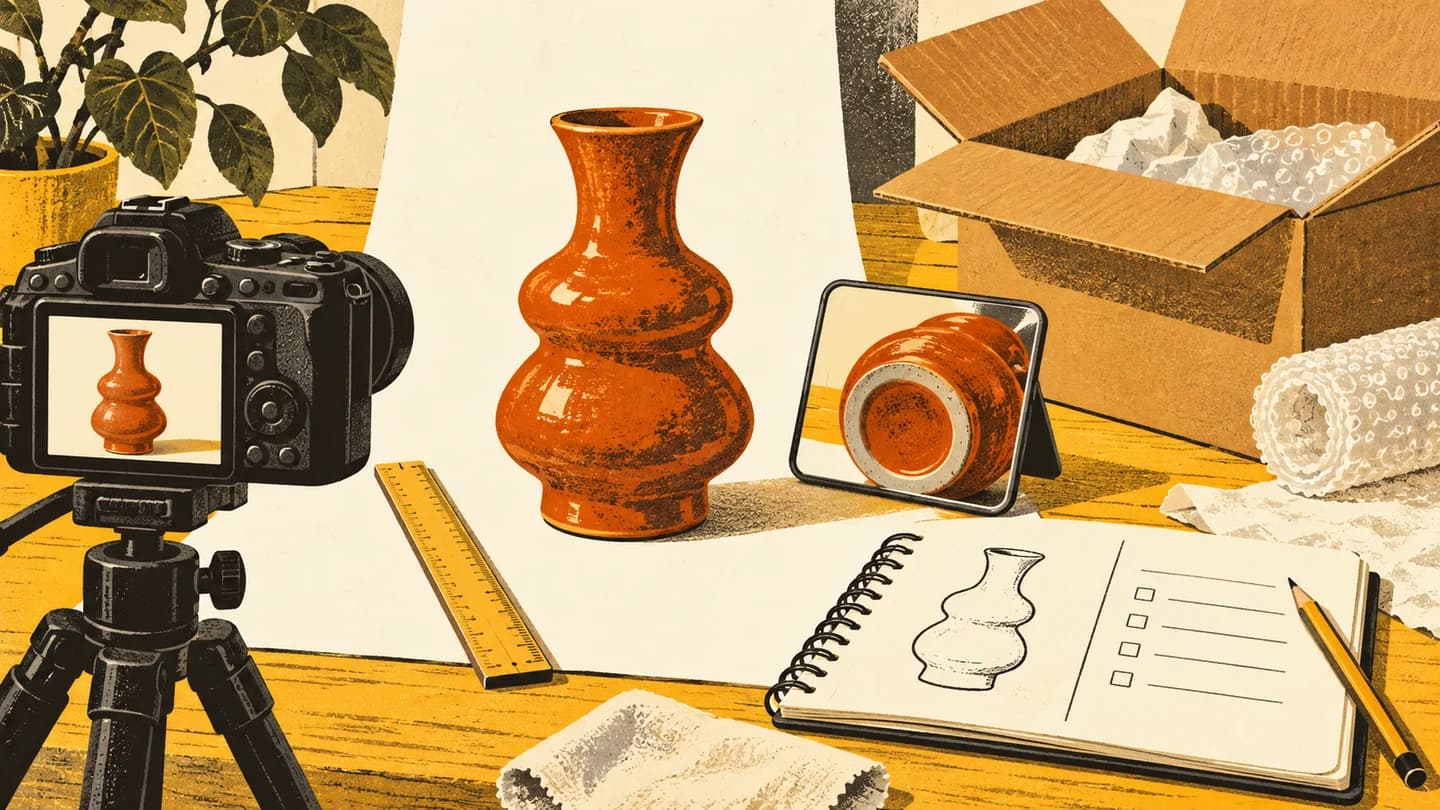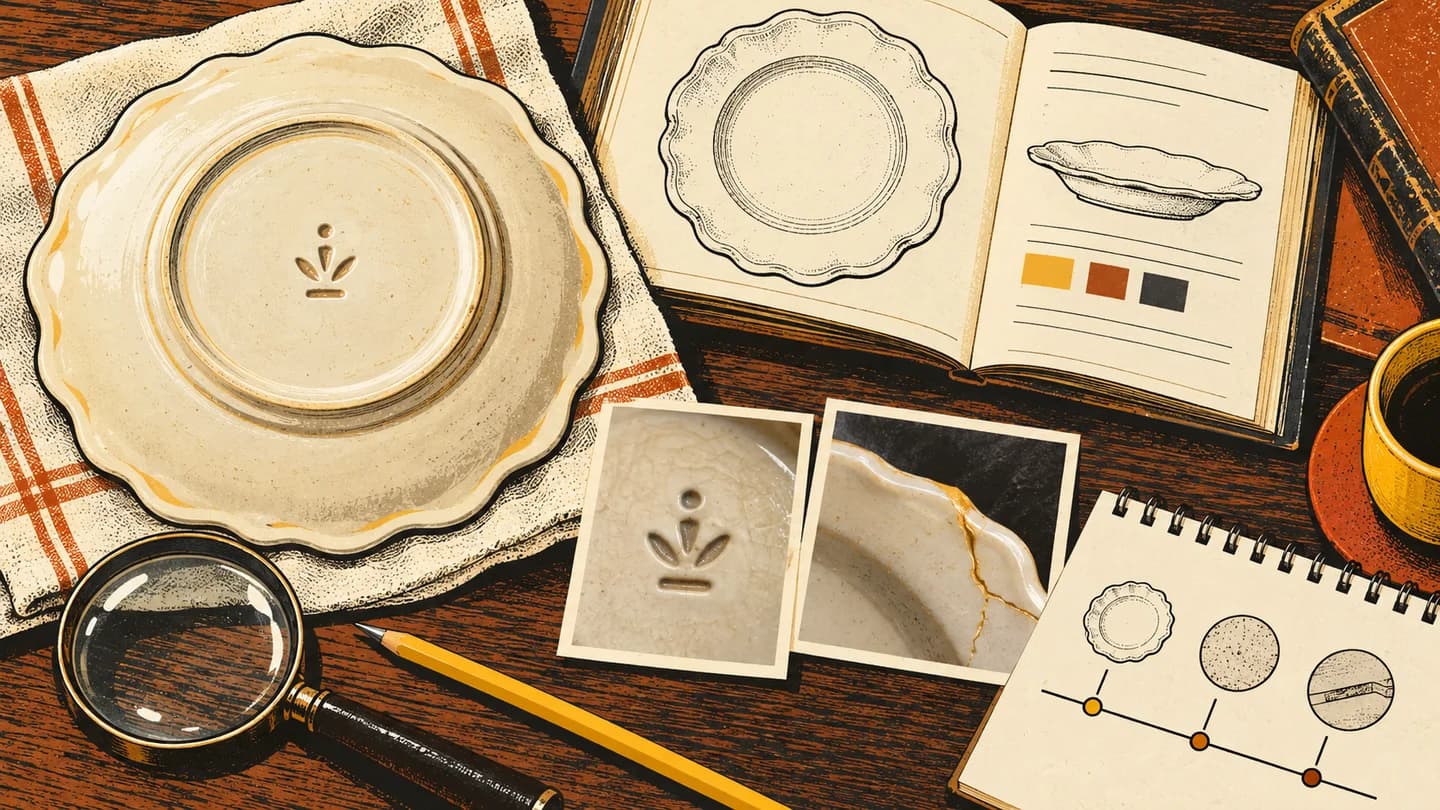
Build an age estimate from several consistent clues and explain uncertainty in the listing.
Build an age estimate from evidence
Dating a vintage object is a process of narrowing possibilities. You identify what it is, collect clues from its marks and construction, compare reliable references and check whether the clues agree. An appealing style or worn surface can suggest where to begin, but neither gives you a production date on its own.
The level of certainty matters. A broad date range may be enough for a decorative description but insufficient for a platform’s age threshold or a valuable attribution. Decide what claim you need to establish, then keep the evidence and uncertainty visible as you research.
Record the object before changing it
Cleaning, removing labels or replacing parts can destroy useful clues.
- Photograph the whole item from several angles.
- Take close-ups of marks, labels, numbers and construction details.
- Record dimensions, weight where useful and included components.
- Write down the source and any history supplied by the seller.
- Separate your own observations from the seller’s statements.
- Give the object a reference so photographs and notes stay together.
Read marks exactly as they appear
Copy the lettering, punctuation, symbols and numbers without completing a partly legible mark from memory. Photograph it under suitable light and compare more than the general shape. A small wording difference can distinguish marks used by different businesses or during different periods.
Identify what kind of mark you are looking at. It might be a maker’s name, pattern number, retailer label, registration mark or something added by an owner. Do not assume that every number is a date or that a retailer’s name identifies the factory. Establish the mark’s purpose before using it in the chronology.
Distinguish design registration from manufacture
A registration date can help identify when a design was recorded, but it is not automatically the production date of every object carrying that design. The National Archives provides records and guidance for British registered designs, including the information encoded in historical diamond marks. Use that information for the question it can answer.
Imagine a design introduced in 1965 and produced for many years afterward. A matching design supports identification, but you still need evidence about the particular example’s production. Look for version changes, labels or construction details that narrow the period. Avoid turning the earliest possible date into a precise manufacturing year.
Look for several independent clues
The strongest estimate usually comes from details that agree for different reasons.
- A documented period of use for the actual maker mark.
- Materials and construction consistent with that period.
- A matching version in a dated catalogue or archive.
- Packaging or paperwork clearly associated with the object.
- Known changes in shape, fittings or decoration across production.
- Reliable provenance that connects this example to a date.
Use material clues carefully
Material and manufacturing details can help distinguish versions, but visual identification has limits. A surface may imitate another material, a finish may be renewed and a replacement part may be newer than the main object. Describe what you can establish and avoid destructive testing on an unfamiliar find.
For example, a modern screw on an otherwise older object might indicate a repair rather than date the entire piece. Equally, an old-looking fastener can be reused. Consider how the parts relate to one another before selecting the clue that best supports the date you hoped to find.
Compare the right features in reference images
A museum or manufacturer reference may identify a model family without matching your exact version. Compare proportions, dimensions, marks, decoration and construction where the reference provides them. A similar colour or silhouette is a starting point, not a complete identification.
Keep the source title and reference details with your notes so you can return to it. If you rely on a printed guide, record the edition and page. For an online catalogue, save the relevant item identifier and date accessed. This small habit prevents a later description from becoming more precise than the evidence you originally found.
Write down what each clue actually proves
The examples below are hypothetical. The aim is to separate a useful observation from a conclusion that reaches too far.
| Clue | Useful conclusion | Limit |
|---|---|---|
| Design appears in a dated catalogue | The design existed by that date | Your example may be later |
| Mark documented across a period | A possible production range | Check authenticity and version |
| Receipt tied to the object | Evidence of purchase by that date | Purchase may be later than manufacture |
| Newer replacement component | Part of the object changed | Does not alone date the original body |
| Similar marketplace listing | A lead for further research | The seller may be mistaken |
Actively search for contradictions
Once you have a likely date, try to disprove it. Does the label wording appear only later? Is the size different from the documented version? Does the reference show a construction detail missing from yours? A contradictory clue deserves attention rather than being dismissed because the rest of the object looks convincing.
Several websites repeating the same description may trace back to one unsupported listing. They are not necessarily independent confirmation. Prefer sources that explain their evidence and distinguish observed facts from attribution. For an important claim, one strong reference can be more useful than ten copied captions.
Wear is not a reliable clock
Handle provenance as a claim to assess
A seller’s account can point you toward useful records, but write it down as an account rather than established history. Ask specific, reasonable questions where appropriate: who owned the item, what documentation survives and how the record connects to this example. Avoid collecting unrelated personal information.
A family story may be sincere and still contain a mistaken date. A photograph of the object in a documented setting may provide stronger support, provided you can identify it reliably. Keep the strength of the public claim aligned with the strength of the evidence. “Reported by the previous owner” and “documented in a dated record” are different descriptions.
Choose an honest level of precision
Use an exact year only when the evidence supports it. A production range, approximate decade or statement that the date is unresolved may be the better conclusion. Explain the meaningful basis in concise language without presenting speculation as certainty.
For Etsy eligibility, check that the supported age range establishes at least 20 years for the physical object. If the range crosses that boundary, investigate further or choose another suitable route. The need to complete a date field is not evidence that your uncertainty has disappeared.
Decide when expert help is worthwhile
Research effort should reflect the stakes and the information still missing.
- Identify the precise question: maker, date, material, authenticity or restoration.
- Gather clear photographs and your existing evidence.
- Find a competent specialist for that object category.
- Ask about the scope and cost of the assessment.
- Compare that cost with the realistic effect on your decision.
- Keep the assessment and any limitations with the item record.
Turn the conclusion into a useful listing
State the object’s identity, supported date or range, dimensions and condition. Show the marks and details that help a buyer understand it. Do not make the narrative more confident simply because a precise date sounds better in a title.
If later evidence changes the attribution, correct the listing and your records. Good dating research is not about defending the first guess. It is about producing the most accurate description the evidence allows, so the buyer can judge the object and you can price it on a sound basis.