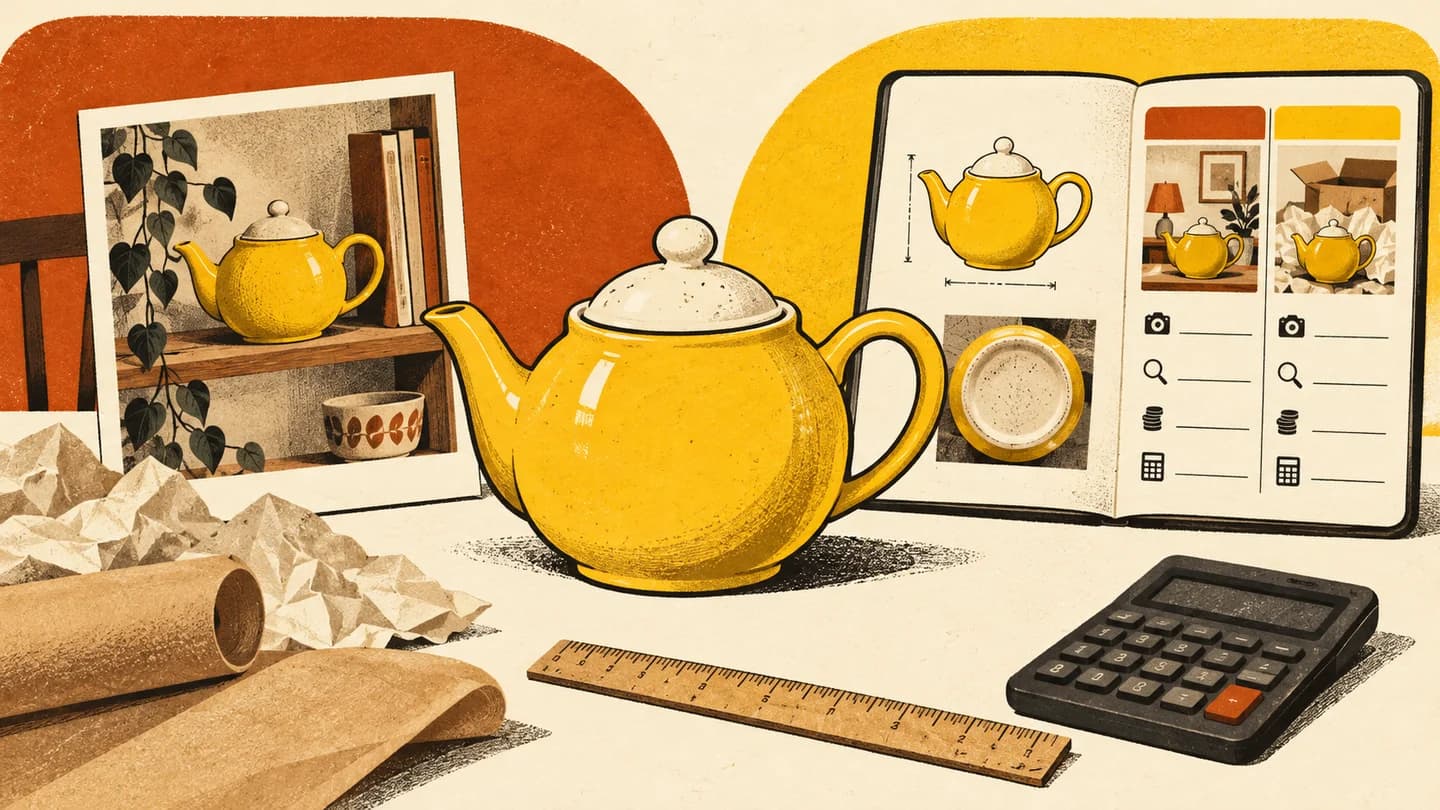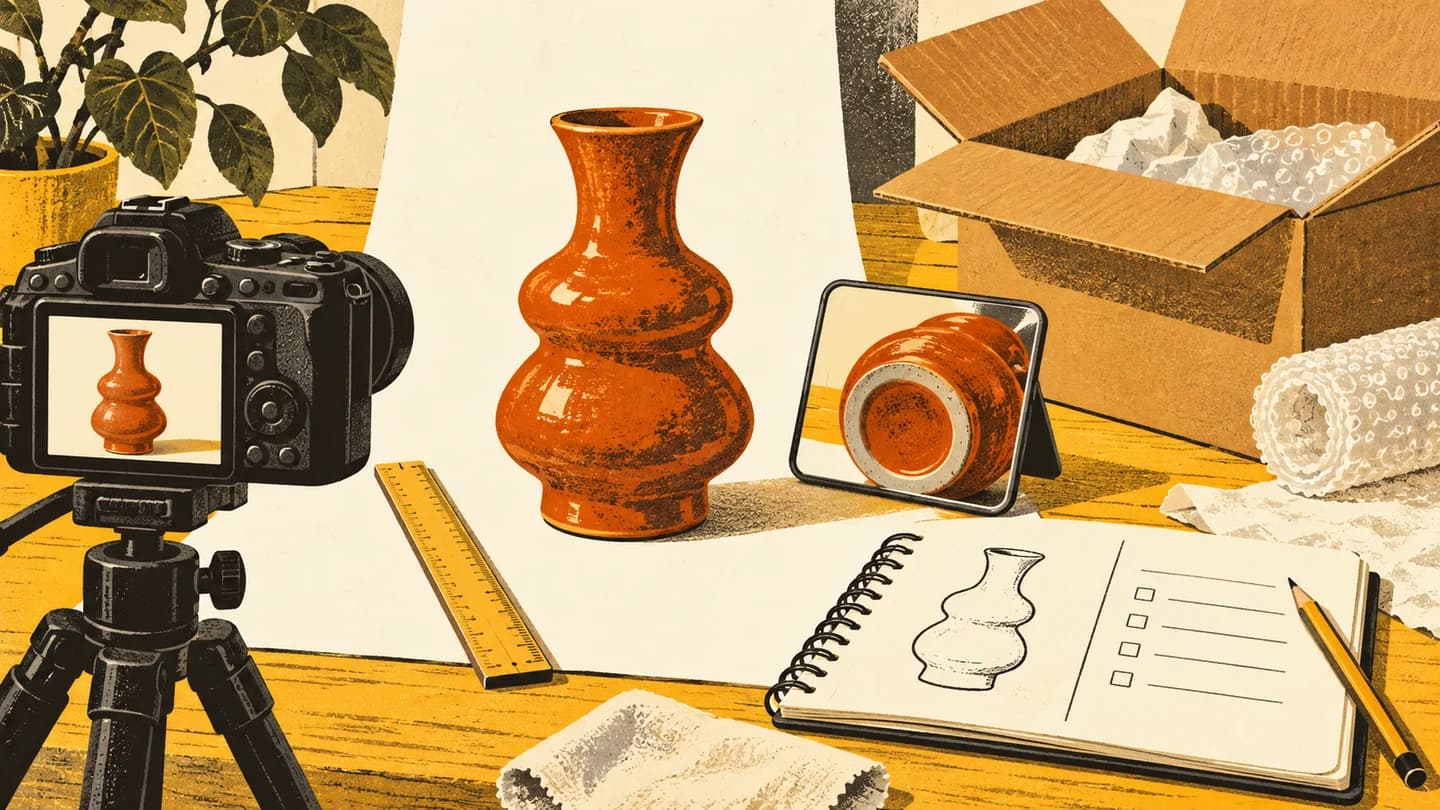
Distinguish eligible vintage or supplies from ordinary second-hand goods before creating a listing.
Second-hand does not automatically mean suitable for Etsy
A charity-shop find may be attractive, useful and worth reselling without fitting Etsy’s permitted categories. The platform’s creativity standards define the seller’s role and the kinds of items allowed. Start by identifying the applicable route rather than choosing a label that seems likely to pass the listing form.
For bargain hunters, vintage is often the relevant route, but supplies or other permitted categories may apply to some finds. Each has its own requirements. This guide helps you test the fit before spending money or creating a listing, with a record you can explain if the item’s eligibility is questioned.
Use an eligibility check before a price check
Value research is more useful once you know where the item can legitimately be sold.
- Identify the actual object and what is included.
- Read the current Etsy creativity standards and any relevant prohibited-item policy.
- Choose the route that describes the object and your actual involvement.
- Gather the evidence needed for that route.
- Check for restrictions that apply regardless of category.
- If the fit remains uncertain, seek clarification or choose another suitable marketplace.
For vintage, date the object rather than the design
Etsy’s vintage threshold is at least 20 years. The relevant age is that of the physical item. A chair design introduced decades ago may still be manufactured today, and a recently printed reproduction of an old poster is not as old as the artwork it reproduces.
A rolling age threshold also means that a broad production range may be insufficient. Suppose your evidence places an object somewhere between 2004 and 2010. In late 2026, that range includes examples both older and younger than 20 years. You need more specific evidence before confidently claiming that this example qualifies as vintage.
Collect evidence tied to your example
Use several consistent clues where possible and preserve the reference details.
- Readable maker marks or labels with documented periods of use.
- A model or product code that can be matched reliably.
- Dated catalogues showing the relevant version and construction.
- Original packaging or records that clearly belong to the object.
- Documented ownership information supported by more than a vague story.
- Features that rule out later reproductions or versions, where you can establish them.
Treat resemblance as a research lead
An image search can reveal a possible maker, pattern or model. It can also return modern reproductions, misidentified listings and related objects that only look similar. Compare marks, dimensions, materials and construction before transferring a name or date to your find.
Another seller’s use of “vintage” is not proof that your item meets Etsy’s rule. Nor is the fact that you bought it at a house clearance. Those details may help explain the source, but they do not independently establish production age. Keep source, identification and dating as separate lines in the record.
For supplies, identify the actual creative purpose
A permitted craft supply should fit Etsy’s current definition and be described as the material or tool it actually is. Do not relabel an ordinary finished product as a supply merely because someone could theoretically decorate it. Read the examples and restrictions for the route you intend to use.
Check quantity, dimensions, composition and condition carefully. A bag of old buttons may require sorting so the buyer knows what is included. A partly used material may need a clear remaining quantity and suitability check. Eligibility alone does not make an incomplete or poorly described supply useful to a customer.
Making or designing requires your real contribution
If you have genuinely made or designed something, investigate the relevant Etsy category and disclosure requirements for that work. Merely cleaning a commercially manufactured object does not establish that you made it. Adding a vague “handmade” label does not change its origin.
Describe your role honestly and keep records of the work performed. If another party participates in production, follow the current rules for that arrangement. This is a different decision from whether an untouched second-hand object qualifies as vintage; do not use one route to avoid an unresolved question in another.
Test the reasoning on common finds
These examples illustrate the questions to ask, rather than giving blanket approval to unseen objects.
| Find | Question that needs answering |
|---|---|
| Old-style lamp bought recently | When was this actual lamp made, and what product requirements apply? |
| Loose sewing buttons | Do they fit the permitted supply definition, and what exactly is included? |
| Unmarked ceramic bowl | Can its age be established beyond a style resemblance? |
| Modern decorative print | Does any permitted route apply to this physical product? |
| Garment from an old design range | Is this example an original period piece or a later production? |
Category eligibility is only one check
Evaluate sets and altered objects carefully
A group of objects needs an accurate contents description and a valid route for the offered product. Putting unrelated modern goods in an old basket does not make the contents vintage. If you are relying on a curated collection category, read its specific requirements instead of assuming any bundle qualifies.
For an altered object, distinguish the original component from later additions. A replacement fitting, modern print or newly attached decoration may affect how the item should be described. Keep the buyer’s understanding central: they should know what is old, what is new and what work you performed.
Keep an evidence file proportionate to the claim
A useful file might contain your photographs, the relevant catalogue reference, a brief explanation of the identifying features and the purchase record. You do not need to bury the public listing in a research essay, but you should be able to explain why the description is defensible.
Record uncertainty instead of silently deleting it. If two sources disagree, investigate the reason: different versions, a copied error or a range that is broader than it first appears. For an expensive or specialist attribution, a competent expert’s assessment may be more useful than hours of repeating the same image search.
Make one of three decisions
Finish the check with a clear outcome so uncertain stock does not drift into a live listing. For research items, write down the question and the evidence needed rather than leaving a general “check later” note.
List
The item fits a supported route and you can describe it accurately.
Research
A specific unresolved question could change eligibility or the description.
Choose another route
The item has resale potential but does not fit Etsy’s standards.
Use eligibility in the buying limit
If your expected margin depends on an Etsy buyer but eligibility is unresolved, the purchase is more uncertain than a comparison price suggests. Work out a realistic alternative route and its net proceeds before paying. Do not buy at a premium that only works if the most favourable age or maker assumption proves true.
A disciplined seller can pass on an appealing object or sell it elsewhere without turning that into a failure. The useful result is a product offered through the right route with clear, supportable facts. That protects the quality of your shop and gives your next buying decision a stronger foundation.