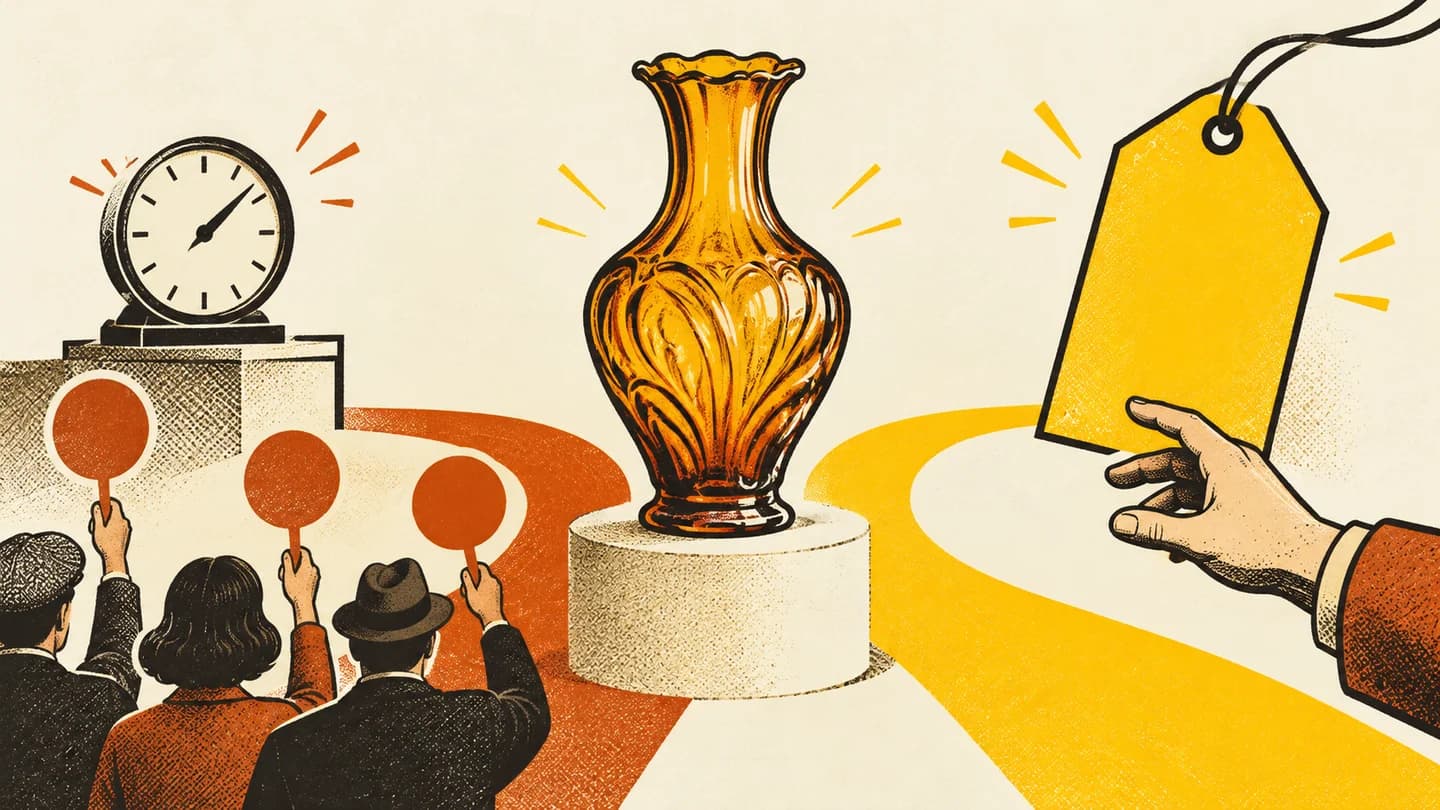
Choose a sale format based on price evidence, demand and the minimum return you can accept.
Choose the format that fits the demand
Auction and Buy It Now solve different selling problems. An auction gives interested buyers a defined period in which to bid. A fixed-price listing lets a buyer purchase at your stated price without waiting for an auction to end. Neither format guarantees the highest return, and neither removes the need to identify, describe and research the item.
The most useful starting question is whether several suitable buyers are likely to compete during the auction window. If the right buyer arrives only occasionally, a patient fixed-price listing may suit the item better. If you need a particular minimum return, make sure the format and settings actually protect that requirement.
Compare the practical trade-offs
Think about the outcome you can accept as well as the outcome you hope for.
| Question | Auction | Buy It Now |
|---|---|---|
| Who determines the price? | Bidding determines the result above the opening price, subject to any reserve | You set the asking price; offers may allow negotiation |
| When can a buyer complete? | Normally after the auction ends, unless an available Buy It Now option is used | When they choose to purchase at the available price |
| What if interest is thin? | One bidder may win at the opening price | The item may remain unsold until the right buyer arrives or you revise it |
| What control matters most? | An acceptable opening outcome and a suitable bidding window | A defensible asking price and a planned review process |
| What still needs budgeting? | Applicable listing, upgrade, sale and fulfilment costs | Applicable listing, renewal, advertising, sale and fulfilment costs |
Research the format as well as the price
Look at comparable completed sales and note whether they were auctions or fixed-price transactions. Check condition, contents and seller terms before comparing outcomes. A specialist dealer’s fixed-price sale with a warranty is not a clean comparison for a lightly described auction of an untested example.
Use a consistent recent period and inspect more than the most impressive result. Several auctions with strong bidding may support an auction strategy; one exceptional result does not establish a dependable pattern. Similarly, an ambitious active Buy It Now listing is evidence of an asking price, not proof that buyers are accepting it.
An auction can make sense when
Look for a combination of suitable demand and an acceptable downside.
- Several potential buyers actively seek the exact type of object, and comparable auctions show credible participation.
- The item is sufficiently identified and documented for bidders to judge it without a long private investigation.
- You can accept the result if the opening bid is the only bid, unless you have correctly configured an available reserve.
- A defined end date suits your selling schedule and you can handle questions and dispatch around it.
- The uncertainty concerns what competing buyers will pay, rather than a basic unresolved question about authenticity, completeness or function.
A low starting price is a real commitment
Starting at a small amount can attract attention, but attention is not a substitute for competing bidders. If you would be unhappy to sell at the opening price, do not rely on a late bidding surge to rescue the decision. Set an opening price whose outcome you can live with, or consider a different format.
Imagine a researched item usually selling around £60 in comparable condition. Starting it at £5 does not make £60 the minimum result. Your own listing may be seen by fewer suitable buyers, end at an inconvenient moment or have a detail that limits demand. Build the plan around an acceptable outcome rather than the expectation that the market owes you the typical price.
Understand what a reserve does and costs
Where the category and listing options support it, a reserve allows an auction to end without a sale if bidding fails to reach the specified amount. Buyers can see that a reserve exists and whether it has been met, but not normally the undisclosed amount. It is a separate setting, not something created by writing a minimum price in the description.
A reserve is an optional paid upgrade. Check the current eligibility, minimum, charge and terms shown for your account before using it, including what happens if the item does not sell. Compare that cost with simply setting a higher opening price or choosing fixed price. A reserve can protect a minimum outcome while still leaving you with an unsold item and costs.
Buy It Now can make sense when
A fixed price is particularly useful when you can explain the asking price and wait for an appropriate buyer.
- Recent comparable sales establish a reasonably clear range for an identifiable model or ordinary second-hand item.
- The buyer may need time to check fit, compatibility, collection arrangements or a specialist requirement.
- You want control over the accepted price rather than exposing the item to a short bidding window.
- You can maintain accurate stock and fulfil the order whenever the buyer purchases.
- You have a review date and an alternative plan if the item sits unsold, rather than treating a fixed price as a reason never to revisit the evidence.
Offers give flexibility without requiring guesswork
If Best Offer is available and you enable it, decide what return you will accept before negotiations begin. Base that decision on costs, current alternatives and the value of releasing the cash. A percentage discount alone does not tell you whether an offer is worthwhile.
Check any automatic acceptance or rejection settings carefully. They should reflect your intended price limits and the way delivery is charged. Do not start far above credible market evidence simply to manufacture a dramatic discount. A realistic asking price with a reasoned negotiation range is easier for a buyer to understand.
Three items, three sensible decisions
These scenarios illustrate a decision process rather than universal category rules. The evidence for your particular item may lead elsewhere.
Common tested game controller
Many closely matched recent sales and plenty of available substitutes can make a competitive fixed price straightforward. An auction adds price uncertainty without necessarily adding useful discovery.
Well-identified collectable with active bidding
Several comparable auctions show genuine demand and the seller can accept a sensible opening price. An auction may let interested collectors compete within a defined window.
Unusual replacement component
The right buyer may appear infrequently and need to check compatibility. A detailed fixed-price listing can provide time for that buyer to find it; rarity alone does not create an auction contest.
Schedule around the buyer and your own capacity
There is no single ending hour that works for every category. Think about when your likely buyers can inspect the listing and act, but do not treat a popular timing tip as a guarantee. Allow enough time for questions, measurements and any clarification the item reasonably requires.
Also check your own calendar. An auction ending just before you leave home for several days may conflict with your stated handling time. A fixed-price listing can sell while you are busy too. Use the available listing and time-away settings appropriately, and do not advertise a dispatch commitment you cannot meet.
A Buy It Now option on an auction is not the same as fixed price
Some auctions allow an additional Buy It Now price. That option is subject to eBay’s rules and may disappear once bidding begins or the relevant reserve condition is met. Do not assume it will remain available throughout the auction or that it combines freely with every offer feature.
Review the options actually offered in your listing form and inspect the preview before publishing. The important question is what a buyer can do at each stage. If you want a stable asking price available until sale, a straightforward fixed-price listing may be easier to manage than a combination whose behaviour you have not checked.
Do not use cancellation as your pricing strategy
Judge the result by proceeds and time
After the sale, record the format, final amount, costs and time the stock was held. Include unsuccessful listing costs where applicable. A high auction result may involve more preparation and uncertainty; a slightly lower fixed-price sale may release money sooner. Compare similar items over several transactions before deciding that one format always wins.
For unsold stock, revisit the evidence before changing format. Correct an unclear title, missing measurement or unrealistic total price first. Switching from fixed price to auction can expose the same weak listing to a lower outcome; switching to fixed price can leave the same overvalued item waiting. The format works best when the underlying offer is already sound.