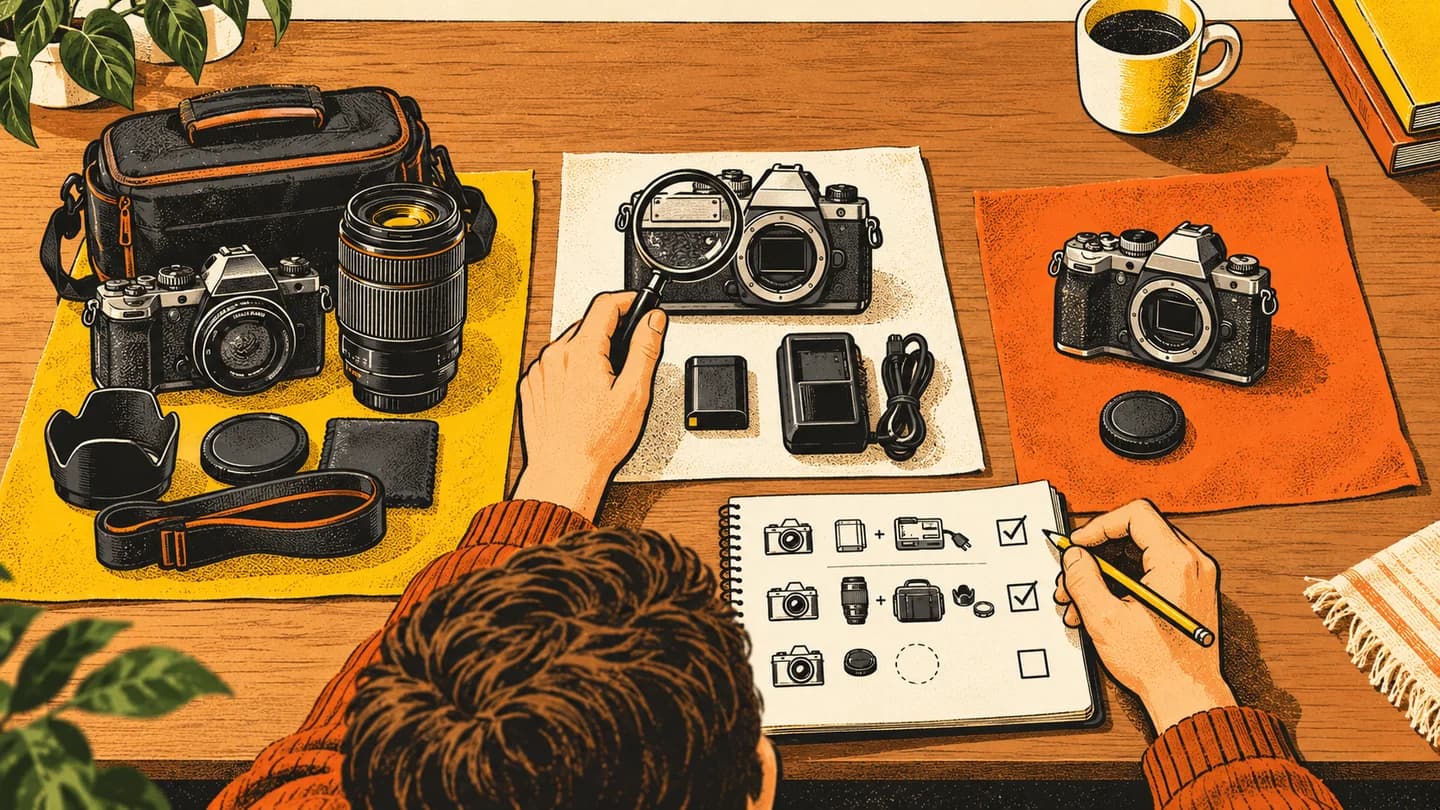
Choose comparisons based on what the buyer received, not simply on similar photographs.
Would the buyer consider these interchangeable?
Two items can look almost identical and serve different buyers. A camera lens in the wrong mount, a game in another region or a replacement lid instead of a complete pot is not a useful direct comparison. Before borrowing a sold price, ask whether someone searching for your item would genuinely consider buying that example instead.
Comparable-sales research works best as a sorting exercise. First identify what you have. Then separate close matches from useful background evidence and irrelevant results. Only after that should you calculate a range. This stops an attractive headline price from quietly becoming the answer you wanted to find.
Build an identity card before opening eBay
Take a few notes beside the item, or ask the seller for the missing details before making an offer.
- Record the maker, exact model and every meaningful suffix from the object itself. Photograph the label so you can check it again later.
- Add the specification that changes compatibility or use: capacity, mount, voltage, region, size, edition or production version.
- List exactly what is included. Separate original accessories, replacements and packaging instead of writing “complete” without checking.
- Describe condition in observable terms, including faults, wear, repairs and the tests performed. Mark unknowns as unknowns.
- Write down how you expect to sell it: posted or collected, working or for repair, individually or as a bundle. That is the proposition your comparisons must support.
Search narrowly, then broaden one thing at a time
Start with the exact identity and the relevant category. Apply sold filters and open promising results rather than accepting the search thumbnail. A short model code may also identify an accessory or another manufacturer’s product, so check photographs and descriptions together. If the title says one version and the label shows another, do not treat it as a clean match.
If results are sparse, remove one restriction at a time: first colour if it is unimportant, perhaps an accessory requirement next, then a wider date window. Keep the model or compatibility restriction until you understand its significance. Broadening every filter at once produces a bigger sample but makes it harder to explain what the sample measures.
Sort each result into one of three groups
You do not need a complicated spreadsheet. A result link, a short identity note and one of these labels will make your research much easier to review.
Direct comparison
The same important specification, broadly comparable condition and substantially the same contents. Include it in your main price range after checking delivery and the actual sale price.
Supporting evidence
A meaningful difference exists, such as a missing charger or a dealer warranty. Keep it separately to understand the market, but do not silently average it with direct matches.
Exclude
The wrong version, an accessory-only listing, a materially different bundle, an unresolved identity conflict or a transaction whose price you cannot interpret. Record the reason and move on.
Condition needs more detail than the category label
Used covers a wide range. A clean camera with a demonstrated working shutter is different from one that only powers on. An amplifier tested through both channels is different from one with an intermittent output. Compare the disclosed test scope as well as cosmetic appearance, because an unknown function leaves a risk for the next owner.
Do not turn “untested” into “probably working” because it looks tidy. Equally, one scratch does not automatically justify taking an arbitrary percentage off every comparable. Look for sales with similar limitations. If those do not exist, describe the uncertainty and reduce what you are willing to commit, rather than presenting a guessed adjustment as a researched market value.
A worked comparison: camera body, battery and charger
These invented figures illustrate the method; they are not current camera prices. Imagine your item is the exact same camera model as the direct matches, tested, with normal wear, one battery and a compatible charger. All amounts below include the stated delivery charge.
| Result | What the buyer receives | Treatment |
|---|---|---|
| £126 | Matching tested body, battery and charger; similar wear | Direct comparison |
| £132 | Same specification and contents; similar disclosed condition | Direct comparison |
| £138 | Same specification and contents; slightly cleaner exterior | Direct comparison; note the difference |
| £189 | Camera plus a useful lens and bag | Supporting evidence only: larger bundle |
| £85 | Body with an intermittent fault | Exclude from the working-item range |
| £159 | Matching body sold with a dealer warranty | Supporting evidence: different buyer proposition |
Use the matched range, not the whole search average
The three direct comparisons above suggest an observed delivered range of £126–£138, with a middle value of £132. That is a description of this tiny example set, not a guarantee of your sale price. You still need to consider current competition, timing and anything about your item that the examples do not resolve.
Averaging all six figures would mix a lens bundle, a faulty body and a warranty-backed sale into a number that describes none of them. More data is useful only when it measures the right thing. Keep the excluded records in your notes if they explain a decision, but do not let them enter the main calculation simply because they appeared in the same search.
Missing accessories can change the buyer pool
Suppose your charger is missing. Buying the cheapest advertised replacement and subtracting its price from £132 is an incomplete calculation. Check that the replacement is appropriate, safe and genuinely available at that total cost. Include delivery, any delay and the work needed to verify operation. A questionable charger can create more problems than it solves.
Then compare complete and incomplete sales where possible. Some buyers will happily source a charger; others want a ready-to-use purchase and will skip your listing. If you can obtain a suitable replacement cheaply and test the kit properly, completing it may be worthwhile. If you cannot, price the actual incomplete package and describe the omission clearly.
Normalise the transaction before comparing prices
The amount beside a title is only the starting point.
- Use a consistent buyer-cost basis: item price plus the displayed delivery charge, noting any other visible mandatory charge that changes the comparison.
- Keep collection-only and posted examples separate when convenience, geography or packing difficulty materially changes demand.
- Check whether the visible number is an asking price associated with an accepted offer. Use the actual accepted amount where the research tool provides it.
- Treat foreign-market sales cautiously. Currency conversion alone does not account for shipping, import costs, compatibility or the local buyer pool.
- Note the sale date and any warranty or service that changes what the buyer is receiving. Do not assume the most expensive seller’s terms apply to you.
Use older evidence without importing an old market
Recent, close matches are usually the best place to start. A longer research window can help identify a scarce object, but a sale from a different season or an earlier product cycle may reflect different demand. Record its date and use it as historical context until you have evidence that the price still makes sense.
eBay Product Research can expose older transactions and more specific filters than a basic sold search. It also provides actual accepted Best Offer prices. Those capabilities improve the evidence available; they do not remove the need to inspect the specification. An exact-looking keyword search can still contain incomplete or misidentified items.
When there are no dependable matches
Turn the comparison into a buying decision
Finish with a short statement: what the item is, the closest observed range, the important differences and the conservative price you will use for budgeting. Subtract applicable selling costs, fulfilment, preparation and the return you require to arrive at a buying ceiling. Keep the evidence beside that calculation so you can revisit it if something changes.
After your own sale, add the actual result and the time taken. Over several purchases, you will learn which details mattered more than expected: an original remote, a specific size, a clean battery compartment or collection distance. That record makes the next comparison faster without turning a single successful sale into a universal rule.