Agree the practical details in advance and verify the transaction before releasing the item.
Make the handover predictable before anyone travels
Local collection can avoid packing and postage, especially for furniture and other bulky goods. It still needs a clear process. The buyer should know what they are collecting, what it costs, where and when to attend, how payment works and what help or transport they need.
The seller should know which item and accessories are committed, who is expected and how the transaction will be confirmed. Most avoidable problems begin with an assumption left in the conversation: that a wardrobe will fit in a hatchback, that someone will help lift, or that a payment screenshot is enough to release the goods.
Confirm the essential details in the listing and messages
Keep the agreement within the selling platform where its process requires that. Give enough information to plan the collection without publishing unnecessary personal details.
- Identify the exact item and included accessories, using the listing reference where available.
- Confirm the agreed price and any change to the advertised package through a permitted process.
- Provide dimensions, approximate handling requirements and relevant access restrictions.
- Agree a collection window rather than leaving the day open-ended.
- Confirm the supported payment method and any platform collection-code requirement.
- Ask the buyer to confirm suitable transport and the people or equipment needed to move the item safely.
A useful collection-confirmation message
Adapt this example to the item and platform. It sets practical expectations without trying to rewrite the buyer’s rights.
Choose a location suited to the item
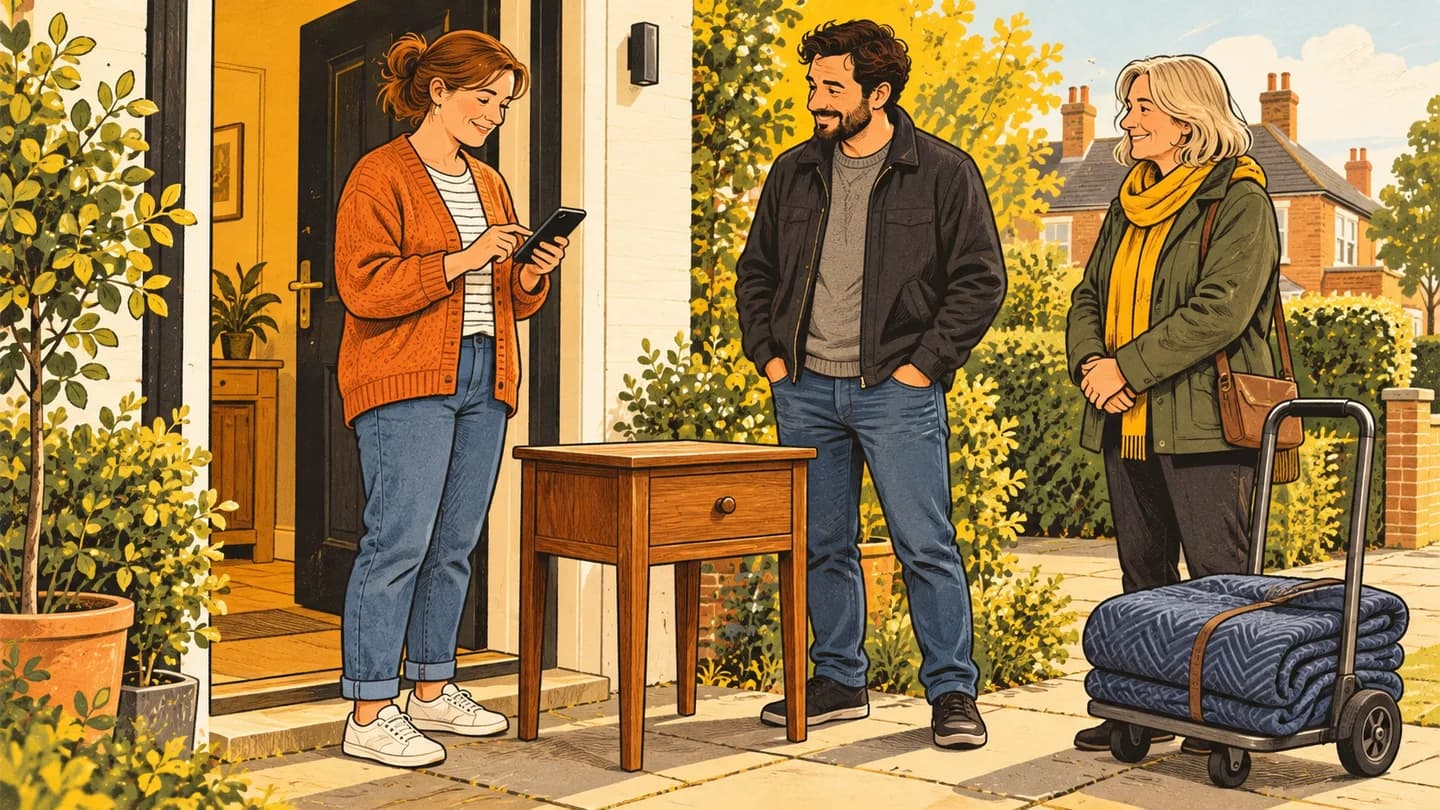
For a portable item, a busy, well-lit public place during daylight can reduce the need to share a home address. Choose somewhere the handover can happen without obstructing others and where the necessary inspection is practical. Have someone you trust with you where possible and let someone know the arrangement.
A large piece of furniture may require collection from home. Limit access to the area needed for inspection and removal, keep other valuables out of view and arrange for another adult to be present where practical. Do not agree to an unexpected secluded location or a last-minute change that makes you uncomfortable.
Share the address when the arrangement is real
Use a general area in the public advert, then provide the precise collection details privately when you have a credible arrangement. Do not post access codes, household schedules or information unrelated to the transaction. Keep the collection window realistic so you are not repeatedly sharing details with people who have made no plan to attend.
An account profile can provide context, but it is not a guarantee of identity or good intentions. Judge the proposed process as well. If someone refuses reasonable arrangements or insists that you abandon the agreed payment and meeting method, pause rather than trying to complete the sale at any cost.
For bulky items, check the route out as well as the vehicle
These questions are easier to resolve before collection day. A buyer’s ability to fit the item in a vehicle does not establish that it can get through every doorway on the way there.
| Question | Detail to agree |
|---|---|
| Will it fit? | Item dimensions, vehicle opening and available load space |
| Can it leave the property? | Doorways, stairs, corners and any access restrictions |
| Who will move it? | Suitable people and equipment; no assumption of lifting help |
| Is dismantling needed? | Who can do it competently, required tools and effect on condition |
| How will it be protected? | Blankets, straps or other suitable transport materials |
| What if the plan fails? | A new arrangement through the platform rather than an unsafe improvised move |
Keep the item ready without losing control of it
Match the physical item to the order and gather the accessories before the buyer arrives. Check that its condition still matches the listing. If you discover damage or a missing part, tell the buyer before they travel and resolve the change through the appropriate process.
For furniture, clear a sensible route and identify loose shelves, drawers or fittings. Do not dismantle an item merely because a buyer might prefer it if that changes the promised condition or makes inspection difficult. Agree any necessary change first and keep the parts labelled together.
Let the buyer inspect what was agreed
Give a reasonable opportunity to compare the item with its photographs and description. Point out significant disclosed faults and check the included contents together. A buyer discovering that a table has a marked top is easier to deal with before loading than after it has left.
Keep demonstrations suitable for the item and your competence. Do not improvise an electrical connection or an unsafe test to prove a sale. If the buyer asks for an inspection you cannot provide safely, explain the limitation and decide whether the arrangement can proceed honestly. Your description should not imply checks that never happened.
Verify payment through your own account
For a platform-paid order, open the genuine order yourself and follow the service’s current status and handover instructions. For a permitted bank transfer, check your own bank account rather than the buyer’s screenshot, email or phone display. If the payment is unclear or pending, wait and seek clarification through the bank or platform.
If cash is the agreed permitted method, confirm the amount and count it before releasing the item. Consider in advance whether you are comfortable handling the value involved and how you will check the notes. Do not accept a larger payment followed by a request to send money to a different account or courier without independent verification.
Complete the marketplace’s collection confirmation
Some platforms use an in-app confirmation or collection code. On eBay, the buyer’s QR or six-digit collection code forms part of the handover process. Use the genuine order and eBay’s own workflow at collection, after the buyer has inspected the item and is ready to proceed. Keep payment through eBay checkout unless the category explicitly permits another arrangement.
Do not replace that process with a photograph of a stranger’s payment screen, and do not mark goods collected before collection has occurred. Check the resulting order status. The collection code is not a bank or email login code, and you should not share private authentication codes to complete a sale.
Use a clear handover sequence
Follow any platform-specific ordering of its payment and confirmation steps. The practical aim is to avoid uncertainty over what was inspected, paid for and released.
- Match the person’s collection arrangement to the correct order without disclosing unrelated customer details.
- Check the item, significant condition points and included accessories together.
- Resolve any genuine difference from the agreed description before proceeding.
- Verify payment through the supported route and complete the required collection confirmation.
- Release the correct item and accessories for the agreed collection.
- Update stock availability and remove duplicate adverts, then retain a basic transaction record.
Reassess a third-party collection rather than assuming it is equivalent
A buyer may later ask a friend or courier to attend. Confirm through the genuine account who is coming and whether the platform supports that arrangement. Check how inspection, authorisation, payment and collection confirmation will work before handing the item to someone else.
A request to pay an unexpected insurance or account-release charge through a link is a separate issue, not a routine part of changing the collector. Verify any claimed service independently. If the new arrangement cannot meet the platform’s rules or your practical requirements, choose another supported route or resolve the order through the platform.
Handle delays and renegotiation calmly
Ask a late buyer for an updated arrival time and set a reasonable boundary around your availability. Keep messages in the transaction record. Do not mark an item collected because someone promised they were on the way, and do not release a committed item to someone else without checking the first order’s status and cancellation rules.
A buyer may make a lower offer at the door. You can consider it, decline it or pause the handover. If a real undisclosed defect has emerged, address that honestly rather than dismissing it as haggling. Record any permitted change to price or contents through the appropriate transaction process.
Collection does not make the description unimportant
Keep a record of the item, price, date, payment route and collection confirmation. Record significant agreed changes rather than relying on memory. Do not collect unnecessary copies of identity documents merely to create a sense of security. Retain the information you actually need for the transaction and applicable business obligations.
A business seller still needs to meet the customer rights and product-safety requirements that apply to the sale. The buyer collecting in person or inspecting the item does not justify concealing a fault or using a broad no-returns sentence to remove rights. If a later problem is reported, use the relevant platform and legal process.