Protect the object from movement and impact, then check the carrier’s restrictions before dispatch.
Plan the parcel before you promise postage
A ceramic jug can look easy to post until you account for its handle, spout, protective material and the box around it. A glass set creates a different problem: several individually delicate objects must travel together without striking each other. Plan that protection before listing a delivery price.
The aim is to keep the object supported, separated from hard surfaces and protected against ordinary handling forces. A fragile label communicates a request; it does not ensure a parcel will remain upright or be handled individually throughout its journey. Your packing needs to do the protective work.
Check acceptance and compensation as separate questions
Read the chosen service’s rules for the specific contents. A carrier may accept a parcel while excluding certain fragile contents from damage compensation, or place conditions on how they must be packed. Do not assume a headline compensation limit covers your particular glassware or collectable.
Also check who supplies the service. A label bought through a marketplace or broker can have a different claim route and terms from one bought directly from a carrier. Use the rules for the actual booking. Keep evidence of value and posting, but recognise that photographs and receipts cannot turn excluded damage into a covered claim.
Identify the weak points before choosing materials
Think about where pressure or movement could concentrate. The attractive part of an object is often its least robust part.
Handles, spouts and stems
These can break if cushioning presses heavily against them or if the main body shifts while the projection stays trapped. Support the object around its stronger areas and leave a protected space for vulnerable parts.
Rims, corners and thin edges
A small contact point against the side of a box can take the force of an impact. Make sure edge protection is continuous rather than assuming a thick layer under the object protects every direction.
Lids, loose parts and matching pieces
Separate pieces can damage each other even inside a padded box. Treat a lid, removable base or second cup as its own object and plan how it will remain separated throughout the journey.
Choose a box that can do its job
Royal Mail recommends a robust box and at least 5 cm of cushioning around each fragile item. Treat that as a service guideline to check against the actual object, rather than a promise that one thickness suits everything. A heavy, unusually shaped or particularly delicate piece may need a different packing design or specialist help.
Inspect a reused box for crushed corners, splits, softness and previous damage. Remove obsolete labels and reject a box that no longer holds its shape. A handsome product box may be suitable for storage but inadequate as the only shipping container. Leave room for protection without creating a large empty cavity.
Pack one item in a controlled sequence
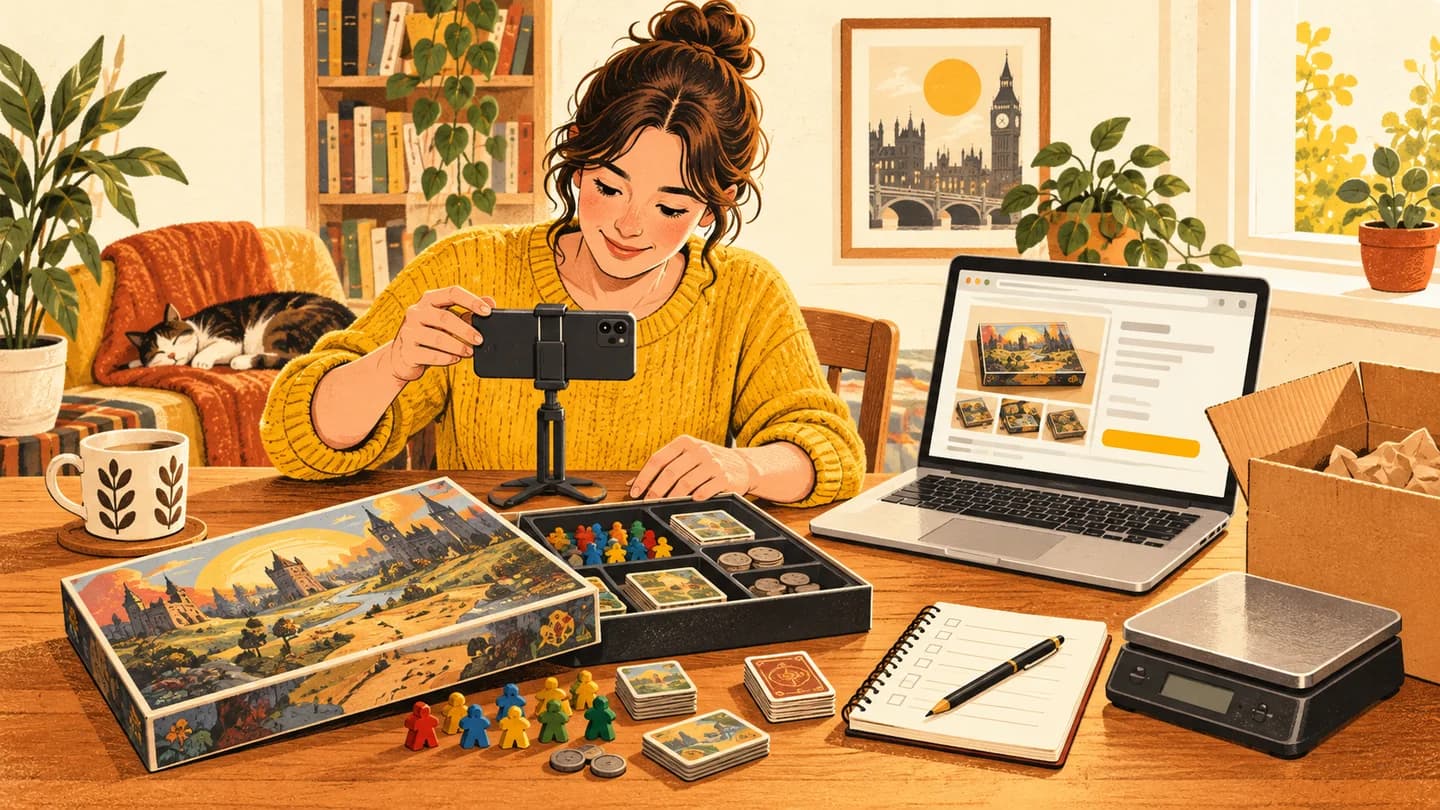
Clear a surface first so parts and packing material do not get mixed with other orders.
- Confirm the item, contents and condition against the order. Photograph significant details before covering them.
- Separate removable components where appropriate and safe. Keep their identity with the stock reference.
- Apply suitable surface protection, then cushioning around the object without forcing delicate parts. Keep adhesive away from the item itself.
- Place it in a sound box with protection on every side. Use suitable separators for multiple pieces so they cannot strike one another.
- Fill remaining movement space with material suited to the weight, without compressing fragile projections or bulging the box.
- Close, check and seal the parcel. Measure the finished external dimensions and weigh the complete package before booking the service.
A jug and lid need two protected spaces
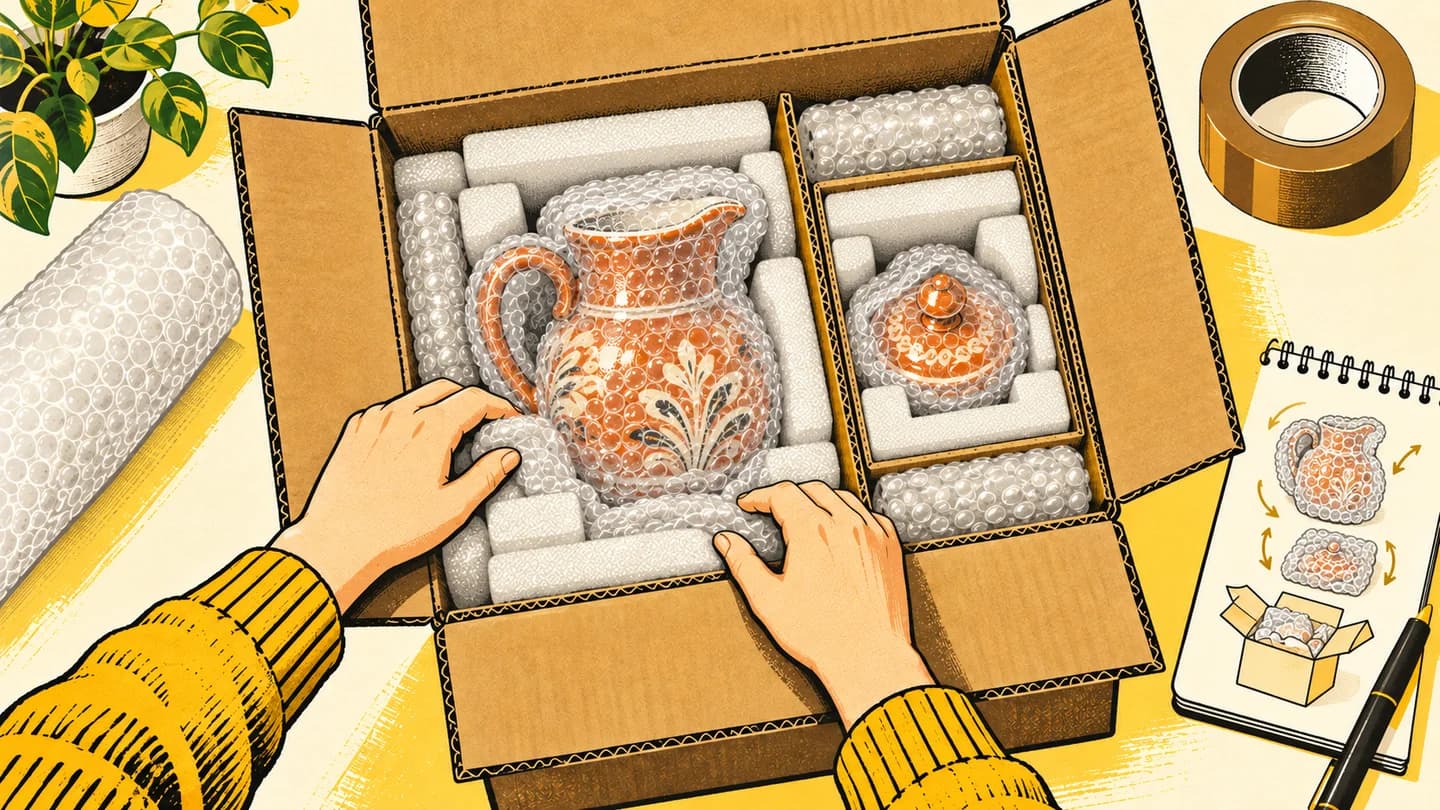
Consider a lidded ceramic jug. Packing it with the lid resting in place leaves two hard ceramic surfaces able to strike each other. Wrapping the lid separately and keeping it isolated avoids relying on the rim to carry the load. Photograph both pieces first so the contents are clear.
Build support around the jug’s body while keeping pressure off the handle and spout. Do not stuff material tightly through the handle and then pull it taut. If you cannot stabilise the body without stressing those areas, stop and rethink the box or ask an experienced packer. More material is not automatically better when it is pushing in the wrong place.
For multiple pieces, prevent object-to-object contact
DHL’s packing guidance recommends individual wrapping and suitable dividers when several fragile pieces share a package. Think about the parcel being turned: a cup that stays separate while the box is upright may slide into another if there is unfilled space or a weak divider.
Lay out the proposed contents before wrapping. Keep heavy pieces from bearing on lighter ones, and make sure every piece has its own protection. If the order needs several parcels, arrange and record that correctly through the order and delivery process. Do not discover halfway through packing that the promised single parcel cannot accommodate the set safely.
Consider a second box only as part of a complete design
For some delicate items, a protected inner box inside a larger outer box can provide another layer of separation. The space between boxes still needs appropriate cushioning; simply putting one loose box inside another adds movement rather than solving it. Follow the selected carrier’s guidance for this method.
Account for the larger dimensions and weight before setting postage. Double boxing can move the parcel into a different charge band. If a valuable piece requires specialist packing or carriage, obtain the cost before accepting the sale rather than trying to preserve the margin with an unsuitable small box.
Common shortcuts and why they disappoint
These checks are particularly useful when you are trying to finish several orders quickly.
| Shortcut | What it leaves unresolved |
|---|---|
| A fragile sticker on a thin box | The container still offers little protection from impact or compression. |
| All pieces wrapped together | Hard surfaces can meet inside the wrapping. |
| Lots of loose paper around a heavy object | Material may compress or shift, leaving the object free to move. |
| Tight wrapping over a handle | Pressure can be concentrated on the weakest part. |
| An oversized box with large gaps | Contents can travel inside the box before hitting a side. |
| A smaller box to save postage | Required protection may be removed to fit an unsuitable price band. |
Check gently, without turning the check into a stress test
Before sealing, look for exposed contact points and confirm that the cushioning stays in position. Close the box and lift it carefully. Gentle changes of orientation can reveal loose movement or rattling. Do not shake it hard, drop it or squeeze the sides to prove that the packing works.
If you hear movement, reopen and identify its source. It may be a poorly secured accessory, a lid touching its body or an object moving through loose filling. Solve that specific problem rather than adding tape outside. A quiet parcel is a useful check, but it is not a certification that fragile contents will survive every transit event.
Include the actual packing cost in the sale
For an illustrative order, a sound box at £2.20, cushioning at £1.60, tape and a label at £0.40 and postage at £6 total £10.20. If you allowed only £6 when pricing the listing, you overlooked £4.20 before counting your packing time. These figures are examples, not current supplier or carrier prices.
Reused material can reduce spending when it remains suitable, but it still takes space and time to collect, inspect and store. Record a realistic cost per parcel so low-value fragile stock does not appear more profitable than it is. A lower-risk local sale may be a better choice for an awkward item.
Keep a useful dispatch record
Store the evidence with the stock or order reference so you can retrieve it quickly.
- Photographs of the item and included pieces before packing.
- A few clear packing-stage photographs showing protection and separation.
- The final sealed parcel, its measured size and packed weight.
- The actual service booked and relevant value evidence.
- Posting receipt and tracking, followed through the order as appropriate.
Know when to use specialist help or collection
If damage is reported, handle both responsibilities
Ask for helpful photographs through the order where appropriate and tell the buyer to retain packaging if it may be needed for the claim. Avoid asking them to handle sharp fragments. Resolve the customer’s issue through eBay while pursuing any separate carrier claim under the booking terms.
Review the failure before sending another similar object. Was the item moving, pressing against the box, touching another piece or unsupported at a weak point? That answer should change the next packing plan, rather than simply producing a bigger fragile sticker.