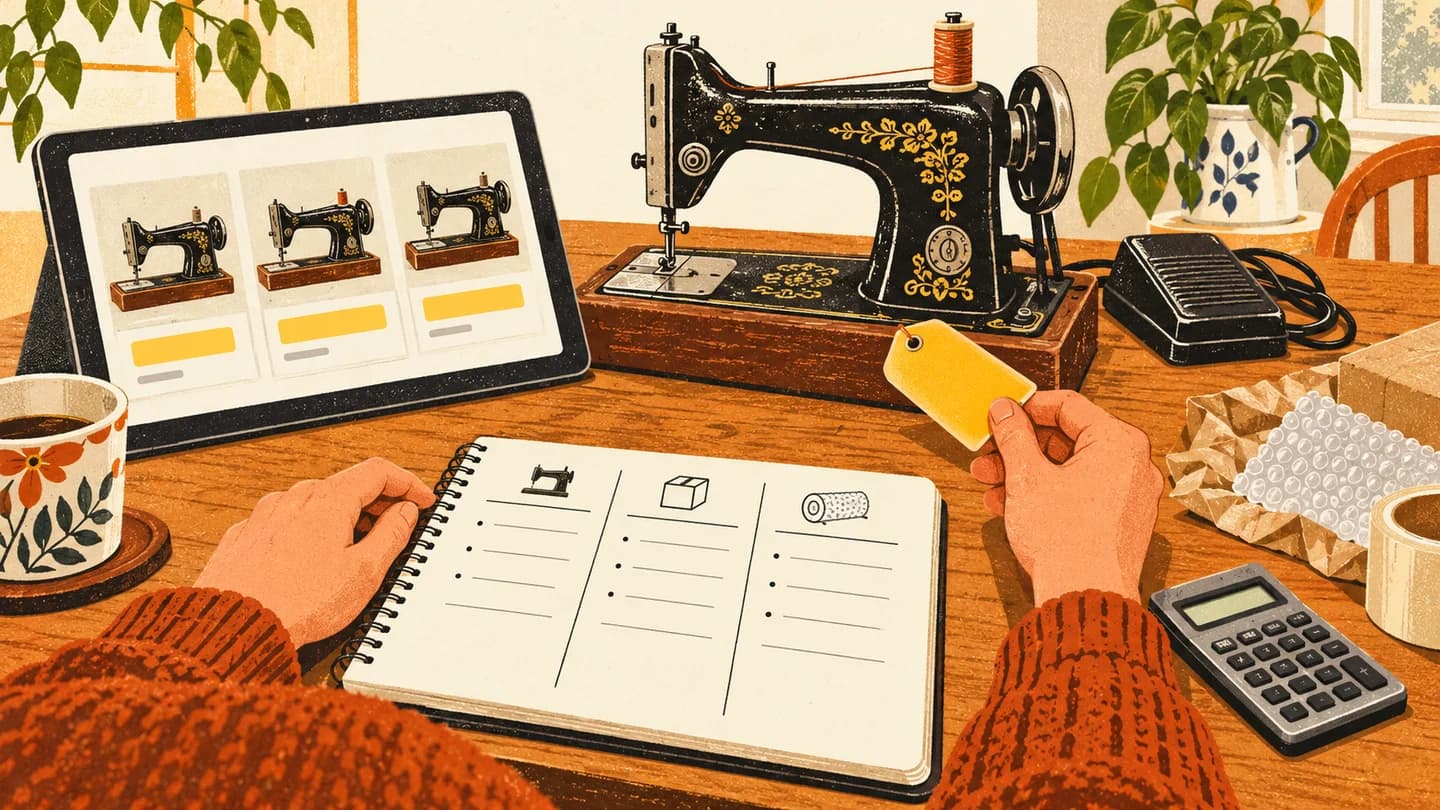
Answer the buyer’s practical questions in a short, accurate order.
Write the inspection the buyer cannot perform
A useful eBay description explains the actual object in front of you. It identifies the item, states its condition, describes what you checked and lists what the buyer will receive. It does not need to persuade someone that cameras take photographs or that a cardigan is a wonderful wardrobe addition. The reader needs the details that distinguish your example from every other one.
Good descriptions are often short, but writing them well requires careful inspection. If you cannot say whether a part is included or a function works, the solution is to investigate or state the limitation. Adding a longer sales paragraph does not fill that information gap.
Gather the evidence before drafting
Keep the item, accessories and your inspection notes together while you write.
- Verify the brand, model and important specification from the item and reliable documentation. Do not assume the packaging belongs to it.
- Inspect all accessible surfaces, including undersides, compartments, seams and connections. Record significant wear, damage, repairs and odours where relevant.
- Perform only tests you can do safely and competently. Write down the function, method and result rather than a single “tested” tick.
- Count the contents against what you intend to sell. Separate included accessories from props and equipment used for testing.
- Record useful measurements with units and explain how they were taken. Photograph details that a buyer would want to check.
- Choose the correct condition category and write a concise description that agrees with the title, photographs and item specifics.
Use four small sections
This structure works for many second-hand listings. Add a separate measurements section when fit or scale is important. You can save the headings as a template, but replace every item-specific detail.
Item
State the exact object and its important version or specification. Lead with anything that changes the offer, such as body only, an incomplete set or a known fault.
Condition
Describe observable wear and damage, including location and significance. Mention relevant repairs or alterations you know about without inventing a history.
Testing
Explain what was checked and what happened. Distinguish a successful test, a failed test and something you could not test.
Included
List the actual contents and name important exclusions. Be explicit about chargers, remotes, leads, instructions and other parts buyers commonly expect.
A sample description for a partly tested CD player
This invented example shows the level of detail to aim for. It is not a template for claiming that your own item passed these checks.
Item and contents
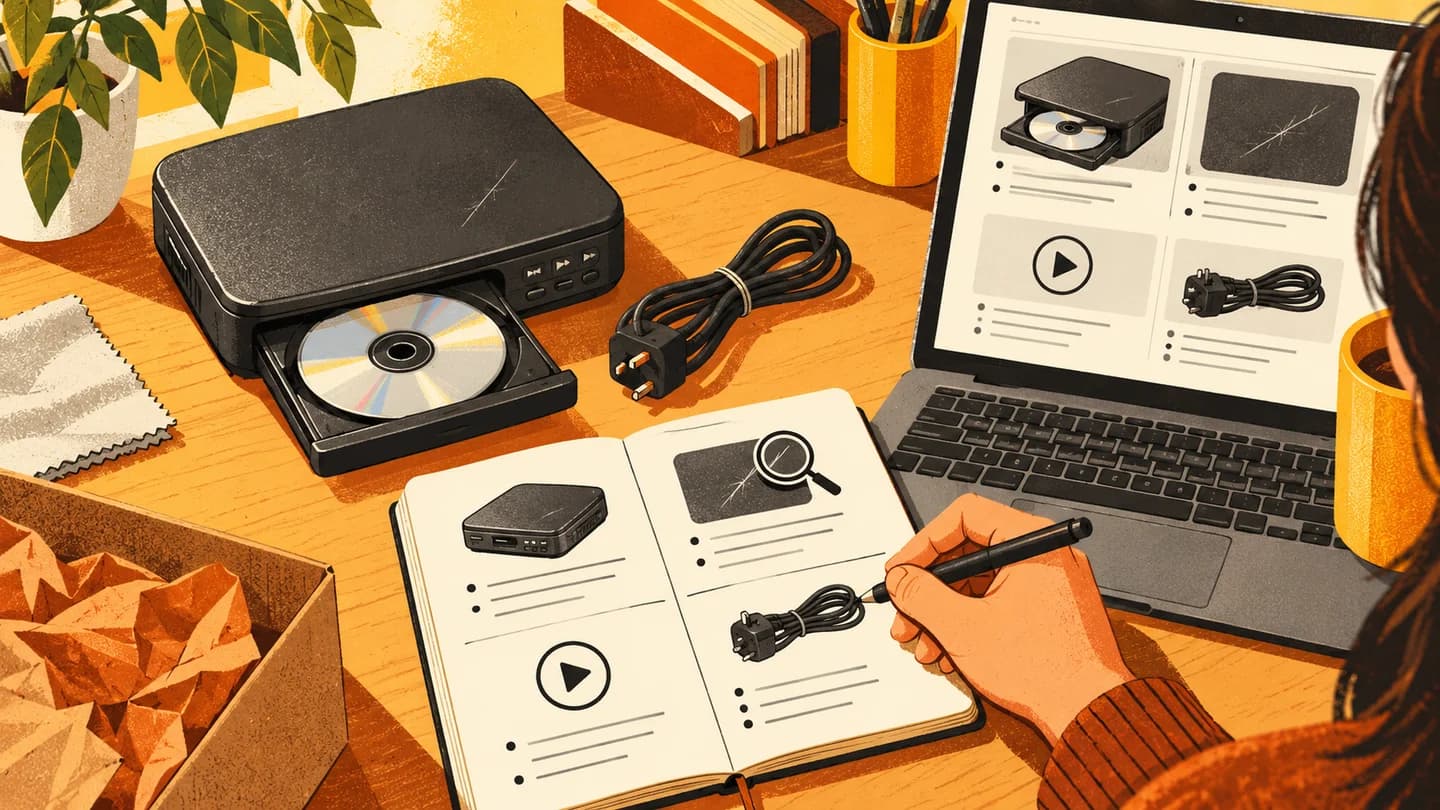
Used compact CD player, model AB-200, with its fitted mains lead. Player only: no remote control, speakers, audio leads or original box included.
Condition
Several scratches across the top panel and a small scuff on the front right corner, shown in the close-up photographs. The display is readable and the front buttons are present.
Checks performed
Played a commercially pressed audio CD for twenty minutes through both analogue outputs. Play, pause, stop and track-skip buttons responded during that check. The tray opened and closed repeatedly.
Not checked
Digital output and remote-control operation have not been tested because the necessary equipment was unavailable. No claim is made about those functions. This was a functional check, not an internal service.
Describe the scope of a test precisely
The example above is more useful than “fully working” because the buyer can see the boundary of the evidence. A device can power on while an input, drive or control remains faulty. If you tested only one function, say so. If an intermittent fault appeared, describe when it happened instead of mentioning only the successful attempt.
Keep a private test record with the date and item reference. That makes drafting easier and helps avoid mixing up two similar products. For anything requiring specialist safety assessment, a casual functional check is not a substitute. Do not claim certification, servicing or professional refurbishment unless you can substantiate exactly what was done.
Replace vague condition phrases with observations
Specific wording lets a buyer judge significance. The examples below illustrate the difference without requiring a lengthy condition report.
| Vague wording | More useful wording |
|---|---|
| Usual wear for its age | Light scratches on the lid and a rubbed patch on the rear edge, shown in the photographs |
| Seems fine | Powers on and the display lights up; other functions have not been tested |
| Small mark | A roughly 8 mm dark mark near the left cuff; close-up and wider photographs included |
| Complete set, I think | Includes the board, six player pieces and forty cards; instructions and two tokens are missing |
| Battery good | Ran for thirty minutes during my check; no full capacity or long-term battery test performed |
Measurements should be reproducible
Give units and a method where ambiguity is likely. For a garment, “52 cm pit to pit, laid flat without stretching” is more useful than “fits medium”. Keep the labelled size in the appropriate field and use measurements to add context, rather than silently replacing the manufacturer’s size with your own judgement.
For furniture, record height, width and depth, plus access dimensions when collection is involved. For a framed print, distinguish the frame’s outer size from the visible image area. A measurement photograph can help, but write the figure too. Buyers should not need to enlarge a ruler in a picture to find a basic dimension.
A clothing example can be short and still useful
Consider this invented description: “Blue wool-blend button-front cardigan, labelled size M. The care label states 80% wool and 20% nylon. Laid flat without stretching, approximately 52 cm pit to pit and 66 cm from the back neckline seam to the hem. Light pilling under the arms and an 8 mm dark mark near the left cuff, photographed. All five front buttons present. Cardigan only.”
That paragraph gives material evidence, labelled size, a measurement method, wear and contents. It does not promise a universal fit or describe an unverified fabric as pure wool. Adapt the amount of detail to the item: a rare garment with alterations may need more explanation than an ordinary cardigan, while a simple paperback may need much less.
Name exclusions that could change the purchase
Do not rely on “everything pictured” as the only contents statement. Photographs can include props, and small parts are easy to overlook.
- For electronics, specify whether the appropriate power supply, battery, remote and necessary connection leads are included.
- For cameras, distinguish a body, a lens and a kit. State which caps, batteries, chargers and accessories are actually supplied.
- For games, count the important components and explain any known missing pieces. “Boxed” does not mean complete.
- For furniture and tools, identify removable attachments or fittings that are absent, especially if they affect use or assembly.
- For books and media, describe missing inserts, discs, dust jackets or other material that a buyer may expect from that edition.
Use AI and catalogue details as drafts to check
A generated description may sound polished while inventing a material, specification, compatibility claim or test result. Give the tool a factual inspection note and ask for a concise rewrite without additions. Then compare every sentence with the item. Remove unsupported adjectives and any feature you cannot verify.
Catalogue information can explain a model’s original specification, but your example may be altered, incomplete or faulty. Confirm the exact version and distinguish original capability from current tested condition. If a stock paragraph says a remote is included but yours is missing, correct the description and the contents list before publishing.
“Sold as seen” does not repair an inaccurate listing
Keep the layout simple and readable
Use short paragraphs, clear headings and a small contents list where it helps. Important faults should appear near the relevant condition or testing information, not after a long block of promotional text. Avoid tiny type, decorative backgrounds and repeated all-capital warnings that make the practical details harder to find.
Keep dispatch and collection information consistent with the listing settings. If you reuse a template, inspect old model names, measurements and accessory lists particularly carefully. A sentence copied from yesterday’s item can create a stronger misunderstanding than an empty field because it looks like a deliberate statement.
Read it once as a buyer before publishing
Put yourself in the position of someone who has only the listing. Can you identify the exact item, understand its limitations and count what will arrive? Compare the description with the title, selected condition, specifics and photographs. Resolve disagreements instead of expecting the buyer to infer which version is correct.
If the same question keeps arriving from different buyers, add the missing factual answer to future descriptions and revise the current listing where permitted. Keep the language neutral and useful. A good description reduces uncertainty without pretending to know more than you do, which is far more persuasive than a paragraph full of enthusiasm.