Identify the release and grade the record and sleeve before assigning a resale value.
Buy a record you can identify, assess and sell
A crate of records can contain a worthwhile find, a collection of enjoyable but common albums, or damaged stock that will cost more time than it returns. The difference is rarely visible from the artist’s name alone. Your buying decision needs three things: the particular edition, the condition of that copy and evidence that somebody wants it.
Start with a small number of records in a musical area you understand. You will learn more from identifying, checking and selling five carefully chosen copies than from bringing home fifty because they were cheap. Keep enough of your budget for proper packaging and a few mistakes while you develop your eye.
Take a simple buying kit
You do not need a portable record shop, but a few practical tools make inspection easier.
- A phone for research and photographs, with permission where appropriate.
- A small light to reveal marks without touching the playing surface.
- A sturdy carrier that supports the records upright.
- A note of the categories and maximum spend you planned.
- Space at home to inspect, store and prepare what you buy.
Check that the record belongs in the sleeve
Look inside before researching the cover. Confirm the artist, title, number of discs and side labels. A familiar sleeve can contain a different album, an incomplete double set or a later replacement copy. The sleeve and disc may also come from different editions.
Keep the contents together while inspecting and return them carefully. For a set, count every disc and check both sides. An attractive cover is not evidence of completeness, and a missing second record changes both the likely buyer and the sensible price.
Identify enough detail to make the price search useful
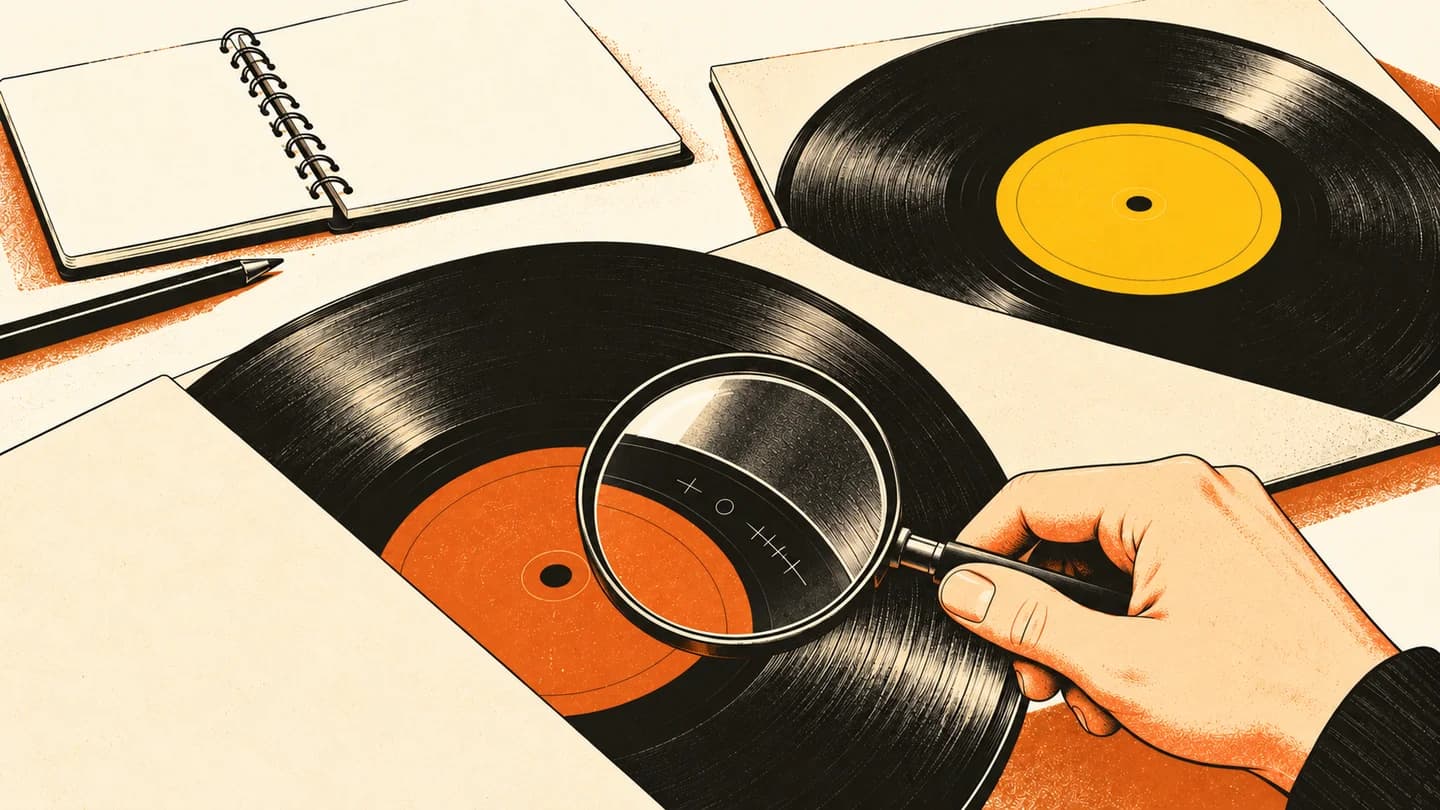
Write down the label and catalogue number as well as the artist and title. Compare the record with the relevant release entry, including format, country information, sleeve details and identifiers where needed. The etched or stamped information near the centre can help distinguish similar-looking versions.
You do not have to become a pressing expert on your first trip. You do need to recognise when the price depends on a distinction you have not resolved. If the only profitable outcome assumes a scarce edition, finish that identification before paying. An ordinary reissue should not inherit the price of an early collectable copy.
Inspect the copy before negotiating
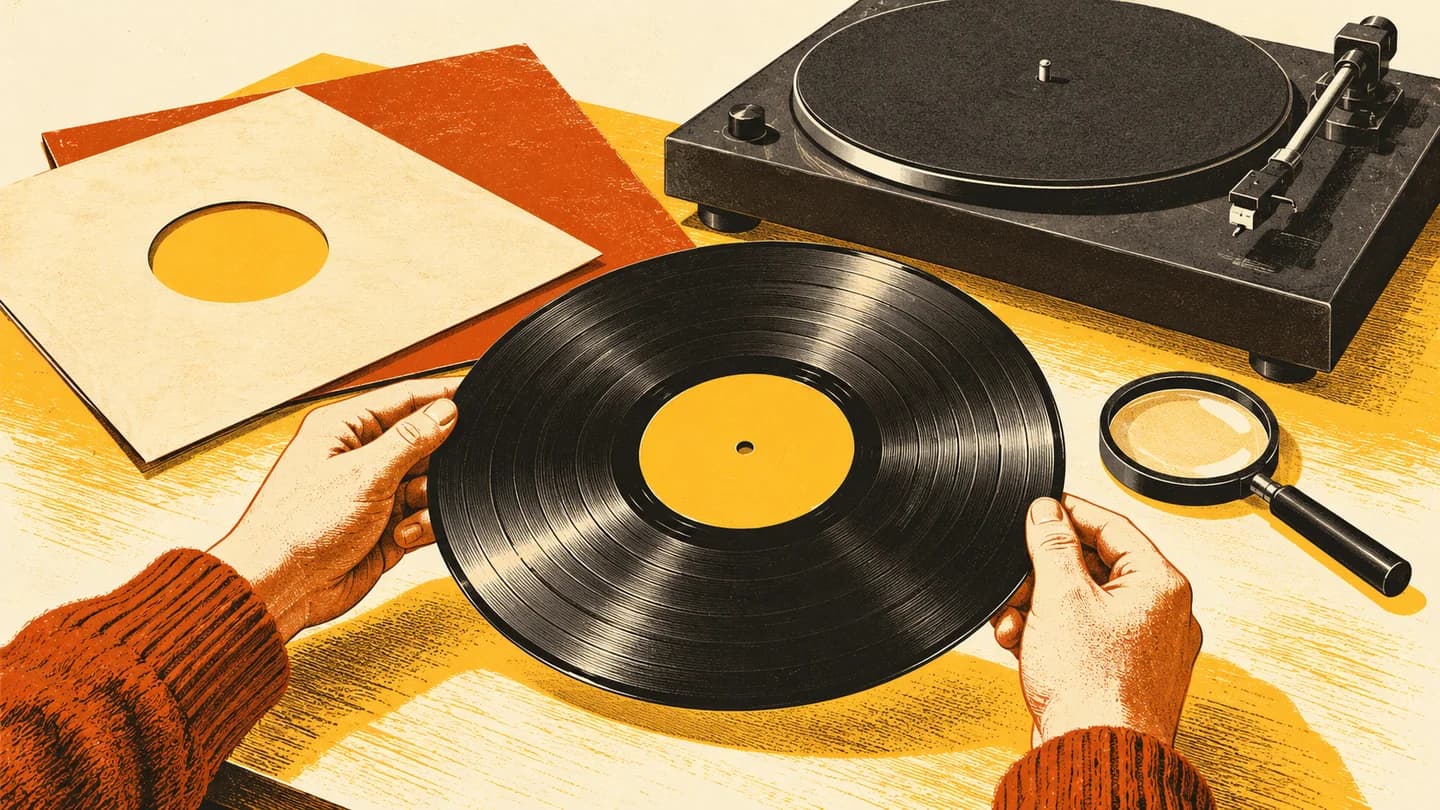
Handle the record by the edges and label area, keeping fingers away from the grooves.
- View both sides under useful light, gently changing the angle.
- Look for scratches, embedded dirt, cracks and visible distortion.
- Inspect the label for writing, damage or signs that need investigation.
- Check the sleeve seams, spine, corners and signs of damp.
- Look for expected inner sleeves, inserts or posters.
- Record anything you cannot assess, including playback.
Separate visual inspection from listening
A shiny surface is encouraging, but it does not prove quiet playback. Conversely, a superficial mark may look worse than it sounds. When you can test a record on suitable, maintained equipment, listen closely enough to understand the condition you intend to describe.
If you only sampled a passage, say so. Do not advertise a record as fully play-tested after hearing the introduction. For an untested purchase, allow for the uncertainty in your buying limit rather than assuming cleaning will cure every problem. Damage and groove wear are not simply dirt waiting to be removed.
Read the grading scale before using its labels
Research sales, not the most exciting asking price
Open comparable sold examples and check the edition and condition. Discogs sales history can help, but its headline figures summarise a limited set of recent transactions. They do not automatically describe your copy. A high sale for an exceptional example is not a sensible forecast for a worn one.
Look at how recently relevant copies sold and whether the market has several competing listings. Sparse evidence calls for a cautious estimate. Save a few useful comparisons with the identification notes so your buying decision can be explained later, rather than remembered as “I saw one for quite a lot”.
Turn the estimate into a maximum purchase price
This is an invented example, not a valuation of a particular record or a statement of current fees. Use the charges and delivery costs that apply to your selling route.
| Line | Amount |
|---|---|
| Expected sale proceeds | £28 |
| Selling charges, mailer and delivery | −£8 |
| Preparation materials | −£1 |
| Desired contribution before tax and time | −£9 |
| Allowance for uncertain condition | −£3 |
| Maximum buying price | £7 |
Make the calculation survive a weaker sale
In the example, paying £12 because the seller will not accept £7 removes £5 from the planned return. It does not make the original estimate more reliable. Repeat the calculation with a lower plausible sale price and decide whether the downside still fits your budget.
Include any collection or travel cost that the purchase actually creates. If you were going to the sale anyway, avoid inventing a separate journey for each record; if you drive across town specifically for one album, that trip belongs in the decision. Consistent records matter more than a complicated spreadsheet.
Treat a job lot as a sorting project
A mixed collection is not worth the sum of the highest online prices for its best-known sleeves. Divide it into records with identifiable individual demand, lower-value copies that may suit a coherent bundle, and damaged or unwanted material. Cost the time to inspect all three groups.
For a first purchase, avoid a lot whose economics depend on selling every record individually. Ask what you would recover if only the strongest copies sold within your intended period. Include storage and the effort of moving the rest. A larger stack is not automatically a better buying opportunity.
Prepare a listing a record buyer can trust
Photograph your actual copy in clear light. Keep reflections from hiding the surface or sleeve wear.
- Give the verified artist, title, format and release details.
- Show front and back covers, labels and important identifiers.
- Describe disc condition separately from sleeve condition.
- List missing or included inserts and any replacement sleeve.
- Explain the extent of playback testing.
- Show significant defects rather than making buyers infer them from a grade.
Protect the value after you have bought it
Store records upright with support, away from heat, damp and direct sunlight. Keep food and drinks away from the sorting area. Use a suitable protective sleeve and retain original printed material even if you add a fresh inner for everyday protection.
For dispatch, use a rigid record mailer and appropriate protection against movement and corner damage. For an opened LP, consider a packing arrangement that keeps the sleeved disc from splitting the outer jacket in transit. Do not open a genuinely sealed item just to follow a routine intended for used copies. Weigh and measure the finished parcel before selecting the service.
Build knowledge from completed sales
Record what you paid, the exact edition, preparation time, final proceeds and any issue raised by the buyer. A small run of completed transactions will show which categories you identify well and which absorb too much effort.
Use that evidence on the next trip. You might discover that modest, clean copies in a familiar genre are more dependable for you than obscure records requiring hours of investigation. The aim is a repeatable process that pays for your work, with enough care that the next collector receives the copy they expected.