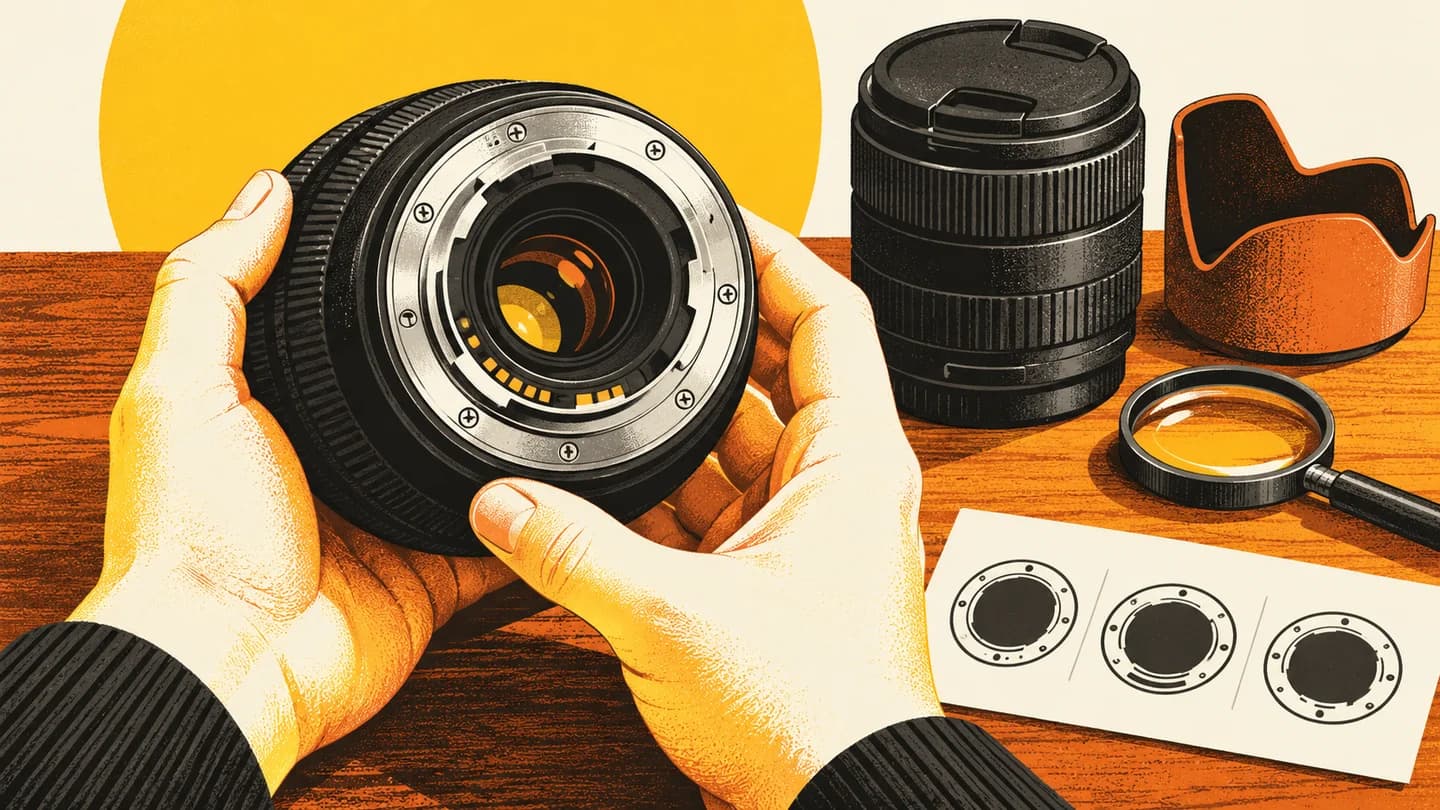
Read the full lens markings and confirm the mount before searching prices.
Read the whole lens name before searching a price
A lens described only as “a Canon zoom” or “a Sony 50 mm” is not identified well enough for a dependable resale calculation. Mount, aperture, generation and features can distinguish products with very different compatibility and value. Start with the lettering and the physical item, not the seller’s abbreviated title.
This guide helps you build an exact identity record and carry it into price research. It is particularly useful for mixed camera bags, third-party lenses and similar-looking versions. Identification comes before valuation: a perfectly researched price for the wrong lens is still the wrong price.
Photograph the identifying details
Use clear views so you can check the information later without repeatedly handling the glass.
- Full wording on the front ring and lens barrel.
- Focal length or zoom range and maximum aperture.
- Maker, product series and generation markings.
- Mount area and any native-mount label.
- Switch labels and relevant feature markings.
- Model code and serial information for your private record.
- Included hood, caps, collar, adapter or other accessories.
Separate focal length from aperture and filter size
Several numbers can appear close together. Focal length describes the lens’s optical specification, while the maximum aperture describes a different characteristic. A filter diameter is another measurement again. Copy the markings accurately before deciding which number belongs in the search.
For example, two zooms may cover a similar focal-length range but have different maximum apertures, construction or generations. Do not shorten both to the same broad description and average their prices. Use manufacturer information to understand the actual notation, particularly where a variable maximum aperture is shown across a zoom range.
Find the native mount
The mount is the lens’s connection standard to the camera body. A brand name does not establish universal compatibility within that brand. Sony, for example, distinguishes A-mount and E-mount, and its compatibility guidance treats the camera, lens and any adapter as a specific combination.
Look at the lens itself rather than assuming the camera beside it tells the whole story. An adapter may be attached. Identify that separately and record the native lens mount beneath the arrangement without forcing unfamiliar parts. If you cannot determine it confidently, seek a reliable reference or competent assistance before buying.
Resolve a third-party lens carefully
The same product family may be offered for different camera systems.
- Copy the complete maker and model wording.
- Find the exact product code or mount information where provided.
- Compare official specifications and images for that version.
- Check the rear connection and any fitted adapter.
- Confirm that the reference describes your actual example.
- Only then search prices for the matching mount and condition.
Do not treat an adapter as a universal promise
An adapter can allow some combinations, but it does not automatically preserve every function. Physical fit, autofocus, aperture control and other behaviour depend on the specific equipment. Check the manufacturer’s compatibility information and describe only what you can support.
If you tested a lens on one adapted body, record that setup rather than claiming it works perfectly on all cameras of the same brand. The adapter itself may also have value or limitations. Decide whether it is included in the sale and compare prices on the same basis.
Distinguish mount from sensor coverage
A lens’s mounting standard and the image area it is designed to cover are related but separate facts. For instance, Sony’s E-mount range includes lenses described for APS-C and full-frame use, with different consequences for particular camera combinations. Read the exact compatibility guidance.
Do not value a smaller-format lens as though it were a different full-frame model because the focal-length numbers match. Likewise, avoid turning a crop-mode result into a claim that the physical lens has changed focal length. A resale listing needs the verified product identity and appropriate compatibility information, not an improvised explanation.
Keep each identity detail in its own field
This record helps prevent a search from quietly changing to a more valuable version.
| Field | What to capture |
|---|---|
| Maker and full name | Exact wording, including series and suffixes |
| Focal length | Single value or zoom range |
| Maximum aperture | Full marking, including a variable range where shown |
| Native mount | The lens standard, separate from an adapter |
| Generation | Version or revision supported by markings |
| Features | Verified stabilisation, focus or other specification |
| Contents | Caps, hood, collar, case and adapter actually included |
Check versions rather than relying on appearance
A later generation can retain a similar shape and focal-length range while changing features or demand. Look for version markings, product codes and documented design differences. A hood or cap can be swapped, so a part carrying a familiar name is not enough to identify the lens underneath it.
Keep a possible identification as a hypothesis until the important details agree. If a reference image has a different switch layout or mount, investigate the discrepancy. Do not ignore the mismatch because the higher-priced model makes the purchase more attractive.
Add condition after identity
Once you know what the lens is, inspect its actual condition. Check the exterior, mount, accessible glass and controls without disassembly or aggressive cleaning. Record scratches, visible haze, damage, missing parts and anything you cannot assess.
Use a compatible known-good camera to test relevant functions where possible. Take and review sample images, trying the controls the model supports. A quick view cannot establish every optical or mechanical issue, so describe the tests and limits. An exact model name does not justify comparing an untested example with a professionally assessed one.
Uncertainty belongs in the price, not just a footnote
Research genuinely comparable sales
Keep the identity worksheet beside the results.
- Search the full model, generation and mount.
- Open completed examples and check the actual contents.
- Separate working, faulty, untested and repaired condition.
- Exclude different versions, bundles and dealer-service packages where they distort the comparison.
- Consider delivery on a consistent basis.
- Record a cautious range and the relevant evidence.
Convert a lens valuation into a buying limit
These figures are invented to demonstrate the method and are not current lens prices or charges.
| Line | Amount |
|---|---|
| Cautious expected proceeds | £180 |
| Selling, packing and delivery | −£25 |
| Necessary preparation or missing parts | −£15 |
| Desired contribution before tax and time | −£35 |
| Allowance for uncertainty | −£20 |
| Maximum purchase | £85 |
Cost the accessories on their actual contribution
A missing hood or tripod collar can matter, but do not automatically buy every original accessory before selling. Check the correct part, its cost and whether the likely increase in proceeds justifies it. Some parts are useful for protection or operation; others mainly affect completeness.
For a direct-buyer quote, confirm the expected contents and effect of omissions. For a marketplace sale, describe the package accurately. A £30 replacement that adds only £10 to the outcome reduces the result, even if it makes the listing photograph look more complete.
Write the listing so the next buyer can identify it too
Use the full verified name and native mount in the title or core details. Show the markings, controls, rear connection and included accessories, along with condition photographs. Keep any tested adapter combination and functional limitations clear.
Save your identification notes with the stock record. The next time you encounter a similar lens, they provide a starting point rather than permission to skip the checks. A reliable lens reseller learns to notice the small differences that determine compatibility, condition and the price a buyer can reasonably justify.