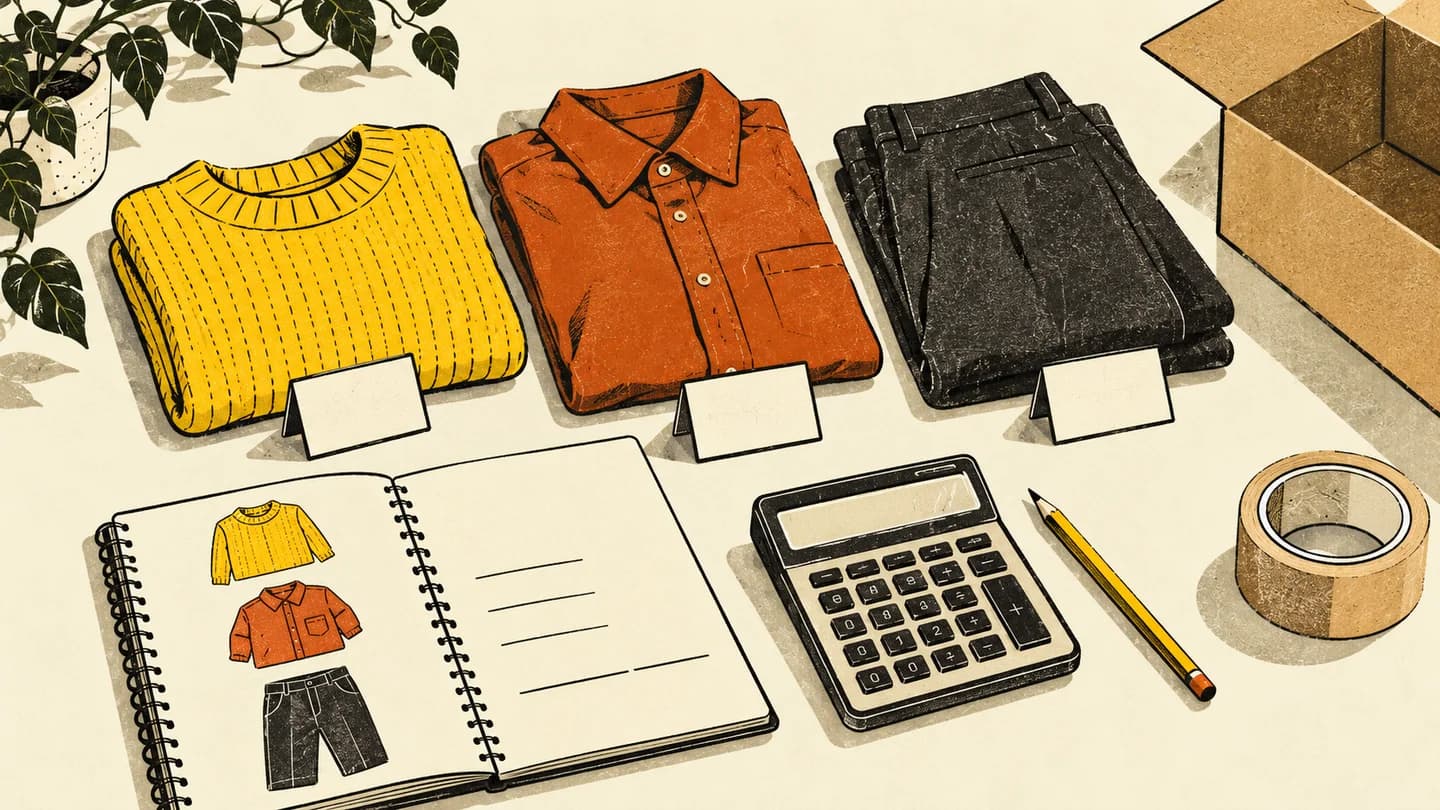
Decide the lowest worthwhile return before discounting individual garments or bundles.
Choose your limits before an offer arrives
Vinted pricing is easier when you separate the amount you ask from the amount you are willing to accept. Without that distinction, every offer can feel like a fresh argument about the garment’s value. A clear floor lets you decide calmly and consistently.
The floor should reflect your purpose. Clearing space from your own wardrobe may justify a lower amount than buying clothing to resell as a business. Neither purpose makes the original retail price a promise of resale value. Start with realistic demand, then consider your costs, effort and available alternatives.
Set your selling prices and buying limit
Keep them in your own notes so you do not need to calculate under pressure.
- A realistic expected sale based on relevant evidence and competition.
- An asking price that presents the garment credibly and allows any negotiation you intend.
- A minimum acceptable outcome after considering costs and your objective.
- For purchased stock, a buying limit that leaves a worthwhile contribution at the expected sale.
Avoid an asking price built only for discounting
Adding a large amount purely so you can appear generous later may make the listing uncompetitive from the start. Buyers can compare similar items and total checkout costs. A realistic asking price with room for a sensible offer is different from an inflated anchor with no market support.
Search the exact garment where possible and then close substitutes. Compare condition, material, measurements and included components. Active prices are asking prices, so use them as competition evidence rather than guaranteed outcomes. Where reliable achieved-price information is limited, build a cautious range and review your own results.
Calculate the floor on purchased stock
This is an invented example of a pricing decision, not a current Vinted fee calculation. The desired contribution is what you want left before tax and your own time.
| Component | Amount |
|---|---|
| Purchase cost | £5 |
| Cleaning and repair | £2 |
| Packaging | £1 |
| Other relevant selling costs assumed | £1 |
| Desired contribution | £6 |
| Minimum proceeds under these assumptions | £15 |
A cost-based floor still needs a willing buyer
If comparable garments are realistically selling around £10, the £15 floor above does not make this item worth £15. It reveals that the purchase and cost structure may not work. You can change the route, reduce avoidable costs or accept a lower result, but you cannot make demand obey your spreadsheet.
For clothing you already own, distinguish historical spending from costs needed to complete the sale now. A coat bought years ago for £150 may still be sensible to sell for £20 if that is the realistic market and you no longer want it. Record the outcome honestly without treating the entire original purchase as a fresh expense caused by the listing.
Respond to offers with the whole transaction in mind
Check which item or bundle the offer covers and whether any discount is already included. Compare the proposed proceeds with your floor and current alternatives. A lower offer might be reasonable for a slow-moving garment, but a quick acceptance is not compulsory simply because someone has asked.
Use the platform’s supported offer controls. Keep replies concise and factual. If the amount does not work, decline or counter at a price you can accept. There is little value in a long argument about what you once paid. Equally, do not claim another buyer is waiting unless that is true.
An agreed amount is not payment
Calculate bundles as a whole
A bundle can reduce repeated handling and spread delivery costs across several garments. Check your account type before planning a discount: Vinted Pro sellers can offer bundles but cannot set bundle discounts. Standard-account bundle settings do not describe the tools available to a Pro business.
Suppose three garments are individually priced at £18, £12 and £10: £40 in total. For a Pro seller, combined purchase and preparation costs of £18 plus £2 packaging would leave £20 before other costs, tax and time. These invented figures illustrate the calculation; they do not establish an achievable selling price.
For a personal clear-out using an eligible standard-account discount, 20% off the same £40 total would reduce item proceeds to £32. You give up £8 in exchange for moving several items together. Decide whether that suits your clearance objective and current alternatives; do not transfer that setting into a Pro stock-buying plan.
Check which items belong together
A group of compatible sizes or a coherent set may be useful to a buyer. A bundle of unrelated garments is not automatically attractive because it contains more pieces. Make the contents clear and ensure each item’s condition remains visible. Do not let a bundle description hide the flaw that would matter in an individual listing.
For a personal clear-out, review any available automatic bundle discount against the items you are selling. A percentage that suits ordinary basics may give away more than you intended on a valuable coat. Calculate a few likely combinations before enabling it. If you sell professionally, use the supported Pro arrangements and price each garment realistically from the start.
Include the combined parcel in the decision
The saving in listing effort does not remove the fulfilment work.
- Weigh and measure the bundle with its actual protective packaging.
- Check the shipping arrangement and limits shown for the order.
- Keep every garment identifiable until the contents check is complete.
- Make sure the package protects clean, dry clothes during ordinary handling.
- Resolve an unsuitable size or service through the platform before dispatch.
- Record one combined sale against the correct individual stock items.
Treat optional promotion as a costed experiment
Paying for visibility may increase attention, but attention alone does not establish additional profit. Record what you paid, the listing condition before promotion and what happened afterward. Do not automatically repeat a paid option because the item received more views.
For a low-value garment, even a small promotional cost can consume a large share of the contribution. First check whether the price, photographs, measurements and condition description give a buyer enough information. More people seeing an unclear or overpriced listing may not solve the problem you actually have.
Review pricing on a schedule
Use a date or stock-age threshold that fits your business rather than reacting to every notification.
- Look at genuine offers and relevant new comparisons.
- Check whether recurring questions reveal missing information.
- Recalculate the result at a lower price before accepting it.
- Consider a suitable bundle or another sales route where allowed.
- Choose a revised price and record why you changed it.
- Review the completed outcome so the next buying limit improves.
Separate a deliberate clearance from repeated bad buying
Sometimes clearing a garment for a small return is the right decision. It releases space and cash and ends further work. The problem is treating that outcome as evidence that the original purchase was profitable when it was not. Keep the loss or weak result visible in your records.
If you regularly need discounts below your intended floor, investigate the source: optimistic comparisons, overlooked condition, expensive preparation or buying too much of a slow category. Better buying decisions usually give you more room than increasingly determined negotiation. Your goal is a worthwhile completed result, not winning every conversation about price.