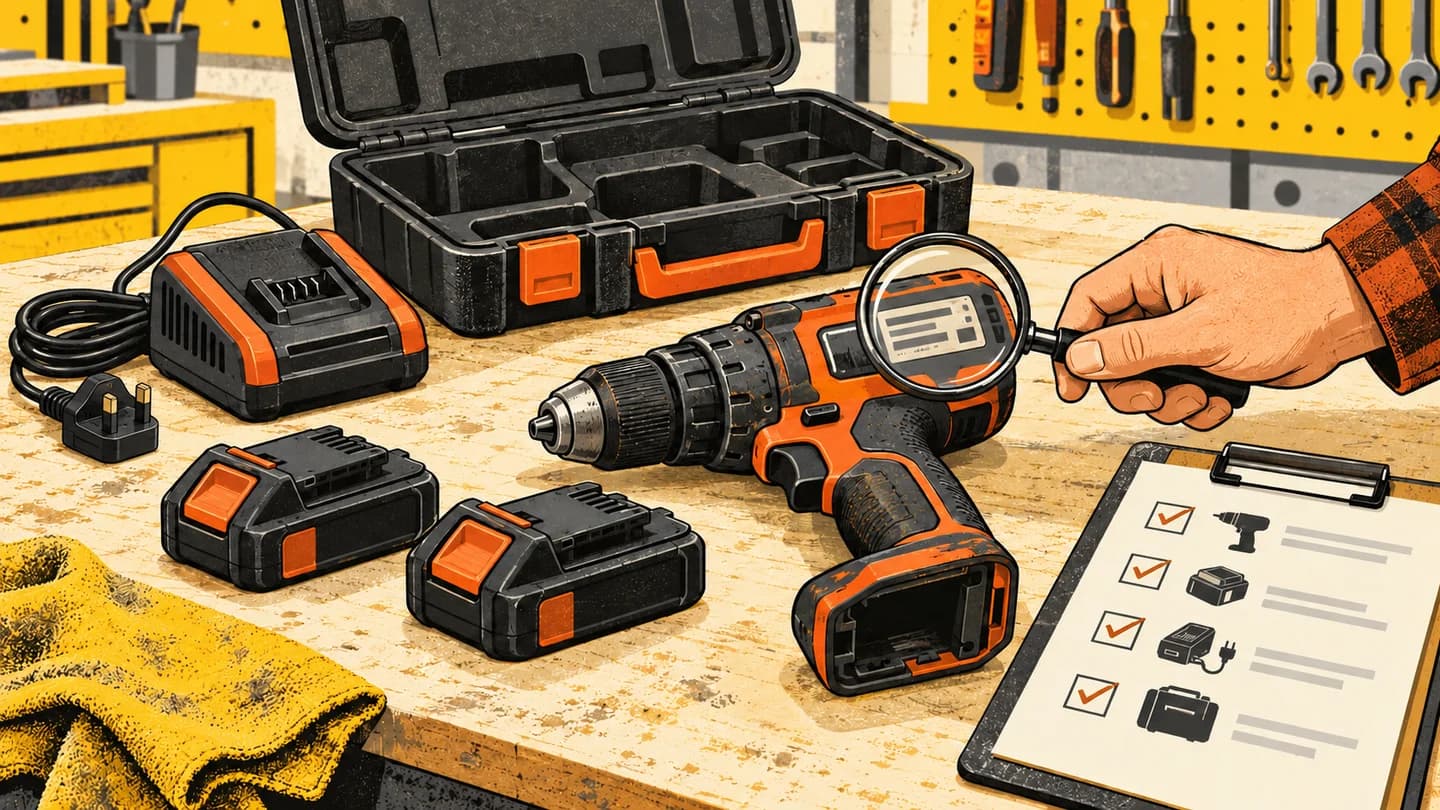
Check safety, model compatibility and the complete usable package before buying a power tool for resale.
Value the complete usable package
A £25 cordless drill can look like a bargain beside a £100 used kit, until you discover that the battery is worn out, the charger is missing and the comparison includes two good batteries. Second-hand power tools need to be valued as an exact package: tool, compatible power supply, necessary safety parts, accessories and verified condition.
Start with models you understand and can have assessed properly. A quick demonstration may show that a motor turns, but it does not establish electrical safety, performance under load, battery capacity or the condition of mechanical protection. If the purchase only makes sense when every unknown turns out well, the buying price leaves too little room for the real work.
Identify everything before discussing the price
Take clear photographs and ask about ownership, use and repairs. A plausible history helps your research, but it does not replace inspection.
- Record the tool’s exact model, variant, voltage and serial number where present. Keep a private purchase record identifying the seller and what was bought.
- Identify each battery and charger separately. Record model codes and rated capacity rather than treating the brand colour as proof of compatibility.
- List the accessories actually included: guards, handles, keys, fences, dust fittings, case and any attachments relevant to that model.
- Find the manufacturer’s instructions and parts information. Compare the item with what should be present before attempting a demonstration.
- Check official product-safety notices and manufacturer recall information against the model and any affected serial or batch range. An unclear identity is a reason to investigate further.
Bare tool, kit or project: compare the right sale
The headline selling price is only useful when the contents and condition match. Do not compare the cheapest possible purchase with the best-equipped advertised kit.
| Package | What to establish |
|---|---|
| Bare cordless tool | Whether the buyer receives only the tool body, and whether all essential handles and guards are present. |
| Tool with battery | Exact battery model, compatibility and what is known about its condition and runtime. |
| Complete kit | The tool, each battery, the correct charger, necessary accessories and their individual condition. |
| Corded tool | Correct supply requirements, lead and plug condition, safety features and appropriate assessment. |
| Faulty or incomplete item | A suitable lawful route and accurate fault description; do not borrow a working example’s price. |
Make the first inspection with the power disconnected
Remove the battery or disconnect the mains supply as the instructions require before a visual inspection. Do not open electrical housings or remove safety features to investigate a bargain.
- Look for cracked casings, missing fasteners, damaged handles and evidence of improvised repairs.
- Inspect visible leads, plugs, charger housings and connectors for damage, overheating or exposed conductors.
- Check that the correct guards and other protective parts are present. A missing guard is not an optional cosmetic fault.
- Look for corrosion, liquid damage, heavy contamination or unusual wear around vents and moving assemblies.
- Inspect batteries for cracks, swelling, leakage, heat damage or altered casings. Do not charge or test a damaged pack.
- Record missing identity labels and suspiciously altered serial markings. If legitimate ownership or product identity cannot be resolved, leave the purchase.
Battery compatibility is more specific than voltage
Two packs labelled with the same voltage may belong to different systems or use different connections and controls. Check the manufacturer’s compatibility information for the exact tool, battery and charger. Physical fit, a similar connector or an online seller’s broad claim is not enough. Do not force a pack into place or improvise an adaptor to make a demonstration possible.
Some manufacturers provide explicitly supported adapters for particular combinations, so a blanket rule that all systems are entirely separate can also mislead. For example, a specified charger may support another battery range only with the manufacturer’s named adapter. Verify the complete arrangement in current product documentation and include the adapter cost, rather than assuming a charger in the box solves every compatibility question.
A charge indicator does not establish battery health
A pack showing full charge tells you little about how much useful work it can still deliver. Its runtime and behaviour under appropriate use matter, and those checks depend on the tool, task and conditions. Treat an unknown-history battery conservatively when calculating the purchase ceiling. Do not price it as a healthy replacement pack simply because the tool runs briefly.
Where a competent assessment is possible, keep a record of the battery used, the activity, duration and result. Avoid turning an informal trial into a precise percentage-of-original-capacity claim. If you cannot establish useful performance, make that uncertainty explicit in your budget and description. For damaged or suspect packs, use the manufacturer’s service or appropriate recycling guidance instead of trying to revive or rebuild cells.
A PAT sticker is not a complete power-tool inspection
Arrange a demonstration that answers a useful question
Only operate a tool after the relevant safety checks, in an appropriate setting, following its instructions and with someone competent to use it. A crowded stall is not a suitable place to improvise a cutting test. If a safe, meaningful demonstration is unavailable, treat the purchase as unverified or agree an appropriate assessment arrangement before committing.
For a drill, the useful questions can include the chuck, controls, operating modes and behaviour during suitable work. For a saw or grinder, guarding, mechanical condition and the correct accessory are essential as well as motor operation. Stop if the tool behaves abnormally. A seller saying that noise, heat or vibration is “normal for these” is a claim to check, not a substitute for diagnosis.
Costs that commonly disappear from the first calculation
Write these down before making an offer. An attractive bare-tool price can become an expensive usable kit.
Power system
A sound compatible battery, the correct charger and any explicitly supported adapter. Check genuine replacement availability for older systems.
Missing hardware
Model-specific guards, handles, keys, fences or dust fittings. Generic parts may not be suitable substitutes.
Assessment and repair
Electrical and mechanical checks, necessary service work, parts and labour. Obtain a quote instead of assuming a fault is a cheap switch or brush.
Selling and fulfilment
Platform charges, preparation, packaging, battery transport requirements and realistic provision for returns or an unresolved fault.
Work through the deal with actual replacement costs
Suppose comparable, properly assessed complete kits could sell for £120. For an illustrative calculation, allow £14 for applicable selling costs, £10 for packing and delivery not recovered from the buyer, £20 for assessment and £30 for your time and margin. That leaves £46 for buying the kit, assuming it needs no additional work. These are example allowances, not current service or platform quotations.
Now suppose the offered kit needs a compatible replacement battery costing £45. The same calculation leaves just £1 for the purchase, before any further repair. The £25 asking price no longer works. You might instead research a safe, correctly described bare-tool sale, but that route has its own selling price and costs. Removing the battery from the comparison does not preserve the full-kit valuation.
Resale responsibility is part of the buying decision
Business sellers of second-hand electrical goods in Great Britain must meet applicable safety requirements. Equipment supplied for use at work also carries duties concerning safety and information. An “untested” or “sold as seen” label is not a general escape from those responsibilities. Requirements can differ by location and transaction, so check current guidance for where and how you sell.
If safety is uncertain, use a competent person and keep a report tied to the specific item. Address recalls through the appropriate manufacturer process before considering resale. A tool that cannot be made safe may need an authorised recycling route. Do not assume that offering it cheaply for parts automatically makes every kind of supply acceptable.
Write a listing that separates evidence from assumptions
The buyer should understand both the package and the scope of your checks.
- Name the exact tool model and state whether it is bare or supplied as a kit. List every battery, charger and essential accessory.
- Photograph labels, connectors, guards, wear and damage clearly. Keep purchase and service records associated with the item.
- Describe the work and assessment completed, including relevant dates and results. Do not claim “fully tested” when only a brief power-on check occurred.
- State battery condition and runtime evidence honestly. Distinguish a demonstrated result from an estimate or an unknown.
- Provide appropriate instructions and disclose repairs or replacement parts. Check that the final package matches the description before dispatch.
Plan battery transport before advertising postage
Lithium-ion batteries have transport requirements that depend on factors including condition, energy rating and whether they travel alone, with equipment or inside it. Check the selected carrier’s current rules for your exact parcel and destination. An ordinary postage label does not establish that a battery shipment is accepted.
Follow the applicable packing requirements, prevent accidental activation and protect terminals from short circuits. Damaged or defective batteries need an appropriate specialist route; do not put them into an ordinary parcel because they came with the tool. For collection, still provide a safe package and clear information. Collection changes the delivery method, not the condition you are responsible for describing.
A worthwhile tool deal has few expensive unknowns
Look for identifiable equipment with legitimate provenance, complete safety parts and a realistic assessment route. Price the package that can actually be sold after necessary work. That approach will rule out some tempting cheap tools, while making the sound purchases easier to describe, easier to fulfil and more likely to leave a real margin.