Use surface and production clues to guide further checks, without treating one visual sign as proof.
An original print is still an original work of art
The useful distinction is not simply painting versus print. An artist can create a work through printmaking, producing multiple impressions as part of the intended artwork. A reproduction copies an existing image, while a painting or drawing may be a unique work made directly on its support. Digital processes add further possibilities.
For a second-hand buyer, the task is to identify what this physical object is, not to rank every medium in advance. A collectible print can be more valuable than an unknown painting. A decorative reproduction can also have a market, provided it is described accurately. The process, attribution, edition, condition and demand all matter.
Keep these categories separate
These descriptions are a starting framework. An unfamiliar object may need specialist assessment before you can assign it confidently.
Painting or drawing
An image made directly with paint or drawing material on a support such as paper, canvas or board. That alone does not authenticate a named artist.
Original artist’s print
A work conceived through a printmaking process. Multiple impressions may be legitimate examples of the artwork rather than copies of a separate painting.
Reproduction
An image reproducing another work, such as a commercial print of a painting. Paper quality, a frame or added numbering does not change that relationship.
Mixed or digital work
A work may combine printing with hand-applied elements or originate digitally. Describe the supported process and edition context rather than forcing it into a misleading category.
Begin with a non-invasive examination
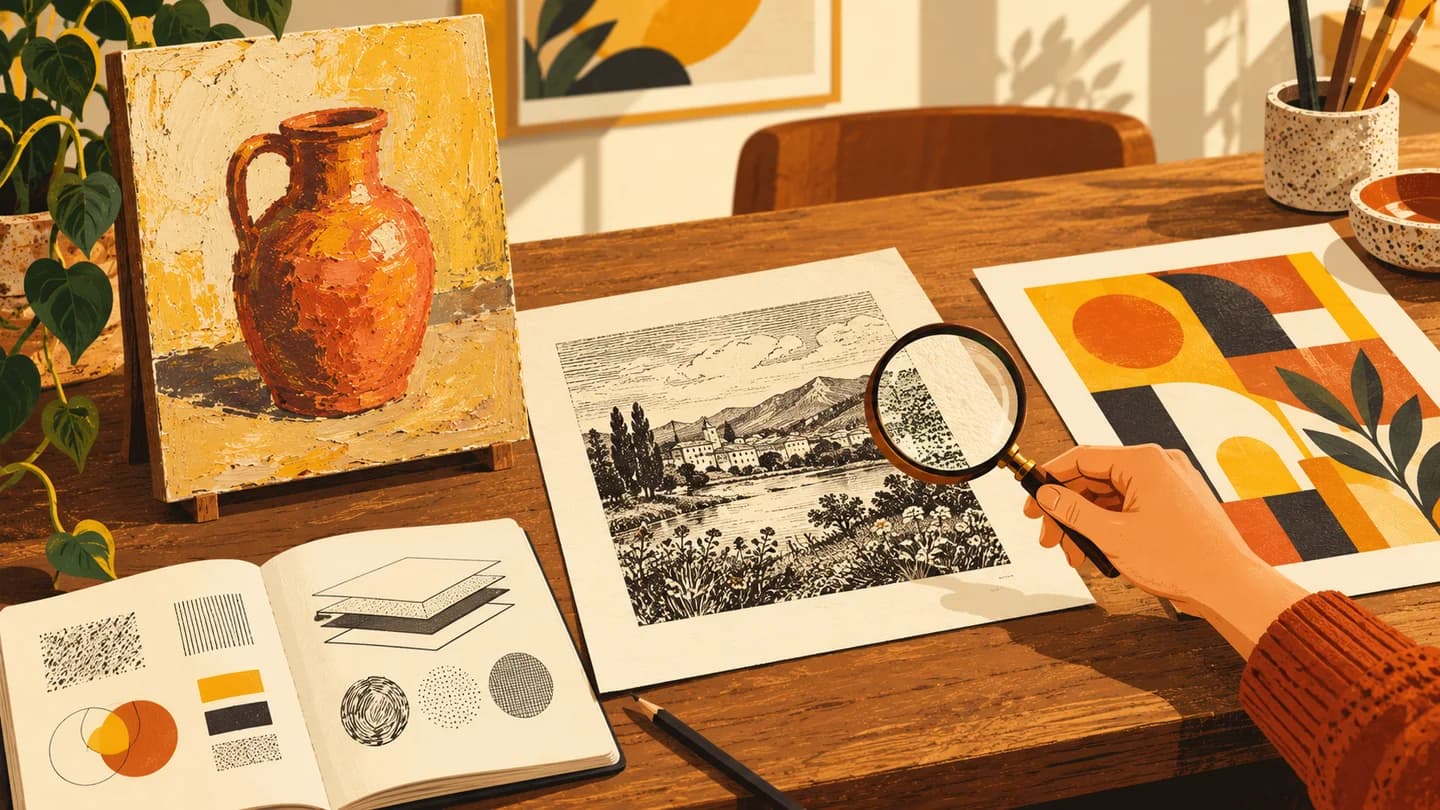
Use good light and a magnifier without touching the image. Do not scrape, wet or rub a surface to test it.
- Photograph the entire front and any accessible back. Record the frame, mount and visible support.
- Look from a slight angle for surface features. Notice whether raised marks correspond to individual painted forms or appear uniformly across the image.
- Examine several different areas under magnification, including a pale area, a dark area and the signature if visible.
- Record margins, impressions, inscriptions and labels. Note when glass, a mount or backing prevents a proper view.
- Write down observations separately from conclusions: “regular coloured dots visible” is more useful than “definitely cheap” when the process is not yet established.
Texture is useful evidence, but not a verdict
Raised brushwork can support the possibility of a painting, but texture can also be applied over a printed image or reproduced in a manufactured surface. A genuinely hand-painted work can be a copy of another artist’s composition. Conversely, some paintings have a very smooth surface with little visible brush texture.
Canvas is only a support. Reproductions can be printed on canvas, and original works can be made on paper or board. Look for a coherent combination of material, image formation, surface and documented context. If only a small window is visible through the frame, keep that limitation in the description rather than pretending to have examined the whole object.
A short guide to common printmaking processes
The technique can help you search references, but a visual resemblance to one process does not authenticate an artist or an edition.
| Process | Basic principle | Research clue |
|---|---|---|
| Woodcut or linocut | Ink transfers from the raised areas of a carved surface. | Compare the image and cut shapes with documented impressions. |
| Etching or engraving | Ink held in recessed lines of a plate transfers to paper under pressure. | A plate impression may be visible, but must be interpreted with the image. |
| Lithography | Image and non-image areas on a printing surface accept ink differently. | Drawn-looking marks do not necessarily mean a unique hand drawing. |
| Screenprint | Ink passes through open areas of a stencil on a mesh screen. | Compare colour layers and the documented edition, not just the flat colour. |
A plate mark is a clue with limits
An indentation around an image may be associated with a plate-based printing process, but do not use it as the sole test for an original print. Marks can be imitated, margins may have been trimmed, and framing can conceal the relevant area. Absence of a visible indentation is therefore not a universal rule for rejecting a print.
Compare a suspected work with a reliable catalogue or documented museum example. Check image dimensions, sheet dimensions where known, orientation, inscriptions and details within the composition. A reproduction of an etching can reproduce the appearance of its lines without having been printed from the original plate. The subject alone does not establish the process.
Dots and digital printing need careful interpretation
Regular dot patterns can indicate a photographic or commercial printing process. They are a useful observation, but modern printing methods vary, and low-resolution phone photographs can introduce patterns that are not present on the object. Inspect the physical surface when possible and avoid deciding solely from a compressed online image.
Terms such as giclée describe a type of printing rather than automatically proving an artist’s authorship, rarity or value. An inkjet print might reproduce a painting or present an artwork created for digital output. Ask what the edition is, who issued it and how it relates to the artist’s practice. A premium-sounding process description is not a substitute for that evidence.
A pencil signature does not settle authenticity
Read edition numbers without inventing a story
A notation such as 12/100 usually identifies impression number 12 within a stated edition of 100. It does not, by itself, establish the order in which impressions were printed, their quality or whether the edition is authentic. Other proofs or editions may also exist, so the denominator need not represent every related impression ever produced.
Artist’s proof and similar notations need context. They are not automatic promises of greater value. Compare the notation, publisher information, paper and dimensions with records for the actual work. A catalogue raisonné is a scholarly catalogue of an artist’s work; where an appropriate one exists, it may help distinguish versions, editions and documented details. It still needs to be matched to your object correctly.
Condition can change the answer to “is it worth buying?”
Once you have a plausible identification, inspect the features that affect this kind of work. Do not assume that a print under glass is undamaged.
- Look for fading and uneven colour, including a protected border that appears different from the exposed image.
- Record staining, spotting, creases, tears and missing paper. A good photograph should not conceal them.
- Check whether margins appear trimmed or the sheet has been attached to a backing. These details can matter to collectors.
- Look for visible tape marks, discoloured mounts and signs of moisture. Avoid peeling tape or separating adhered surfaces yourself.
- For paint or mixed media, note lifting, flaking, abrasion and any apparently added texture or retouching.
- State inspection limits. If the frame was not opened, do not claim that all margins and the entire reverse are sound.
Use a description that matches your confidence
Suppose you find a landscape with coloured dot patterns and a signature reproduced within the image. You have no evidence of a separate signed edition. A description such as “framed landscape reproduction with printed signature” may be appropriate if that is what your examination supports. Calling it a signed original by the artist would add a claim you have not established.
Now consider a print whose image, measurements, paper details and edition notation match a reliable reference, but whose condition has not been fully examined under the mount. You can record the identification evidence while keeping the condition limitation explicit. Confidence in the image’s identity does not grant knowledge of hidden tears or repairs.
Choose price comparisons only after classification
For an identified original print, compare the same work and relevant edition, including condition, margins, signature status and whether a frame is included. For a reproduction, research equivalent decorative prints rather than borrowing the sale price of the source painting. If the work is still unresolved, use a conservative supported route or seek further assessment before buying.
Imagine a seller asks £40 for what they describe as a valuable limited edition. If you can only establish a decorative print likely to sell for £35, the claim does not make the deal profitable. Even a £35 sale has selling, packing and time costs. A low edition number or elaborate certificate should not override the missing evidence in your calculation.
Escalate the right question to the right person
Good photographs and concise notes help a specialist tell you whether they can assist.
- Send the full object, relevant details, dimensions and accessible reverse rather than a signature close-up alone.
- Explain the specific uncertainty: printing process, artist attribution, edition, condition or possible restoration.
- Ask whether physical inspection is required and what the service costs. Authentication, condition assessment and market valuation are different tasks.
- Keep the object unchanged while advice is pending. Preserve labels, paperwork, mounts and purchase records.
- Update the sale description to the supported result. If uncertainty remains material to the price, do not present the optimistic possibility as a settled fact.
Learn from confirmed examples
Keep a small reference file of objects whose processes you have established, with photographs of both the whole image and the relevant details. Comparing real examples builds more useful judgement than memorising one supposed test for authenticity. The aim is to recognise what you can responsibly claim, choose the right comparison and leave enough room in the purchase price for what you still do not know.