Identify the exact release and check fragile joints and accessories before setting a resale price.
Identify the release before valuing the character
A familiar character can appear in several toy lines, sizes, costumes and reissues. Two figures that look similar in a quick photograph may belong to very different releases. Start with the actual object: maker, scale, sculpt, decoration and any useful markings.
Then check which accessories and packaging belong to that release. A loose figure with one borrowed accessory is not the same product as a complete boxed example. Accurate identification keeps you from paying for a premium that the contents of the purchase do not support.
Build an identity record for the figure
Use clear photographs and avoid forcing fragile parts into position.
- Photograph the figure from the front, back and sides.
- Record maker marks, product codes and other visible information.
- Measure its approximate height and note its construction.
- Compare costume details, face sculpt and paint application with reliable references.
- Check the manufacturer’s original product information where available.
- List the accessories actually present, keeping uncertain matches separate.
Treat a moulded date as a clue, not the whole answer
A marking can help narrow the research, but do not assume every date on a figure identifies the exact retail release. Compare the whole object and the documented version. Similar tooling or parts can appear in related releases, and a seller’s title may be based on a rough resemblance.
Look for contradictions rather than explaining them away. If the reference has a different head, costume detail or accessory attachment, investigate. A precise identification of a common figure is more useful than an optimistic identification of a rare one that depends on ignoring the mismatch.
Make an accessory list for that exact package
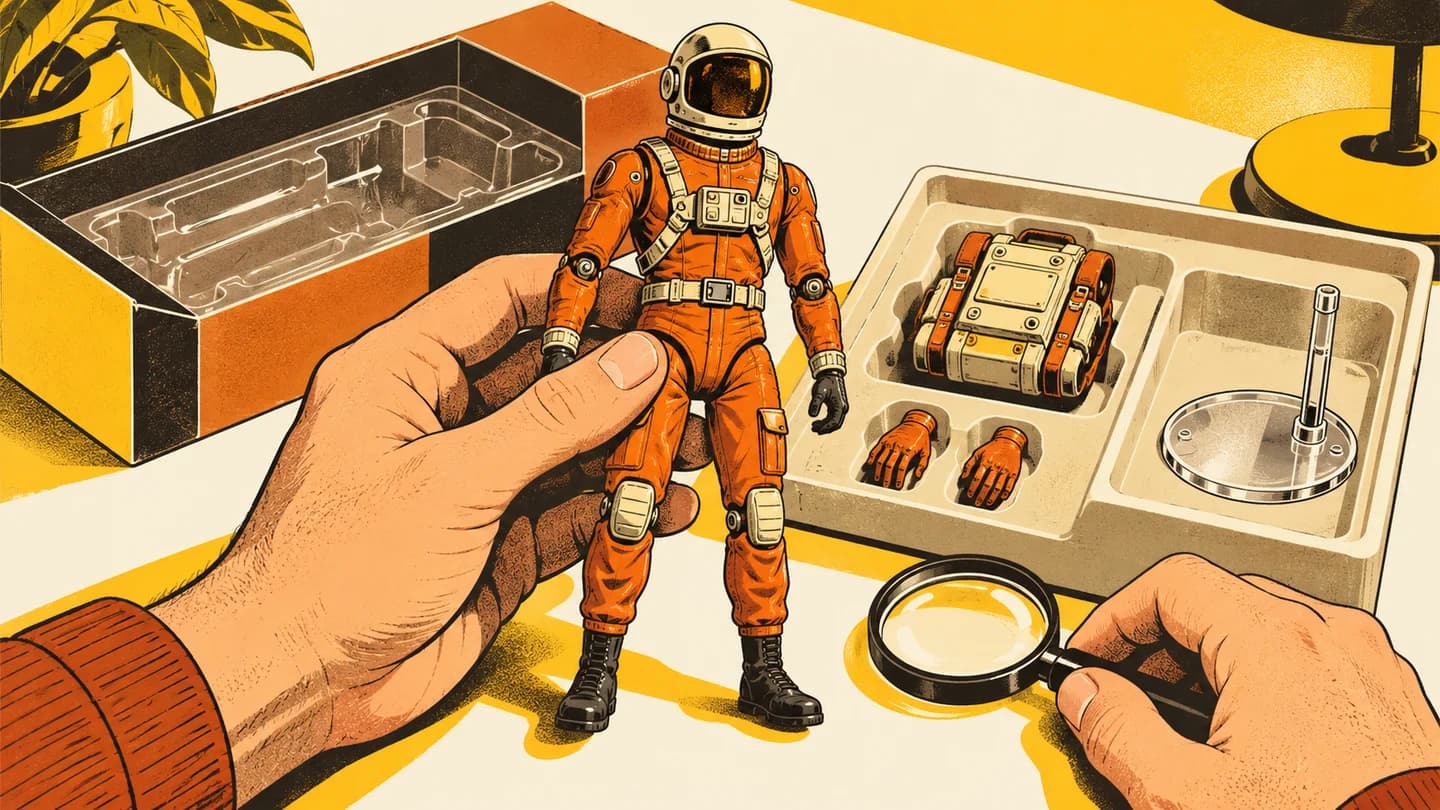
Use the manufacturer’s contents description and clear product photographs when available. Modern collector figures can include alternate hands, heads, effect pieces, stands or components intended to build another figure. What looks like a spare piece may be part of the original package.
Keep the list tied to the release. A reissue or multi-pack can include different accessories from an earlier single figure. Do not declare a loose example complete because it has the main character’s most recognisable item; check the full expected contents and state any omissions.
Separate four kinds of completeness
These descriptions answer different buyer questions. Make the distinction clear instead of using “complete” loosely.
The figure itself
Are the required body parts present, correctly matched and undamaged?
Original accessories
Are the specific hands, heads, stands or other pieces included with this release present?
Retail packaging
Is the appropriate box, card, tray or insert included, and has it been opened?
Additional extras
Are any display stands or aftermarket items extra to the original package? Identify them separately.
Inspect the faults that photographs can hide
Good light and gentle handling are more useful than repeatedly posing the figure.
- Cracks, broken pegs and visible repairs.
- Loose joints or parts that do not stay in position.
- Stiff joints that should not be forced for a test.
- Rubbed paint, fading, scratches and mismatched colours.
- Sticky surfaces, odours or residues needing investigation.
- Bent or damaged thin accessories.
- Missing attachments and substituted body parts.
Describe what you observed without inventing a diagnosis
If a joint is loose, record that and show its effect where possible. Do not claim it needs only an easy fix unless you have established the actual repair and its consequences. A visible glue mark should not disappear from the description because the figure now stands unaided.
Avoid using heat, solvents or an improvised repair on an unfamiliar collectable simply to improve the listing. Treatment can change paint, materials or originality. For a potentially valuable piece, seek appropriate specialist advice; otherwise value the figure in its actual condition and disclose the limitation.
Unverified accessories do not become original through repetition
Inspect packaging without assuming it proves provenance
Check the box or card against the figure’s release and look at the tray, seals, edges and any signs of alteration. Packaging can be damaged, replaced or assembled around different contents. A sealed-looking flap is not enough to support a confident never-opened claim.
Describe what you can observe and preserve genuinely unopened packaging while researching it. Do not open a collectable merely to make every inspection easier, but do not promise hidden condition you cannot assess either. The appropriate description depends on the evidence and the item, not the highest-priced listing you hope to match.
Research comparable sales in separate groups
Keep boxed, loose complete and loose incomplete examples apart. Compare the same line, scale and version, with similar condition and credible authenticity. An exceptional package with documented provenance can explain a high result that is not relevant to an ordinary loose figure.
Open completed results rather than relying only on thumbnails or a price snippet. Check whether accessories or multiple figures are included and whether the achieved amount is actually clear. Current listings show competition; they do not establish the price a buyer will pay you.
Decide whether replacing an accessory pays
These invented figures illustrate the choice. They are not current prices for any character or brand.
| Line | Sell with missing accessory | Buy verified replacement |
|---|---|---|
| Expected proceeds | £26 | £40 |
| Replacement including delivery | £0 | −£9 |
| Selling, packing and dispatch | −£7 | −£8 |
| Acquisition cost | −£12 | −£12 |
| Contribution before time, tax and other costs | £7 | £11 |
The bigger sale may produce only a small improvement
In the example, a verified replacement raises the expected sale by £14 but improves the contribution by only £4. Consider the research, waiting time and risk of buying the wrong part before proceeding. If the replacement is uncertain, the complete-figure price is not a justified forecast.
You may decide to sell the figure honestly incomplete or keep looking for a more economical source. The useful habit is to calculate the extra return from the repair or completion, not just celebrate the higher possible selling price.
Value a mixed lot from its strongest verified contents
Identify the figures that appear to account for most of the seller’s asking price. Assess the rest cautiously, allowing for incomplete, common or damaged stock. Do not assume every accessory in the bottom of the box belongs to a valuable figure.
Sorting a bundle can uncover useful pieces, but it also creates work: matching, inspecting, photographing and storing small components. Ask what you would recover if only the clearly identified items sold. That gives you a more resilient buying limit than a total built from hopeful character names.
Make the listing easy for a collector to inspect
Use your own clear photographs and show exactly what will arrive.
- Verified maker, line, character, scale and release details.
- Front and rear views, with useful close-ups of markings.
- All included accessories laid out separately.
- Condition issues, repairs and any replacements.
- Packaging condition and the evidence for any unopened claim.
- A clear distinction between original contents and extra display items.
Pack for the weak points, not just the overall shape
Protect thin projecting parts, keep small accessories contained and prevent the figure moving around in its outer parcel. Do not let loose accessories rub against painted surfaces. Where practical, support the item in a stable position without stressing joints or making an untested disassembly part of the packing routine.
Treat collectable packaging as part of the sold object and protect its corners and surfaces too. Keep the final contents photograph and stock notes until the transaction is settled. A reliable description and careful dispatch make it easier for a buyer to trust the next figure you list.