Use labels alongside construction and provenance rather than treating a logo style as proof of age.
The label starts the investigation
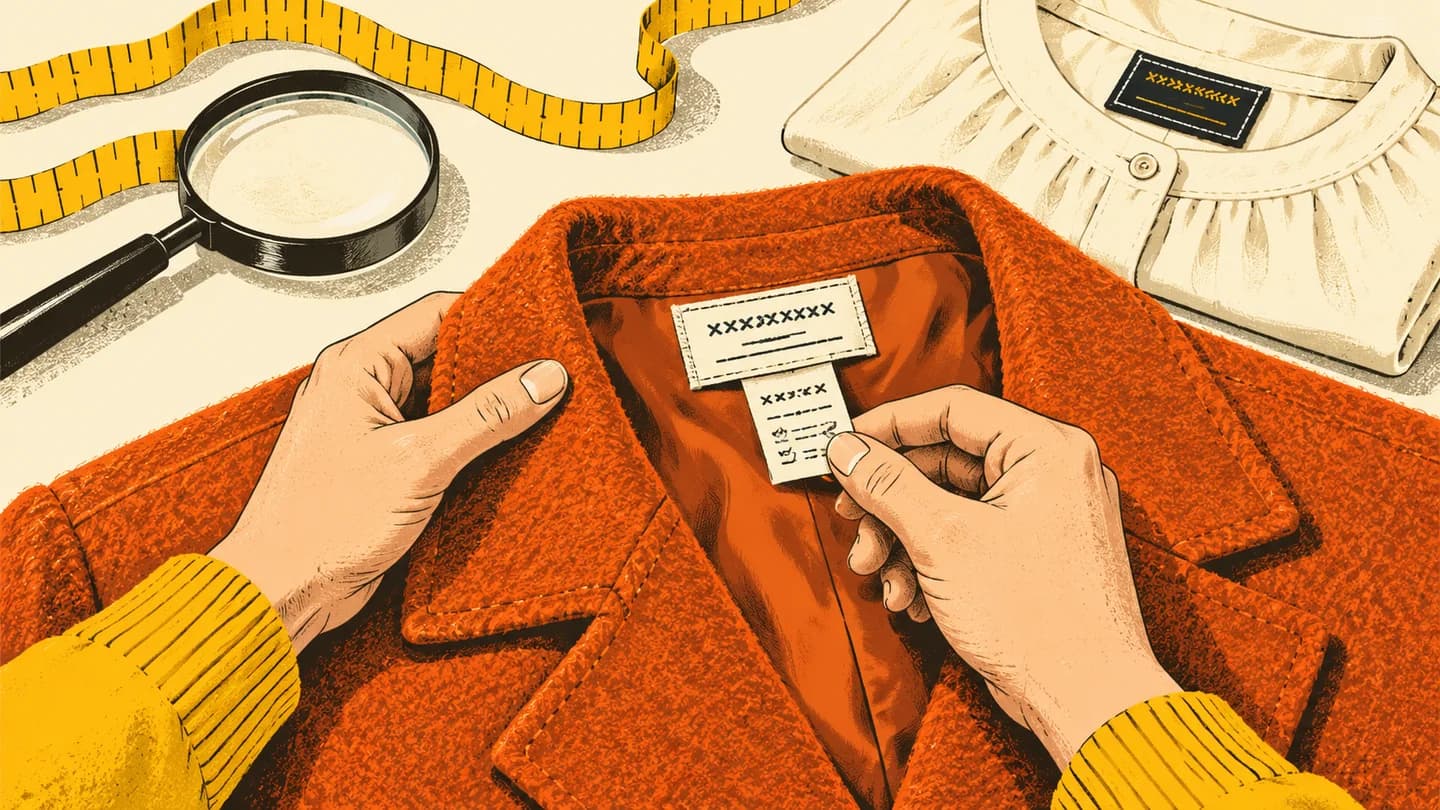
An unfamiliar woven label can turn an ordinary rail of clothes into an interesting research project. It might identify a designer, a department store, a manufacturer or a particular clothing line. What it rarely does on its own is tell you the exact year the garment was made, whether it is genuine or what someone will pay for it.
Use the label alongside the whole garment. A convincing identification should make sense of its fabric, cut, fastenings, construction and ownership history. This is especially useful when buying to resell: you want a description you can support, rather than an exciting decade attached to a jacket because the lettering looks old.
Capture the evidence before cleaning or altering anything
Look beyond the neck label. Information can be tucked into a side seam, waistband, pocket or lining. Photograph each label clearly, including the reverse when accessible without pulling stitches.
- Record the main name exactly, including a sub-label, licensing phrase, store name or country wording.
- Photograph fibre content, care instructions, size, style codes and any registration numbers on separate labels.
- Take front and back photographs of the garment, then close-ups of fastenings, seams, lining and distinctive details.
- Note where the label is attached and whether the stitching looks consistent with the surrounding construction. A replacement label needs explanation.
- Ask about ownership history. Keep specific, attributable information separate from a seller’s general belief that it is “very old”.
What different labels can actually tell you
Treat each type of information as a different research lead. A brand name, factory identifier and care instruction are not interchangeable dating tools.
| Label detail | Useful lead | Limit |
|---|---|---|
| Brand or sub-label | The business, designer or product line to research | A famous name may cover several ranges and eras. |
| RN number | A US business involved in making or marketing the garment | It identifies a business, not the garment’s production date. |
| Care and fibre information | Materials, intended care and clues to the market served | Rules and practices differ by country and period. |
| Style or product code | A possible match to a catalogue or product record | Decoding systems are specific to the brand and can change. |
| Size label | The original labelled size | It does not establish present-day fit or the actual measurements. |
| Union or trade label | A historical organisation or manufacturing context | The exact design and region need to be researched. |
A registration number is not a date stamp
On clothing made for the US market, RN means Registered Identification Number. The Federal Trade Commission assigns these numbers to businesses that manufacture, import, distribute or sell covered products. The number may appear instead of a company name, so the business you find can be a retailer or importer rather than the factory that sewed the garment.
Use the official RN database to identify the business and record what you found. A company can use its number across many products and years, so converting it into a precise garment date is not justified. Likewise, a brand’s founding year does not date every garment carrying its name. Separate the history of the business from the history of the particular item.
Narrow the period using several independent clues
Start with the clearest evidence and keep a note of uncertainty. A broad, supported date range is more useful than an exact year borrowed from a similar listing.
- Search the exact label wording and compare the design with a specialist label reference, such as the Vintage Fashion Guild’s Label Resource. Read the associated context rather than matching a thumbnail alone.
- Look for dated manufacturer catalogues, advertisements, museum records or original purchase documentation that show the same line or garment details.
- Compare the silhouette, fabric, lining, fastenings and construction with the proposed period. Check whether a later reissue could explain the same appearance.
- Investigate any contradiction. A much newer care label, an altered fastening or a different sub-label may change the initial identification.
- Write down the narrowest period that the combined evidence supports. If dating remains unresolved, describe the observable style and construction without presenting a guess as fact.
A reference photograph is an example, not a universal rule
Specialist label archives are valuable because they bring together photographed examples and company histories. However, a label illustrated on a garment dated to one decade may have been used for longer. Manufacturers can also use overlapping label designs across ranges or markets. An apparent visual match helps your search; it does not transfer every detail of the reference garment to yours.
Be particularly careful with simple rules such as “metal zip means this decade” or “no care label means it must be old”. Fastenings can be replaced, labels can be cut out and traditional construction methods can continue into later production. Country names, union marks and care-symbol systems require context. Research the exact clue instead of treating a broad internet checklist as a dating certificate.
Vintage-inspired is a style; vintage is an age claim
Separate age, brand attribution and resale demand
An old garment can be unattributed, and a branded garment can be recent. A label apparently naming a designer is also not enough to authenticate a valuable piece. If the purchase depends on a substantial designer premium, use an appropriate specialist assessment and provenance checks. Packaging or an old-looking receipt should not replace inspection of the garment itself.
Once the identification is credible, research the specific line. A licensed accessory, a diffusion-range jacket and a mainline designer piece can attract different buyers even when they share a familiar name. Avoid pricing an ordinary garment from the brand’s most expensive auction result. Match the type of piece, era, material, size, condition and level of attribution.
Inspect the parts a label cannot explain
Turn the garment gently and check it in natural light. Avoid stretching fragile fabric to prove that it is strong.
- Look at underarms, neckline and cuffs for staining, wear and odour; photograph rather than promise that marks will wash out.
- Check the lining, pocket bags and seams for tears, repairs or fabric that is becoming brittle.
- Inspect wool and other vulnerable textiles for holes or signs of pests. Keep a suspect purchase separate from clean stock while it is assessed.
- Test accessible buttons, hooks and zips gently. Note missing original fastenings and repairs that alter the appearance.
- Look for shortened hems, taken-in seams, replaced elastic and other alterations that affect fit or originality.
- Record the fabric stated on the label. If a label is missing or doubtful, avoid presenting an unverified fibre identification as certain.
Measurements turn an interesting find into a wearable purchase
A vintage size label is useful to photograph, but a buyer needs measurements. Lay a robust garment flat without stretching and record the relevant dimensions: chest across, shoulder width, sleeve and overall length for a jacket; waist, rise and inseam for trousers; bust, waist, hips and length for a fitted dress. Explain where you measured and whether the fabric has stretch.
Keep the labelled size in the listing and present measurements alongside it rather than silently converting it to a modern size. Alterations and shrinkage can change the fit independently of the original sizing system. If you describe a likely modern fit, label it as an estimate and encourage comparison with a garment the buyer already owns.
Price the garment in its present condition
Find completed sales of genuinely comparable pieces, then allow for differences you can explain. An intact label helps identification but does not make moth damage, a missing belt or a stained lining disappear. An unbranded piece with an appealing cut and wearable measurements can have a clearer market than a recognisable label on a badly damaged garment.
For an illustrative buying decision, suppose comparable wearable jackets suggest a £70 selling price. You allow £12 for cleaning after obtaining suitable advice, £8 for selling costs applicable to your route, £6 for packaging and delivery not recovered from the buyer, and £24 towards your time and profit. That leaves a £20 purchase ceiling. If the stain may be permanent or the repair quote is unknown, the £70 outcome is not established enough to support the calculation.
Do less until you understand the material
An original care label is useful evidence, but an aged textile may no longer tolerate the treatment it did when new. Fragile fabric, dyes, linings and trims can react differently. For a valuable or delicate garment, ask a textile conservator or an appropriately experienced cleaner before washing, steaming or applying stain remover. A fresh smell is not worth a damaged finish or distorted shape.
Store the item in a clean, dry place with suitable support. Avoid forcing heavy or fragile garments onto narrow hangers. Keep documentation with your stock record and use removable identifiers on storage materials rather than adhesive labels on the garment. Photograph the item again after any agreed cleaning or repair so the sale represents its actual condition.
Write a listing that shows the reasoning
A useful listing might say: “Labelled wool-blend jacket, estimated late twentieth century from label and construction; exact year unconfirmed. Labelled size shown in photographs; measurements supplied. Lining repaired at one underarm.” That gives the buyer more usable information than an unsupported “rare museum-quality vintage” claim.
Include the main label, secondary labels, whole garment, measurements and defects in the photographs. Use the verified brand and descriptive features naturally in the title; do not add unrelated designer names for search traffic. Your advantage as a reseller comes from making a neglected item understandable and accurately presented, not from forcing every label into a more valuable story.