Match maker, scale, version and condition before comparing model prices.
A familiar model can hide a very different value
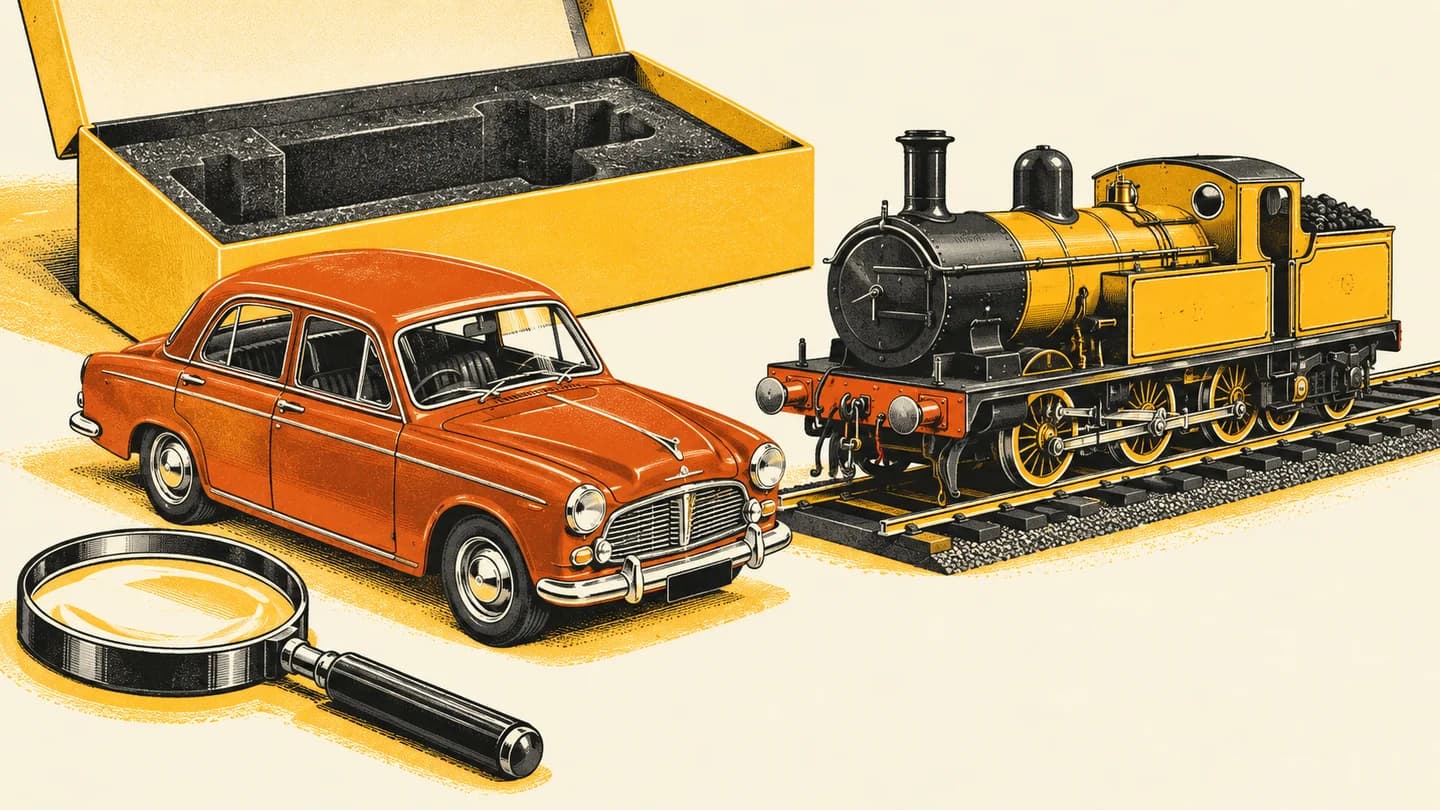
A box of toy cars and trains looks straightforward until you try to price it. Two models of the same vehicle can belong to different scales, production runs and collecting markets. One may be an original release with its correct packaging; another may be a repaint, a later reissue or a damaged example assembled from spare parts.
The useful starting point is a short inventory, not a headline price. Record the maker, catalogue reference, scale, colour or railway livery, condition and packaging for each promising model. Die-cast vehicles and model railways share an emphasis on identification, but powered trains add another question: what has actually been tested, using which equipment?
Choose the buyer you are trying to reach
The most profitable presentation depends on what you can establish about the models. Keep these buying audiences separate when researching prices.
Originality-focused collector
Looks closely at the release, paint, wheels, small details and correct box. A tidied-up repaint may be less attractive than honest original wear.
Railway operator
Needs suitable scale, track and control-system compatibility, usable couplings and credible running information. A famous locomotive name alone is not enough.
Restorer or layout builder
May want a clearly described project, spare chassis or incomplete body. Price the present condition and disclose what is missing.
Identify the release before searching sold listings
Work on a clear surface and support delicate models underneath. Avoid holding a locomotive by handrails or a car by its mirrors.
- Photograph the model from both sides, above and underneath where this can be done safely. Record every maker mark, reference and railway running number.
- Compare the reference with a manufacturer catalogue, product page or reliable specialist reference. A number on the base may identify a casting rather than every colour variation.
- Check the details that distinguish releases: body colour, wheels, glazing, interior, transfers, couplings, lighting and included accessories.
- Read the box end label separately. Match its product code and description to the model instead of assuming that a branded box is the original box.
- Save a few genuinely comparable completed sales. Separate loose models, boxed examples, damaged projects and professionally restored items.
Scale and gauge are different measurements
Scale describes the size of the model relative to the real thing. Gauge describes the distance between the rails. Hornby OO models use a scale of 1:76 and 16.5mm track gauge; Hornby TT:120 uses 1:120 and 12mm gauge. HO uses 1:87 while sharing the 16.5mm gauge associated with OO. These details help identify a lot, but shared track width does not settle every compatibility question.
Older wheel profiles, couplings, curve requirements and electrical systems can still matter. A mixed collection may also contain older three-rail equipment or models intended for a different control arrangement. Do not connect an unfamiliar locomotive simply because its wheels appear to fit the track. Establish the exact model and consult its instructions or an experienced model railway specialist.
Die-cast condition: inspect beyond the shiny roof
Check in good light without dismantling the model. Opening a model or trying to improve it can introduce damage and make originality harder to establish.
| Area | What to look for | Why it matters |
|---|---|---|
| Paint and decoration | Edge chips, overpaint, uneven finish and damaged transfers | Restoration and original paint should be described separately. |
| Wheels and tyres | Matching wheel type, cracked tyres, bent axles and replacements | A model may look complete while differing from the identified release. |
| Small fittings | Mirrors, aerials, doors, glazing and separate accessories | A missing tiny part may be difficult or costly to replace. |
| Body and base | Cracks, distortion, corrosion and disturbed fastenings | Structural damage can make a superficially attractive model a poor purchase. |
| Packaging | Correct end label, inner tray, display case and any certificate | A box without its protective insert is not equivalent to a complete boxed example. |
Original, restored and reissued are separate descriptions
A later commemorative release can deliberately resemble an older model. Fresh paint is not proof of excellent original condition, and a familiar box design may be a reproduction. Look for a consistent match between the model, product reference and packaging. Where a premium depends on a rare variation, ask a specialist who knows that range before committing money.
Avoid upgrading an uncertain identification into a confident listing. If the wheels appear replaced, describe that uncertainty and show close photographs. Do not polish, repaint or remove transfers to make a collectible look newer before understanding the effect on its market. Buyers who want an untouched example may value evidence that an enthusiastic clean-up would remove.
For trains, separate appearance from running condition
A clean body can conceal an operational fault. Ask the seller for the test history, then inspect what you can without forcing parts or opening the model.
- Check buffers, couplings, handrails, valve gear and tender connections against the correct product photographs or instructions.
- Look for missing wheels, damaged gears visible without dismantling, loose wires and broken body fixings. Do not assume that a part is easily available.
- Record whether the model is analogue, DCC fitted, sound fitted or still unverified. Previous owners may have modified the original specification.
- Check included accessory packs, instructions and service records. A sealed detail pack may contain pieces deliberately left unfitted.
- Treat an old controller or power supply as a separate item requiring appropriate assessment. Damaged plugs, cables or cases are reasons not to power it.
DCC ready does not mean DCC fitted
Write down a test that another buyer can understand
Use the correct equipment and the manufacturer’s procedure, or have someone competent test the model. Record the control system, the duration of the test, whether it ran in both directions and any observed hesitation, noise or lighting faults. If sound was checked, say which functions were demonstrated. Keep an address or configuration record where relevant, without casually resetting a seller’s locomotive.
A brief straight-track test is useful evidence, but it does not establish performance on curves, with a load or over a long running session. Describe those limits plainly. If testing is unavailable, value it as untested and budget for that uncertainty. “Probably only needs oil” is a diagnosis you have not earned; unnecessary lubrication can create further problems.
Use a buying ceiling, not the best result in the search
A rare boxed example can distort expectations for an ordinary mixed lot. Compare several sales with matching references and condition, and note whether the asking figure actually represents a completed sale. A limited-edition certificate identifies a release or issue; it does not tell you how many buyers currently want it. Demand and condition still decide the practical selling price.
Here is an illustrative calculation, not a valuation: an identified model might realistically sell for £65. Allow £9 for the selling costs applicable to your account, £6 for packing and postage not recovered from the buyer, £10 for a verified replacement part and £20 for your intended contribution towards time and profit. That leaves a £20 buying ceiling. If the fault is unconfirmed, the replacement budget is not reliable enough to justify that ceiling.
A collection needs a stock plan as well as a total price
Sort a large lot into individually saleable models, sensible grouped lots and projects. Cost missing parts by exact reference, including delivery and the time to fit them properly. Do not add up the best possible individual selling prices and call the total cash value of the collection: listing, storage and slow sellers all sit between those numbers.
Keep model and box pairs together with a removable inventory label on an outer bag or storage tray, never adhesive on collectible packaging. Decide which pieces warrant deeper research before spending hours identifying common low-value items. A few good individual listings alongside an honestly described remainder can be more workable than trying to extract a premium from every wagon or loose car.
Photograph and pack for the buyer who checks details
Good records make the sale easier and preserve the condition you have just described.
- Show the actual model, underside markings, box label, accessories and every significant defect. Include the running-test description for powered models.
- Use the correct inner tray when present, checking that the model is secure without pressure on delicate fittings. Protect collectible packaging separately inside an outer carton.
- For unboxed models, support robust areas and prevent movement without crushing aerials, buffers or handrails. Bag already-detached accessories separately.
- Confirm the parcel size, packed weight and suitable delivery cover before setting the postage charge. Never attach a shipping label directly to the collectible box.
The best first purchases are the ones you can explain
Start with a manageable range whose references and condition issues you can learn. A modest, correctly identified model with clear photographs and an honest test record gives you a repeatable process. A supposed rarity whose value depends on unverified paint, a mismatched box and a promised easy repair gives you several different problems at once.
Before paying, you should be able to explain what the item is, which buyer wants this example, what it will cost to prepare and dispatch, and what evidence supports the selling price. If one of those answers is missing, reduce the commitment or leave the model for someone with the specialist knowledge to assess it.