Verify legitimate ownership and obtain a realistic mechanical assessment before buying a bicycle to resell.
A cheap bicycle needs two separate checks
Before buying a bicycle to resell, establish that the seller has a legitimate right to sell it and that its condition can be assessed properly. A low asking price does not compensate for unresolved ownership or a damaged frame. Once those checks are satisfactory, the commercial question is whether a realistic selling price covers purchase, repairs, transport and your time.
Start with a type of bicycle you understand and a repair route you can afford. A straightforward hybrid may be easier to assess than an unfamiliar full-suspension mountain bike or an electric model with an unknown battery. A prestigious badge does not simplify worn components, scarce parts or specialist service work.
Check identity and ownership before negotiating
Keep a purchase record tied to the physical bicycle. A screenshot of an advert is useful context, but it is not the whole record.
- Record the make, model, colour, frame size and identifying frame number or security marking. Photograph the number clearly.
- Ask how the seller obtained the bike and look for relevant purchase or service documentation. Check that the details correspond to this bicycle.
- Use BikeRegister’s BikeChecker with the frame number or registration marking to check whether it is recorded as stolen.
- Investigate an altered, removed or unreadable identifier and inconsistencies in the history. Do not let pressure to pay immediately replace these checks.
- If you buy, obtain a receipt recording the date, seller details, bike identity and price. Arrange any applicable registration transfer through the relevant service.
A clear database result is not proof of ownership
Identify the specification you can actually sell
Find the manufacturer’s specification or geometry information for the correct model and year where possible. Then compare it with the bike: wheels, brakes, drivetrain and suspension may have been changed. Value the actual configuration rather than copying the original retail specification into the listing. Replacement parts can be useful upgrades, ordinary maintenance or incompatible alterations.
Record the labelled frame size and useful measurements. A medium from one brand is not automatically the same fit as a medium from another. Do not promise a universal rider-height range based on the label alone. Clear size information and the correct model reference help a buyer decide whether an inspection is worthwhile.
Use the first inspection to identify the repair questions
This is a buying checklist, not a substitute for a competent mechanical assessment. Do not test ride a bike with unresolved safety concerns.
| Area | What to look for | Why it affects the deal |
|---|---|---|
| Frame and fork | Cracks, dents, corrosion, impact marks or suspicious repairs | Structural concerns can rule out resale for use. |
| Wheels and tyres | Damage, visible wear, uneven running and deteriorated tyres | Replacement wheels or tyres can consume the margin. |
| Brakes | Damaged parts, worn pads or braking surfaces, leaks and poor operation | The system needs appropriate assessment and safe performance. |
| Drivetrain | Chain wear, damaged teeth, poor shifting and incompatible parts | A chain-only budget may not cover worn associated components. |
| Bearings and controls | Play, roughness, damaged cables and insecure fittings | Small symptoms can represent several service jobs. |
| Seatpost and fittings | Seized adjustment, damaged clamps and missing hardware | Fit and safe assembly may require more than a quick adjustment. |
Carbon damage deserves particular caution
Carbon parts can suffer damage that is not obvious from a quick visual check. A bike that looks straight or feels normal during a short ride is not thereby cleared of structural concerns. Ask about crashes, impacts and transport damage, and use a suitably experienced specialist when the material or history raises questions.
Do not rely on tapping a frame, covering a mark with a sticker or accepting an unsupported “only cosmetic” assurance. The same need for sound structure applies to metal frames and forks, although failure modes differ. If an assessment cannot establish an appropriate resale route, leave the bike rather than treating a safety uncertainty as a negotiating opportunity.
Measure wear instead of guessing from cleanliness
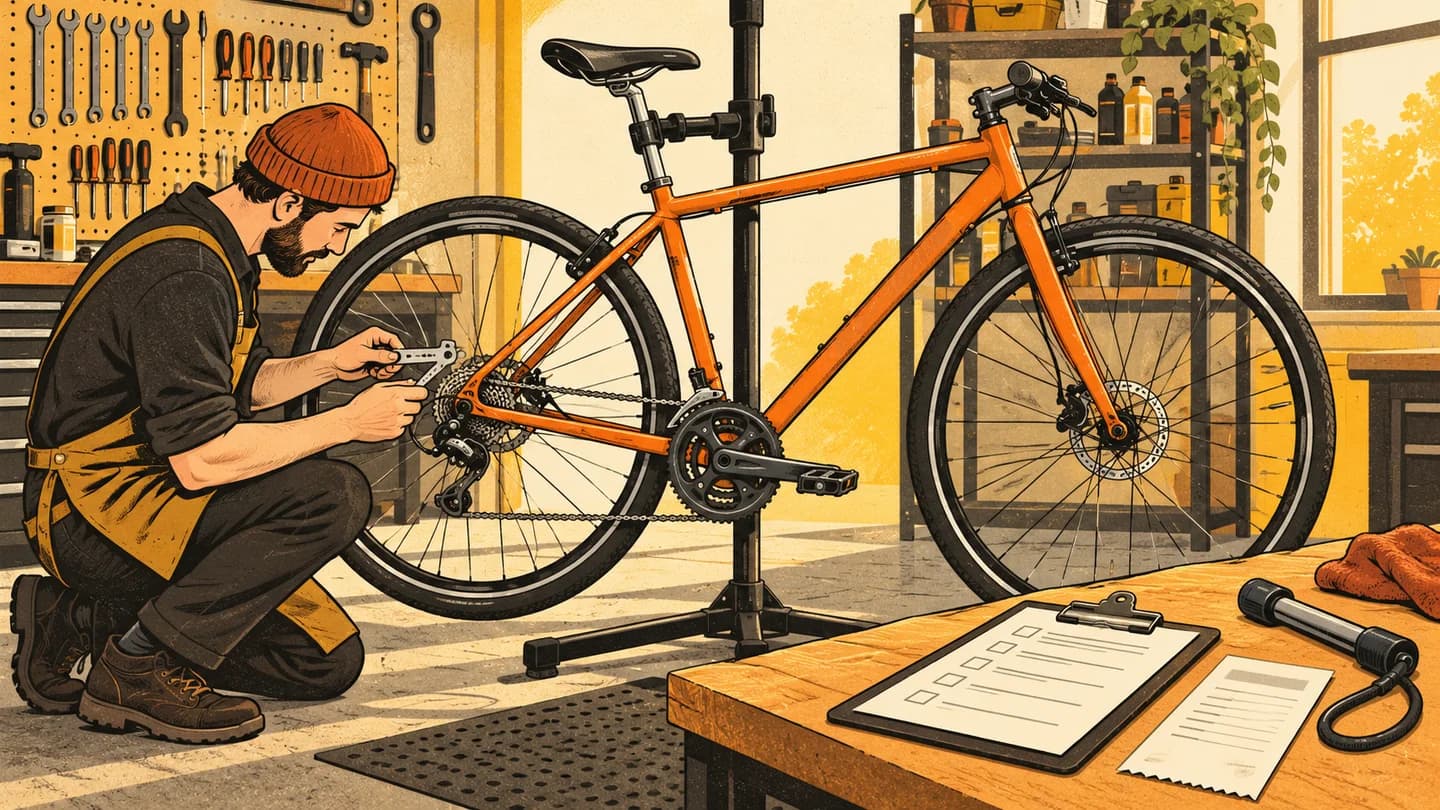
A clean chain can still be worn. Use a suitable chain-wear gauge correctly and follow guidance for that chain system, or ask the mechanic to assess it. Excessive chain wear can affect other drivetrain components, which is why “it only needs a chain” can be an expensive assumption.
Ask for a quote that lists necessary parts and labour separately. Include tyres, tubes where applicable, brake work, cables, bearings and any model-specific parts the inspection identifies. Check compatibility and availability before buying. A low-priced discontinued component is not a bargain if the matching replacement cannot be obtained economically.
Questions for the mechanic or service provider
A useful assessment answers the questions that determine whether you can offer the bicycle honestly and safely.
- What work is necessary before the bicycle can be offered for its intended use?
- Are there unresolved structural concerns or signs of crash damage requiring another specialist?
- Which parts need replacement, and are compatible replacements available?
- Does the quote include labour, consumables and a final functional check after the work?
- What is the likely turnaround, and what further costs could appear during disassembly?
- What written record can you retain of the work and any remaining limitations?
Do not let a service label do more work than it should
A recent receipt can show work performed, but read what it actually covers. Replacing a tyre is not a full mechanical assessment, and an old service does not establish the bike’s current condition. Keep the invoice with the correct frame number where possible and record any subsequent changes.
If you are doing repairs yourself, work within your competence and follow the relevant manufacturer instructions, including specifications for the exact components. A resale business needs a reliable process, not a succession of improvised fixes. For safety-critical uncertainty, paying a competent mechanic is part of the cost of bringing the bike to saleable condition.
Example: a £180 resale does not justify every £50 purchase
Use conservative sold comparisons for the actual model, size, specification and condition. This illustrative budget assumes the seller absorbs the listed costs.
| Item | Amount |
|---|---|
| Supported expected sale | £180 |
| Necessary parts and labour | −£70 |
| Selling costs applicable to the route | −£10 |
| Collection and preparation expenses | −£15 |
| Allowance for time, contingency and profit | −£40 |
| Maximum purchase price | £45 |
Recalculate when the assessment changes
In that example, a £50 purchase already exceeds the planned ceiling. If the mechanic then finds a £30 wheel problem, the ceiling falls to £15 unless your expected sale or other costs change for a supported reason. Do not preserve the hoped-for profit by leaving necessary work out of the plan.
Research local demand as well as national prices. An unusual size, specialist riding style or collection-only location can reduce the number of suitable buyers. Store the bike securely and consider how long you can hold it. A slightly lower achievable sale can be preferable to months of storage and repeated viewings.
Electric bikes need an additional assessment
An e-bike adds a battery, charger, electrical system and model-specific support requirements to the mechanical inspection. Establish the correct compatible equipment, battery condition and any diagnostic or recall issues with an appropriate specialist. An assist function that works briefly does not prove useful range or safe battery condition.
Do not treat a damaged or modified battery as an ordinary repair project, and do not assume a missing charger can be replaced with any unit that fits. Check the rules governing the bike’s specification and intended use before describing it for sale. If you lack a dependable assessment and service route, choose a conventional bike you can evaluate properly.
Prepare a clear listing and handover
Describe the finished bicycle, including the work actually completed. A buyer should understand its size, configuration and remaining wear.
- Photograph both sides, drivetrain, brakes, tyres and significant faults. Retain identifying details in your transaction records.
- State the exact model where established, frame size, wheel size and relevant component changes. Avoid copying features the bike no longer has.
- Describe servicing by scope and date. Explain remaining cosmetic wear without disguising mechanical faults.
- Provide relevant instructions and records, and arrange a safe, agreed viewing or collection process within the platform’s rules.
- For delivery, use suitable packing and a clear plan for any disassembly and competent reassembly. Do not assume a partly assembled bike is ready to ride on arrival.
Sell on the evidence you have created
Business sales of second-hand bicycles carry product-safety and consumer obligations; a “sold as seen” phrase is not a substitute for meeting them. Keep traceable purchase records and documentation of assessment and repairs. Check current requirements for your location and selling activity, particularly if refurbishing or modifying the product.
The strongest bicycle purchases combine legitimate provenance, identifiable specifications and a manageable repair list. When those foundations are in place, good presentation and accurate sizing help find the right buyer. When they are missing, the low asking price is only the beginning of the cost.