Read the full group of marks and verify uncertain metal claims before paying a silver price.
Read the object as well as the marks
A silver-coloured spoon can be solid silver, silver plate or a base-metal alloy. A heavy candlestick may contain a substantial filled base. A clear-looking stamp might belong to one component rather than describe everything attached to it. These distinctions matter before you start multiplying weight by a silver price.
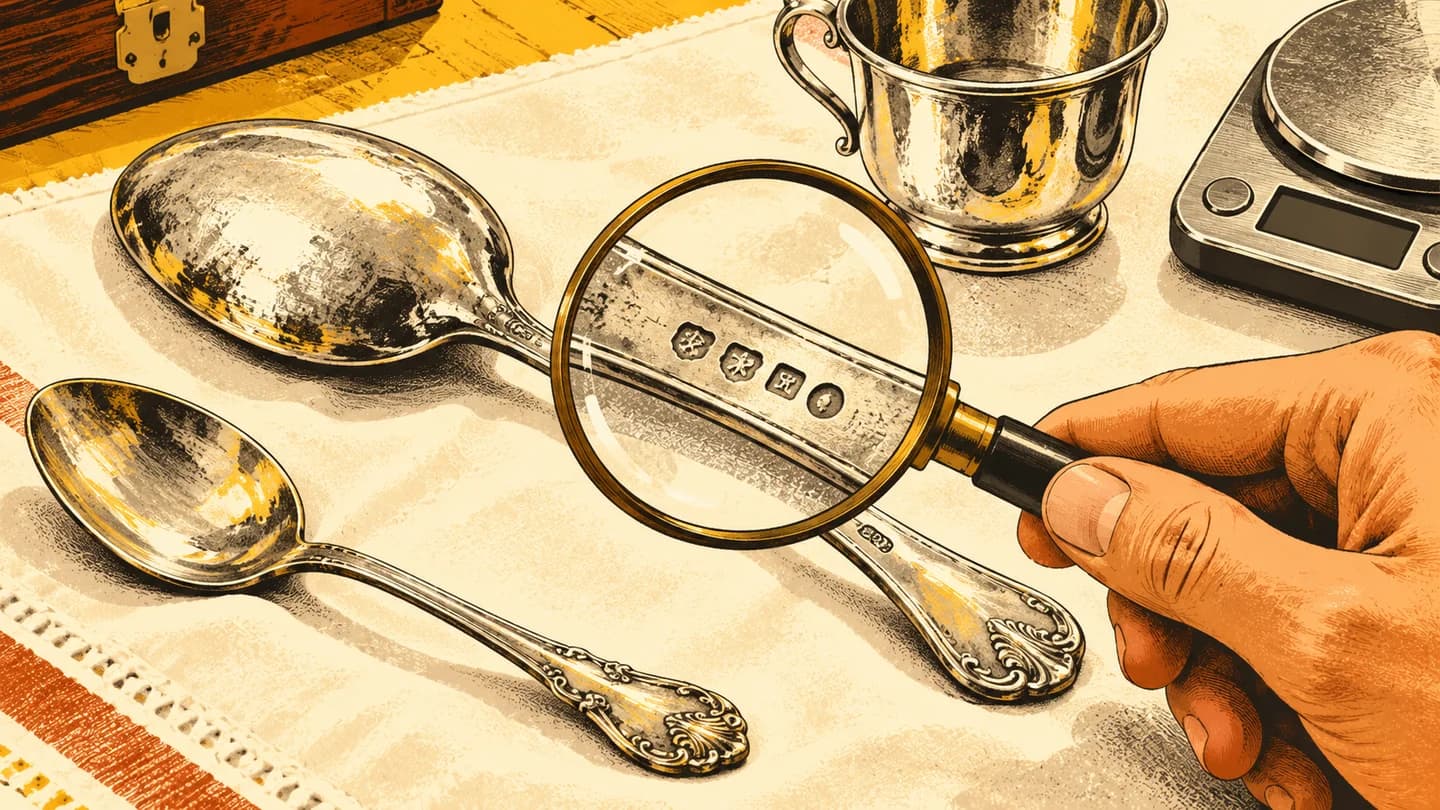
At a car boot sale, aim to establish what the marks actually support and what still needs checking. Take a magnifier, use good light and photograph the whole item as well as the marking. You do not need to recognise every historical system to make a sensible decision; you do need to avoid paying a confirmed-silver price for an unresolved identification.
The main parts of a modern UK hallmark
A hallmark is a group of marks recording independent testing. Historical and overseas systems differ, so use the reference appropriate to the item.
| Component | What it tells you |
|---|---|
| Sponsor’s mark | The registered person or business responsible for submitting the item; not necessarily the actual manufacturer. |
| Fineness mark | The precious-metal standard, expressed numerically in parts per thousand. Sterling silver is 925. |
| Assay-office mark | The office that tested and marked the item. |
| Date letter, when present | The assay year within the relevant office’s letter system. This is optional. |
| Other symbols | Traditional or commemorative marks may provide further context. They do not replace the required components. |
A practical inspection sequence at the stall
Ask before turning over an object or opening a lid. Support fragile parts and do not lift a heavy piece by a thin handle.
- Photograph the complete object, including its base, handle, lid and any separate pieces. Look for marks on more than one component.
- Take a sharp close-up of the entire group of marks. Try light from another angle if a stamp is worn, without scraping or polishing it.
- Transcribe what is visible, keeping uncertain letters uncertain. Note the outline around each mark as well as the symbol inside.
- Check an official assay-office reference for the suspected country and period. Confirm that the combination of symbols makes sense together.
- Inspect construction and condition, then decide whether you have enough evidence to value the item or need a specialist opinion first.
Do not date a piece from a letter alone
Date-letter alphabets repeat, and the letter’s font, case and surrounding shape matter. First establish the assay-office context, then compare the complete mark with the correct table. A letter resembling a modern capital A is not enough to assign a year. Worn punches and photographs taken at an angle can make apparently familiar letters misleading.
Different components may carry different marks. A replacement lid, handle or mount can affect the interpretation and value of an assembled object. Keep a record of where each mark appears rather than combining separate stamps into an invented single hallmark. If a date or attribution is central to the purchase price, have that interpretation checked before paying the premium.
Recognise plating clues without dismissing the object
EPNS means electroplated nickel silver: a silver coating over a base alloy of copper, nickel and zinc. The nickel-silver core itself contains no silver. An EPNS stamp therefore does not describe sterling silver throughout the object. Other plating descriptions and trade names need their own interpretation; do not assume that a word containing “silver” means a solid precious-metal item.
Silver plate can still have a resale market through its design, maker, pattern, completeness or decorative use. The right comparison is another plated example in similar condition, not the scrap value of a solid-silver object with the same gross weight. Look for worn-through plating on high points and working surfaces, especially if photographs make the finish look more uniform than it is.
A 925 stamp is a lead, not the whole answer
Gross weight can be the wrong number
Weighing is useful only after you understand the construction. Do not dismantle a collectible item to satisfy curiosity about its contents.
Solid-metal object
A verified silver spoon may be suitable for a metal-content estimate, subject to its standard and any non-silver additions.
Filled or weighted object
A candlestick or handle can include filling material. Its full weight cannot be treated as silver-alloy weight.
Mounted or mixed-material object
A frame, brush, knife or glass container may combine silver with wood, steel, glass or other materials. Identify what is actually silver.
Metal value and resale value are different calculations
For a genuinely solid 100g object verified as 925 silver, the nominal silver content is 92.5g. That arithmetic does not apply to a 100g weighted handle or a plated object. Nor does it tell you what a buyer will pay: a precious-metal buyer may apply deductions, and their payable rate should be confirmed at the time of the transaction.
Research the object as a collectible or usable item before choosing a scrap route. A desirable maker, pattern, design or intact set may attract a buyer above the metal value. Equally, a common damaged item may have a narrower market. Compare actual offers and completed sales after costs, rather than assuming the highest advertised antique price is immediately obtainable.
Inspect condition before paying a collector’s premium
Photograph defects clearly. A famous mark does not remove the effect of damage or heavy alteration.
- Look for dents, splits, cracks, loose joints and repairs, especially around handles, hinges and feet.
- Check thin areas, worn decoration and signs of aggressive polishing. Do not rub hard at a faint hallmark to make it easier to read.
- Look for erased engraving, later inscriptions or changed components where these affect the intended market.
- Check whether a lid fits properly and whether all parts of a set match in pattern, size, marking and condition.
- For plated pieces, inspect exposed base metal and uneven plating wear; polishing cannot simply replace missing silver coating.
- Record any uncertainty about fillings, repairs or material claims and price the unresolved work realistically.
Know when further assessment is worth paying for
Clear photographs and a plausible reference match may be enough to decide that a low-priced piece deserves further research. A costly item, suspicious group of marks or uncertain construction needs more than an image match. An assay office or appropriately experienced silver specialist can advise on authentication, testing and interpretation.
Ask what the proposed assessment will establish, what it costs and whether any method could leave a mark. Do not scratch, acid-test or file a seller’s item. A magnet test alone cannot establish silver content: non-magnetic base metals exist, while a mixed object can contain magnetic components. Choose an assessment suited to the actual question rather than collecting reassuring but incomplete home-test results.
Work backwards from a credible selling route
Suppose an accurately identified piece could sell as an object for £90. This is an illustrative budget, not a silver quotation. Allow £12 for selling costs applicable to your route, £8 for packing and delivery not recovered from the buyer, £10 for a necessary assessment and £25 towards your time and profit. That leaves a purchase ceiling of £35.
If a specialist offers £55 outright, compare that net route with the work and uncertainty of achieving the £90 sale yourself. If the object is damaged or the identity remains unresolved, use a lower supported outcome instead of borrowing a pristine example’s price. For a mixed box of cutlery, value the verified pieces individually before assigning anything to unidentified material.
Check the rules before describing a resale as silver
UK hallmarking requirements apply to precious-metal descriptions in trade, including online selling, subject to defined exemptions. Silver has a standard weight exemption below 7.78g, but mixed-material construction and historical exemptions require careful interpretation. An item being second-hand does not create a general exemption, and being exempt from hallmarking does not make an inaccurate silver description acceptable.
Consult current British Hallmarking Council and assay-office guidance for the item and your selling circumstances. Traders also need to consider the required Dealer’s Notice information. If a genuine object needs assessment or hallmarking before it can be offered as described, include that work in the buying decision. Avoid presenting an uncertain legal or metal classification as settled because a previous seller used it.
Create a listing that makes the evidence visible
A buyer should be able to connect your description to the exact object and marks shown.
- State the supported material description, item type, dimensions and condition. Explain whether a quoted weight is gross weight or a verified relevant metal weight.
- Show the complete hallmark group and where it sits on the object. Keep the original photograph alongside any useful close crop.
- Describe repairs, engraving, filled construction and replacement components. Do not imply every part is silver because one mount is marked.
- Use a date or maker attribution only to the level supported by the evidence. Explain uncertainty instead of hiding it in a confident title.
- Protect projecting parts and prevent rubbing in transit. Check the carrier’s cover for precious metals and collectible objects before choosing delivery.
A good buy survives the second look
The useful skill is reading a group of marks in the context of a complete object. Start with material, construction and condition, then decide which buyer and selling route make sense. That process can uncover worthwhile plated pieces as well as solid silver, while keeping a tempting stamp from becoming an expensive assumption.