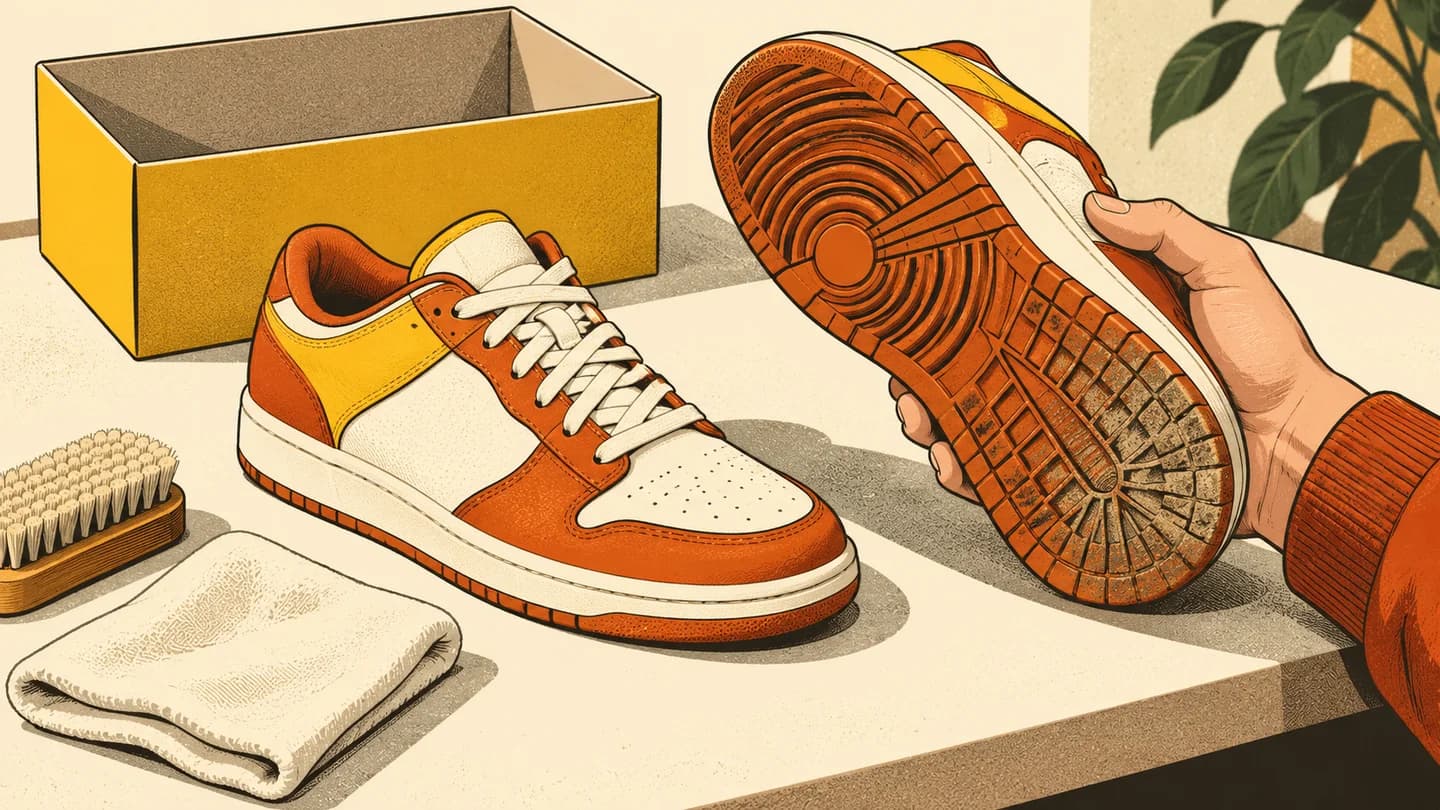
Check the actual pair, size and condition before comparing sneaker prices.
Start with the pair, not the hype
A recognisable trainer on a car-boot table can be worth investigating, but the model name alone does not establish a profit. The exact release, colourway, size, authenticity and condition all affect who will buy it. A clean pair in an awkward-to-sell variant may sit longer than a visibly worn pair with established demand.
Treat resale as two linked decisions: can you describe and authenticate this particular pair reliably, and does the likely net return justify the purchase and work? If the first answer is uncertain, a large apparent discount does not fix it. If the second answer is weak, a fashionable name does not make cleaning and listing time free.
Identify both shoes before checking prices
Use the label inside each shoe and the construction of the pair, rather than relying on the box or a seller’s nickname for the release.
- Record the manufacturer’s product or style code, model, colour information and all stated size systems from each shoe.
- Check that left and right belong together. Compare size labels, colour, wear, shape and materials, while recognising that details can vary legitimately between production runs.
- Search the product code against reliable manufacturer or established retailer records. Confirm whether it identifies a men’s, women’s or junior version.
- Check the box label separately. A correct-looking box is supporting information, not proof that its current contents are the original pair.
- Record the accessories actually included, such as spare laces, insoles, tags or special packaging. Do not price the pair as complete without checking them.
Size and colourway can change the comparison
Search completed sales for the exact product code and size where enough examples exist. UK, US and EU sizes are not interchangeable, and men’s and women’s size systems can differ. Quote the label’s size clearly instead of guessing a conversion. A junior version resembling an adult release is not automatically the same resale proposition.
If there are few sales in your size, widen the comparison cautiously and say what changed. A scarce size is not necessarily a desirable size, and a different colourway may have a very different audience. Record the condition and included packaging for each comparison. New, unworn stock with its original box is a weak benchmark for a used pair with replaced insoles.
Inspect the whole pair in good light
Ask permission before removing insoles or manipulating a seller’s shoes. Use gentle handling and stop if material appears brittle; this is an inspection, not a destructive stress test.
| Part | Look for | Effect on the selling decision |
|---|---|---|
| Outsoles | Uneven heel wear, smooth tread, splits and embedded debris | Photograph both soles; one shoe may be much more worn. |
| Midsole and bonding | Cracks, crumbling, gaps and separation from the upper | Potential structural deterioration needs more than cosmetic cleaning. |
| Uppers | Holes, scuffs, cracking, stretched seams and colour transfer | Match the actual material and defects in comparable sales. |
| Heel lining and insoles | Worn-through fabric, compression, missing parts and persistent odour | The interior can make a good-looking pair unattractive to wear. |
| Repairs and custom work | Repainting, added glue, replacement soles or personalised artwork | Disclose modifications and check whether the selling route accepts them. |
| Box and extras | Matching label, damage, spare laces and original accessories | Describe each separately instead of using “complete” loosely. |
Old and unworn does not automatically mean wearable
Stored footwear can deteriorate even when the outsole shows little wear. Some polyurethane midsole materials are vulnerable to hydrolysis, a process that can lead to crumbling or separation. This does not mean every old trainer has the same fault, but it does mean that an unworn appearance cannot establish the condition of every material in the shoe.
Look for visible cracking, powdery deterioration, sticky or brittle components and lifting around the sole. Storage history may help, but it is not a guarantee of remaining life. Do not claim that a collectible older pair is suitable for regular wear merely because it looks unused. If structural condition is doubtful, get an appropriate assessment or leave it; a simple cleaning plan cannot resolve it.
A QR code or receipt is not the whole authentication
Choose an authentication route before committing serious money
For a valuable or frequently counterfeited release, use a specialist with relevant expertise and a clear description of what their assessment covers. Check whether the assessment is based on photographs or physical inspection, what evidence you must provide and what happens if the result is inconclusive. Keep the report and the photographs identifying the assessed pair together.
Some marketplaces provide authentication for eligible purchases or sales. On eBay, check the actual listing badge and current programme terms, including the item category, brand, price, location and shipping requirements. Eligibility changes, and customised shoes can be excluded. Do not assume a future sale through authentication removes the need to assess stock before buying it. Nor should you list an uncertain pair as genuine simply to see whether it passes.
Use sold results as a condition comparison
Build a small range from examples you can explain. If the sale price depends on the pair being cleaner, newer or more complete than yours, adjust the expectation before making an offer.
- Keep new or unworn examples separate from used pairs and from pairs sold for restoration or display.
- Compare the same size and colourway where possible; note when you have had to use a less direct match.
- Inspect photographs for sole wear, heel damage and missing accessories. A title saying “excellent” is not a substitute for looking.
- Treat undisclosed accepted offers and striking outlier sales cautiously. The visible asking figure may not be the amount paid.
- Look at how often comparable pairs sell as well as the price. A slow market ties up money and storage space.
- Recheck your intended platform’s selling costs and delivery requirements for your account rather than assuming every seller has the same deductions.
Cost the clean before buying the dirt
Light surface dust is a different job from ingrained staining, damaged suede or persistent odour. Look up the maker’s care guidance for the material before choosing products. Nike, for example, recommends gentle hand cleaning rather than putting shoes in the washing machine, and warns that dryer heat can cause damage. A method suitable for an outsole may be unsuitable for suede, leather or a printed upper.
Photograph the original condition, start with the least invasive suitable treatment and let the pair dry fully before judging the result. Do not advertise a pair as disinfected or restored unless you can support that claim. Repainting, re-gluing and changing components go beyond ordinary cleaning and should be disclosed; they may affect both buyer interest and authentication eligibility.
Make the buying decision with numbers you can defend
This example is deliberately ordinary. The amounts are illustrative, not current prices or platform fees. Suppose a used pair in its likely cleaned condition could sell for £60.
| Allowance | Amount |
|---|---|
| Expected selling price | £60 |
| Selling costs for the chosen route | −£7 |
| Cleaning materials and replacement laces | −£3 |
| Packing and delivery not recovered from the buyer | −£6 |
| Amount reserved for your time, uncertainty and profit | −£20 |
| Maximum purchase price under these assumptions | £24 |
Test the weak part of the calculation
The most important number is often the selling price after cleaning. If the mark remains and comparable pairs suggest only £45, the same allowances reduce the purchase ceiling to £9. That is a different offer, not a reason to pretend the stain is certain to disappear. If an authentication assessment or repair is necessary, include its cost before calculating your ceiling.
A bundle needs the same discipline. Value each credible, saleable pair separately and allow little or nothing for pairs whose identity, condition or outlet is unresolved. Ten pairs do not make a bargain if eight need more work than they can repay. Start with a manageable quantity so you can learn how long inspection, cleaning, photography and buyer questions actually take.
Create a listing that lets the buyer inspect the pair
Clean presentation and useful detail are more persuasive than a long string of unrelated sneaker keywords.
- Photograph both shoes together, then each outer side, inner side, toe, heel, outsole and size label. Show defects at a useful distance and in close-up.
- State the verified model, product code, colour and labelled size. Describe wear in each shoe, any odour and all cleaning, repair or replacement work.
- Show the included box and accessories separately. Say clearly when the box is a replacement or the original insoles are missing.
- Use the platform’s appropriate condition category and avoid calling a worn pair new. Do not imply a performance guarantee for used running footwear.
- Pack the dry pair so the shoes do not rub against each other. Protect the collectible shoe box inside an outer parcel rather than taping a shipping label directly to it.
Build knowledge in a manageable part of the market
Learning a few model families, size conventions and recurring condition problems gives you a stronger buying process than chasing every release. Keep a record of what sold, how long it took and the time spent preparing it. Include disappointing purchases in that record; they show which apparent bargains repeatedly consume the margin.
The pair worth buying is the one whose identity, condition and route to a buyer you can explain. When a purchase depends on a hoped-for authentication result, an unpriced structural repair or a perfect cleaning outcome, you have more research to do before treating it as resale stock.