Use marks to guide identification, then check construction and condition before pricing.
A small mark can be useful without being a valuation
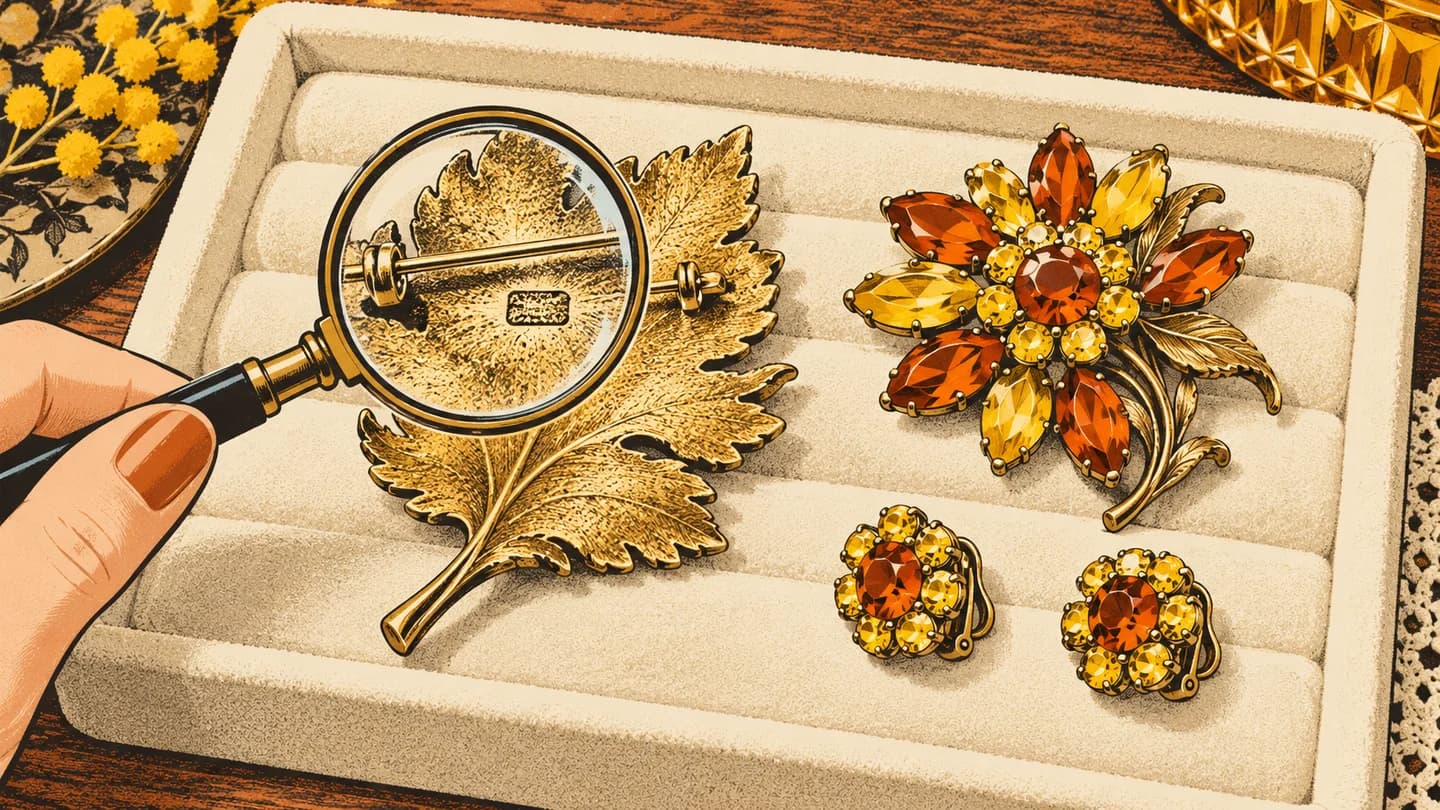
Turn over a brooch or necklace and you may find a name, a tiny logo, initials or a number. That can open a productive line of research, but it does not automatically establish a maker, age or precious-metal content. Some marks identify a brand or retailer; others relate to a design or a component. A worn stamp may also be easy to misread.
Costume jewellery deserves its own assessment. Design, construction, completeness and collector demand can matter more than the material’s scrap value. The task is to identify the actual piece, record its condition and find a comparable market, while avoiding a valuable-sounding attribution built on one ambiguous letter.
Make a clear record before trying to identify the mark
Use a clean, padded surface and good light. Work with one item at a time so that loose parts and notes do not become mixed.
- Photograph the whole front and back. Include a ruler in a separate image to establish dimensions without obscuring the design.
- Inspect likely locations such as a brooch back, clasp, necklace tag, earring clip or inside a bangle. Do not prise apart settings or force stiff fittings.
- Take close photographs of each mark with light from several angles. Rotate the photograph if necessary, but keep an unedited original.
- Transcribe only the letters and symbols you can read. Use a question mark in your private notes for uncertainty rather than silently filling in a famous name.
- Record the mark’s shape, position and method of application, along with the piece’s construction and any signs of repair.
Different marks answer different questions
Start by identifying what kind of information the mark appears to contain. A maker attribution and a metal-content claim require different evidence.
| Mark or clue | Possible purpose | What it does not establish alone |
|---|---|---|
| Name or logo | Brand, designer, retailer or manufacturer attribution | Authenticity, exact age or current resale value. |
| Initials in a surround | Maker, sponsor or another identifying mark | The full identity without matching its form and context. |
| Design or patent number | A route to a design record or technical document | The manufacture date of this particular example. |
| Country wording | A stated manufacturing or trading origin | A precise date or a quality grade. |
| Metal wording or number | A claim about material or finish that needs interpretation | Independent proof of precious-metal content from a single stamp. |
| No visible mark | An unsigned or unmarked piece, or a mark that has been lost | That the piece is worthless or that it belongs to a famous maker. |
Follow the mark back to a reliable reference
Search the exact wording with the item type, then compare the shape of the lettering and the way the piece is made. Prefer original catalogues, advertisements, museum collection records and well-documented specialist references over a chain of sellers repeating one another. A clear reference should explain the attribution rather than merely putting a name in a title.
For example, museum collections include costume jewellery attributed to makers such as Trifari, with descriptions of materials and designs. Those records help research a specific type of object; they are not a price list for every piece with a similar name. Compare the full construction, dimensions, fastening and decorative arrangement as well as the apparent mark.
Use design records without confusing them with production dates
A readable registered-design or patent reference can be more informative than a vague resemblance. Identify which country and type of number you are dealing with before searching the appropriate official register or archive. UK registered designs can be searched through the Intellectual Property Office’s service, while older records may require a relevant archive or specialist reference.
Read the record itself and compare its drawing or description with the item. A registration date concerns the design record, not necessarily the day your example was manufactured. A design may have remained in production or been revived. A copied design or reproduced mark can create a further mismatch, so the date needs to agree with the piece’s other evidence.
A costume-jewellery signature is not a hallmark
Be precise about materials you cannot establish
Describe a gold-coloured piece as gold-tone when that is all you can substantiate. Do not call it solid gold, silver or a particular plating specification on appearance alone. Likewise, coloured stones, imitation pearls and transparent decorations should not acquire gemstone names simply because they resemble them in a photograph. An attractive design can be sold accurately without inventing a more expensive material.
A magnet’s reaction is not a complete metal identification, and scratching or applying chemicals can damage plating, stones and finishes. If a possible precious-metal or gemstone identification materially changes the purchase, take it to an appropriate professional. Keep the assessment tied to the item and describe what was established, rather than turning a limited test into a broad guarantee.
Condition often decides whether the research pays
Compare the front and back under good light. Small defects can be hard to see in a crowded tray and expensive to remedy sympathetically.
| Area | What to check | Resale consequence |
|---|---|---|
| Stones and decorations | Missing, chipped, cloudy, mismatched or loose pieces | Matching an old colour, cut or size may be difficult. |
| Metal surface | Worn plating, corrosion, flaking finish and rough edges | Polishing cannot simply replace lost plating. |
| Brooch mechanism | Pin, hinge and catch operate gently and securely | A broken fitting needs an assessed repair or clear project description. |
| Necklace and bracelet | Clasps, links, stringing, stretch and previous repairs | A complete-looking piece may still be fragile or unusable. |
| Earrings | Matching pair, clips or posts, missing parts and repairs | One earring is a different sale from an intact pair. |
| Back and joints | Excess adhesive, solder, replaced fittings or uneven repairs | Repairs can affect originality, appearance and durability. |
Check that a set really belongs together
A necklace and earrings may share a colour without being an original matching set. Compare design details, marks, finish and construction. Where one element is attributed and the others are not, do not automatically extend the name to the entire group. Describe an assembled coordinating group as such when that is the evidence you have.
Keep matched pairs and their original components together during sorting. A single earring, loose stone or detached clasp can become separated from the item it helps identify. Photograph a mixed lot before reorganising it, then use small compartments or suitable individual bags to prevent tangling and abrasion. Do not attach sticky labels directly to delicate surfaces.
Know the difference between a period design and a period object
Historic designs can be reproduced, including by museums selling modern interpretations of items in their collections. The Met, for example, sells a modern brooch inspired by a mid-century Trifari set. That is a useful reminder that a convincing period style does not establish the manufacture date of the item in your hand.
Look for supporting evidence across materials, fastenings, marks, finish and documented provenance. No single clasp style dates every piece, since fittings may persist in use or be replaced. If the evidence supports only a broad period, use that. If it supports only the style, say so. Avoid phrases such as “unsigned by” a famous maker unless there is credible evidence for that attribution.
Compare sold examples with the same strengths and faults
Search the identified maker and design where supported, then widen to comparable construction and style if the precise piece is uncommon.
- Separate exact matches from loosely similar designs. A valuable museum-quality or scarce variation can be a poor comparison for ordinary production.
- Compare dimensions, material descriptions, marks and completeness. Photographs should support the match.
- Keep signed and unattributed examples separate when the attribution is what creates the price premium.
- Adjust for missing stones, worn plating, repairs and whether the fastening works. Do not borrow the price of an intact piece for a repair project.
- Distinguish completed sales from ambitious asking prices, and record whether the figure includes a matching set or other items.
Let repair costs change the offer
A £5 brooch is not automatically a profitable purchase if the only plausible sale depends on sourcing an unusual replacement stone. Ask a suitably experienced repairer about availability, cost and whether the work would alter the piece. Avoid casual re-gluing or soldering before identifying the construction and assessing the effect. A neat-looking replacement may still need to be disclosed.
Consider this illustrative calculation: a complete, accurately attributed brooch might sell for £40. If selling costs are £5, packing and delivery not recovered from the buyer are £5, a quoted repair is £12 and you reserve £12 for time and profit, the buying ceiling is £6. If the repair cannot be confirmed, the calculation is not a reason to pay £6; you need a price for the item in its actual incomplete condition.
Clean cautiously and describe clearly
Start by assessing the materials and condition, not by soaking a whole mixed lot. Plating, glued settings, foil-backed stones and decorative coatings can react differently to water or chemicals. Aggressive polishing may remove finish. When construction is uncertain, keep treatment minimal and consult someone experienced with that type of jewellery rather than trying a general household cleaning recipe.
For the listing, photograph front, back, marks, fittings and defects, and include dimensions. State any verified attribution and the limits of the material or date identification. Disclose replaced stones, repairs and missing parts. A clear description of an attractive unmarked brooch is more useful to a buyer than a long list of speculative designer names.
The opportunity is in accurate sorting
Some pieces warrant individual research and listings; others are better grouped by style or sold as clearly described repair and craft material where appropriate. Make the grouping reflect what is actually included, without implying that a sorted lot is an untouched collection of hidden treasures.
Over time, keep photographs of marks you have identified confidently, with the sources and outcomes in your private stock notes. That builds a practical reference for future purchases. The aim is to recognise what the evidence supports quickly enough to buy well, while leaving unsupported age, maker and material claims out of the sale.