Look beyond the dial name to condition, originality and the cost of professional assessment.
A ticking watch is only the start of the assessment
A watch can look smart, run during a brief inspection and still need work that consumes the entire resale margin. Equally, an unremarkable-looking watch may deserve research because of its reference, movement or original components. The dial name is a starting point, not a complete valuation.
Before buying, establish the identity, condition and likely cost of making an accurate sale. Keep three descriptions separate: authentic, original and functioning. A genuine watch may have replacement hands or a repainted dial; an original example may need a service; a running watch may keep poor time. Each can attract a different buyer and price.
Identify the watch without opening it
Work over a soft, clean surface and ask permission before operating controls. Leave case opening and internal inspection to a competent watchmaker.
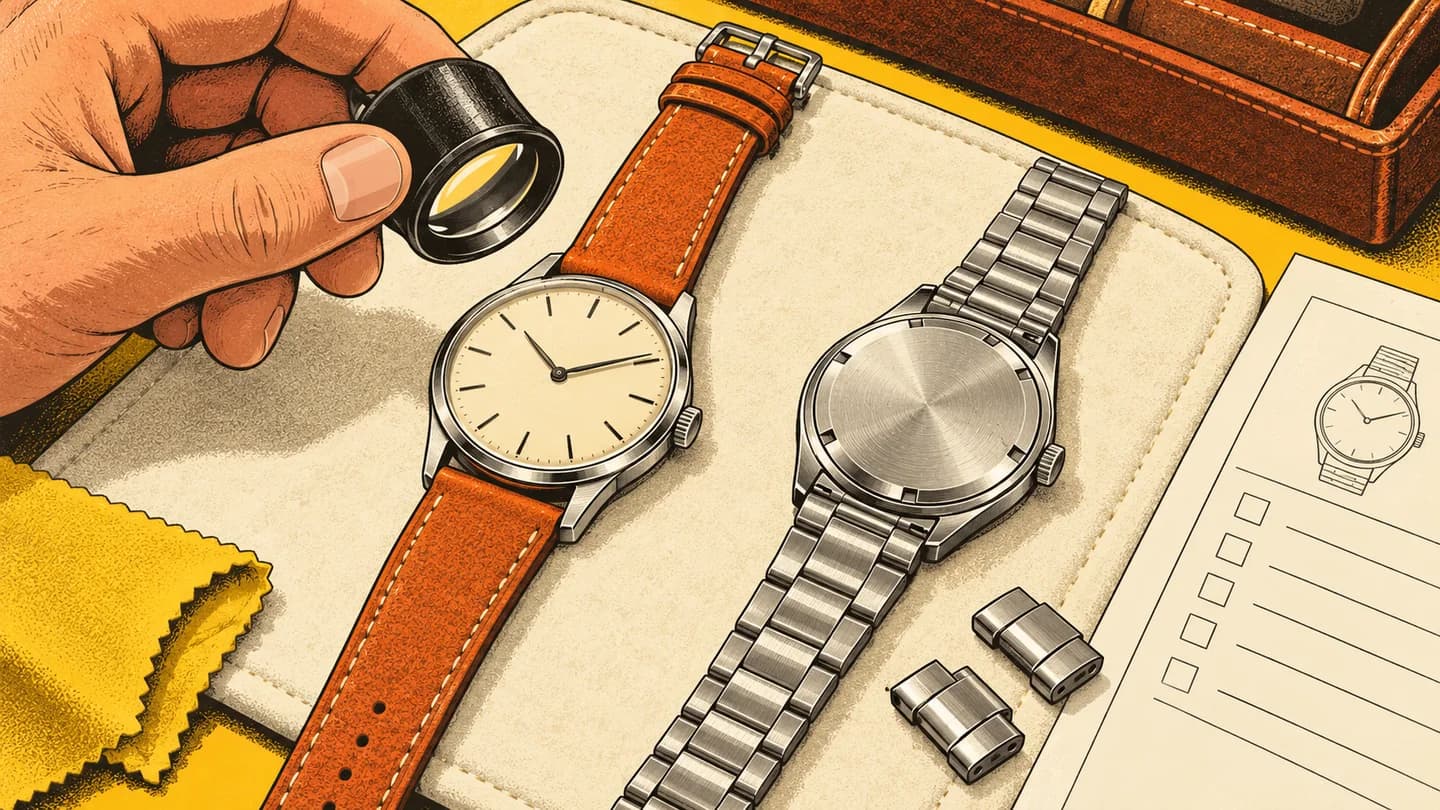
- Photograph the dial, case sides, back, crown, bracelet or strap and clasp. Record readable brand, reference and calibre markings.
- Distinguish a model reference from a serial number or movement identifier. Their location and meaning depend on the maker.
- Find the relevant manufacturer instructions or reliable reference record. Confirm the movement type and functions instead of inferring them from appearance.
- Measure the case and record the bracelet’s wearable length or included spare links. Explain whether a stated case width includes the crown.
- List the box, papers and service documents separately. Check that identifying details correspond to this watch and that the documents describe actual work performed.
Understand the movement before assuming a remedy
These broad categories help you ask the right questions. The exact calibre instructions govern operation and care.
Conventional battery quartz
A depleted battery can stop the watch, but it is not the only possible fault. Leakage, contact problems or movement damage may require further work.
Solar or rechargeable quartz
The watch may need charging, a reset procedure specific to its calibre or professional attention. Do not treat it as an ordinary disposable-battery replacement.
Mechanical or automatic
A moving seconds hand does not prove accuracy, winding efficiency or power reserve. Servicing and worn components can materially change the buying calculation.
Read the model’s instructions before testing controls
Find out how the crown, date setting and any additional functions operate on this particular watch. Some calendar mechanisms have restrictions on when the quick-set function should be used. Do not improvise by forcing a crown, pressing a stiff pusher or turning controls through resistance. A seller demonstrating a function is useful, but it does not replace your record of what was actually checked.
For a watch already running, note the displayed time against a reliable reference and compare it again after a stated interval. A longer observation can reveal issues that a momentary check misses, although it is still not a full service assessment. If you have only watched it for ten minutes, describe that limited observation instead of claiming excellent long-term timekeeping.
The external condition checklist
Use a loupe or clear close photographs to inspect detail without scraping, polishing or dismantling. Worn finishes and replacement parts can matter independently of whether the watch works.
| Area | Inspect | Why it matters |
|---|---|---|
| Dial and hands | Staining, uneven ageing, damaged printing and apparent replacement parts | A refinished dial or changed hands can alter collector interest. |
| Crystal | Scratches, chips, cracks and internal condensation | Replacement or moisture investigation may be needed. |
| Case and lugs | Dents, corrosion, worn plating and softened edges | Heavy polishing or damage can change the appearance and value. |
| Crown and pushers | Missing parts, obvious damage and gentle operation where permitted | Repairs may require specific components and sealing work. |
| Bracelet and clasp | Wear, loose joints, insecure closure and missing links | Fit and replacement costs can materially affect the sale. |
| Case back and records | Legible identifiers, tool marks and matching documentation | Evidence needs to relate to this watch, not just the same model. |
An old water-resistance marking is not a current test
Treat “just needs a battery” as an unconfirmed explanation
A stopped conventional quartz watch may restart after a battery replacement, but you cannot know that from the seller’s description alone. A competent repairer can check the correct battery type, contacts and signs of leakage or other damage. Opening and resealing the case can also affect water resistance; Seiko advises requesting a water-resistance test when a battery is changed.
For solar or other rechargeable systems, follow the exact model’s charging guidance and avoid heat. A watch that restarts after exposure to light has demonstrated something useful, but its ability to retain charge still needs assessment. Do not replace a rechargeable cell with an ordinary battery or assume that a brief restart establishes the condition of the storage cell and charging system.
A service receipt needs to say more than “checked”
Ask who did the work, when it was done and what it included. A battery change, timing check, full movement service, case refinish and pressure test are different jobs. Read the itemised document, match it to the watch where possible and check whether any stated warranty remains relevant to your purchase.
For an uncertain watch, ask a repairer with appropriate expertise for an estimate before paying a price that assumes a cheap fix. Parts availability, access to manufacturer components and the condition found during inspection can affect the outcome. A low initial purchase price is little protection if the work needed costs more than an equivalent serviced example.
Originality is a separate research task
Compare the dial layout, hands, crown, bezel, case and bracelet with reliable examples of the exact reference and period. A service replacement can be genuine manufacturer work while still differing from the original component. An aftermarket strap may be perfectly usable, but it should not be valued or described as the original branded bracelet.
Be careful with watches assembled from a mixture of components or offered with unclear dial refinishing. A familiar brand on the dial cannot authenticate everything behind it. For a valuable watch, obtain specialist assessment of identity and components rather than relying on a serial-number search or paperwork alone. Do not open the watch yourself to obtain a movement photograph if you lack the equipment and experience.
Choose comparisons that match the actual watch
Search by reference, then narrow by the features that make your example different. Keep a short record of the sales used to form the price range.
- Compare the movement, dial version, case material and size. A similar-looking model can have different demand and servicing costs.
- Separate serviced examples with documented work from watches with unknown service history or faults.
- Note original versus replacement parts, refinished dials, heavy case polishing and missing bracelet links.
- Distinguish a dealer’s asking price and warranty-backed offering from a completed private sale or a trade purchase offer.
- Check what the sale included. Box and papers may affect interest, but documents must relate credibly to the watch.
- Allow for the actual selling route, delivery cover, inspection and work needed before your example can be offered accurately.
Calculate the purchase price after the service estimate
Suppose an identified watch, once serviced, could reasonably sell for £250. This is an illustrative example, not a market valuation. If an assessed service is £120, selling costs are £25, delivery and packing not recovered from the buyer are £10, and you reserve £45 towards time and profit, the purchase ceiling is £50. A £90 asking price is therefore not a bargain under those assumptions.
If the service estimate is unavailable, do not quietly replace it with the cheapest price you have heard for a battery. Compare a sale in its current, accurately described condition with the repair route. A specialist may offer an outright purchase price, or an established auction route may suit a particular collectible. Check commission and other charges before comparing their figures with a self-managed sale.
Be selective about the first watches you buy
A manageable starting point is a reference you can identify, with available instructions, visible condition and a credible service route. Buy within a budget that allows for an unsuccessful purchase. A job lot of stopped watches needs individual triage; count the clearly saleable examples rather than assuming every branded dial can be revived cheaply.
Keep storage and handling simple. Separate watches so cases and bracelets do not scratch each other, retain loose links and documentation with the correct item, and keep moisture away. Avoid aggressive polishing to improve photographs. Removing material or original finish can create a problem that a clean cloth and honest condition description would have avoided.
Describe exactly what the buyer is receiving
The listing should distinguish observation from an expert assessment and historical specification from current tested condition.
- State the verified brand, reference, movement type, case dimensions and bracelet or strap details. Include the usable bracelet length and spare links.
- Describe visible wear and all known replacements, repairs or refinishing. Photograph the dial, case, back, clasp and defects clearly.
- Record the test performed and duration, with any observed timekeeping or function issue. Say when a function or power reserve was not checked.
- Summarise documented service work accurately. Do not turn a battery receipt into a full-service claim or an old rating into a fresh water-resistance guarantee.
- Pack the watch and accessories securely, protecting the crystal and keeping a loose bracelet from rubbing the case. Check the delivery service’s watch and jewellery cover before posting.
The best punt is one with a clear limit
A used watch is worth pursuing when the identity, likely buyer and preparation costs are understood well enough to set a buying ceiling. When an unresolved fault or originality question controls the whole value, the next step is an assessment, not a more optimistic comparison. That approach leaves room for interesting finds without asking a momentary tick to prove more than it can.