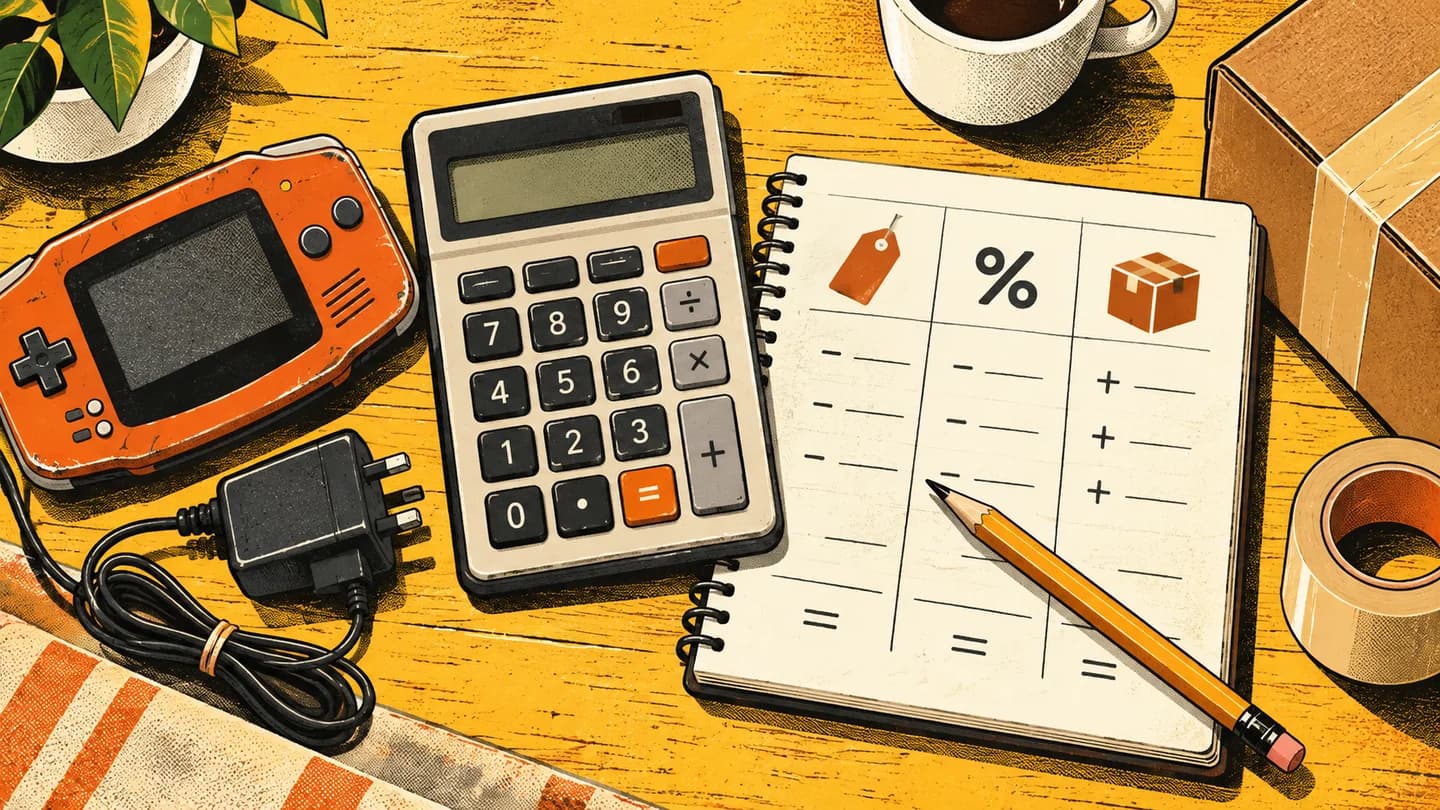
Enter your buying price and selling costs to assess the valuation range, then check alternative sale prices separately.
Profit starts with a realistic sale
Open the full valuation from My finds, or choose See checks & full valuation after Quick Scan. Find What’s in it for you? Before changing numbers, check that the identification is right and the estimated range applies to your item’s condition.
Work through your costs
- In Buy for (£), enter the amount you expect to pay. If the asking price was carried over from the scan, check that it still reflects your proposed purchase.
- In Selling fee (%), enter the percentage that applies to your selling route. The field starts at 0%; that is a starting setting, not a promise of fee-free selling.
- In Postage & costs (£), add your expected postage, packaging and other fixed costs, such as a replacement accessory. Include a fixed selling charge here rather than treating it as a percentage.
- Read the Estimated profit range. The calculator applies your costs to the valuation’s lower and upper estimates, before tax and your time.
- Adjust the buying price or costs to see how much room the deal leaves. If it works only at the highest estimate, reconsider the amount you are willing to pay.
Checking a different sale price
The app’s calculator uses the valuation range; there is no separate sale-price input. To test a lower selling amount, work it out in a separate note or calculator: expected sale minus percentage selling fees, purchase price and fixed costs. Keep that alternative alongside the app’s estimate instead of assuming you have changed the valuation itself.
Try the calculation with the free sample
The app’s sample camera uses an illustrative £45–£75 resale range. It is a demonstration, not a current camera valuation. In its calculator, set Buy for to £20, Selling fee to 10% and Postage & costs to £6. The displayed estimated profit becomes £14.50–£41.50. The 10% fee is only an example; enter the charges that apply to your own sale.
If you want to test a £40 sale instead, calculate it separately: £40 minus £4 fees, £20 purchase and £6 fixed costs leaves £10. That lower-price check does not change the sample’s valuation range.
| Input or result | At the £45 estimate | At the £75 estimate |
|---|---|---|
| Sale amount | £45.00 | £75.00 |
| Purchase price | −£20.00 | −£20.00 |
| Example fee at 10% | −£4.50 | −£7.50 |
| Postage and fixed costs | −£6.00 | −£6.00 |
| Estimated profit | £14.50 | £41.50 |